
by James Lyons-Weiler, PhD, Popular Rationalism, ©2025
(Aug. 27, 2025) — The U.S. Food and Drug Administration (FDA) has rescinded the emergency use authorizations (EUAs) for COVID-19 vaccines, narrowing their availability to high-risk groups. Health and Human Services Secretary Robert F. Kennedy Jr. announced the change on Wednesday, describing it as a step to end broad vaccine mandates while still permitting voluntary vaccination. The move represents a major shift in federal vaccine policy, coming after Kennedy – a longtime vaccine skeptic – assumed office under the Trump administration in 2025.
Robert F. Kennedy Jr., U.S. Secretary of Health and Human Services, testifies before Congress in May 2025 (file photo). As HHS Secretary, Kennedy has pursued sweeping changes to federal vaccine policy. On Wednesday, he announced that the FDA would revoke emergency authorizations for COVID-19 vaccines to fulfill his promise of ending vaccine mandates.
FDA Ends Broad COVID Vaccine Authorization
In a series of regulatory actions revealed August 27, the FDA “ended its broader authorization of COVID vaccines in the U.S.”, now clearing the shots only for individuals at higher risk of severe illness statnews.com. This means that healthy adults and children without risk factors will no longer be automatically eligible for COVID-19 vaccination under an emergency status. Instead, vaccine use will be focused on seniors and those with underlying health conditions that elevate their risk.
- Limited to High-Risk Groups: According to Kennedy, COVID-19 vaccines will now be authorized only for older adults and vulnerable populations – for example, people over age 65 or with medical risk factors for severe COVID. The Moderna vaccine is authorized for ages 6 months and up, the Pfizer-BioNTech vaccine for ages 5 and up, and the Novavax vaccine for ages 12 and up – but in all cases, only for those in high-risk categories statnews.com. Healthy young adults, teens, and children not in a high-risk group are no longer covered by any COVID vaccine authorization, unless doctors choose to use vaccines “off-label” outside the FDA’s guidance.
- EUAs Revoked: Kennedy’s announcement emphasized that the emergency use authorizations (which initially enabled rapid deployment of vaccines during the pandemic) “are now rescinded.” He noted that these EUAs were “once used to justify broad mandates on the general public during the Biden administration” and portrayed their removal as a fulfillment of a campaign promise cnbc. By revoking the EUA status, COVID vaccines now move to standard FDA approvals (or biologics licenses) with narrower criteria, rather than emergency mass distribution.
- New Boosters Approved for Variants: At the same time, the FDA did approve updated COVID-19 booster formulations targeted at newer viral variants, but only under the stricter conditions for high-risk patients statnews.com statnews.com. For instance, Pfizer announced its latest booster (aimed at the SARS-CoV-2 subvariant LP.8.1) is authorized for those over 65, and for ages 5–64 only if they have at least one underlying risk condition statnews.com. Kennedy assured that vaccines “are available for all patients who choose them after consulting with their doctors” – but this will occur within the confines of the new risk-based eligibility framework statnews.com.
Kennedy’s Four Promises on Vaccine Policy
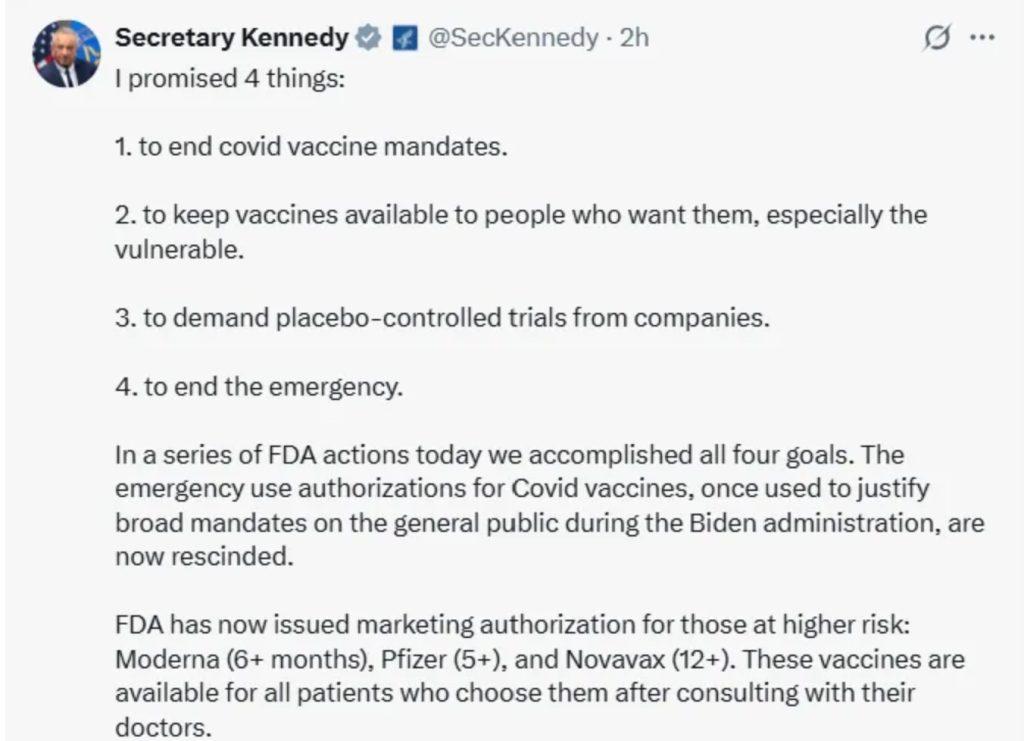
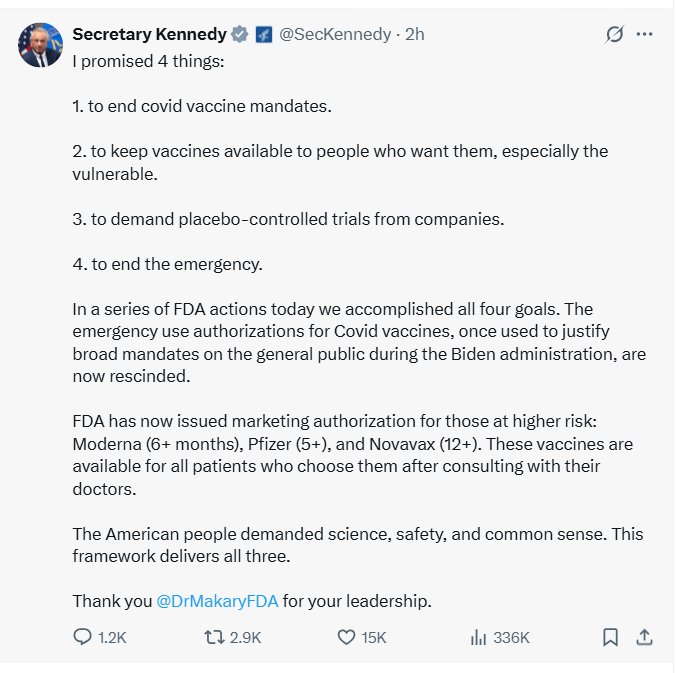
Secretary Kennedy framed the FDA’s actions as delivering on four key promises he made regarding COVID-19 vaccines and pandemic policy. In a post on the social media platform X Wednesday, Kennedy wrote: “I promised 4 things”, then listed his objectives:
- End COVID Vaccine Mandates: Kennedy pledged to end COVID vaccine mandates for the general public. He argues that no one should be forced or coerced to take the vaccine, especially under emergency rulesstatnews.com. By removing the EUA and broad authorization, Kennedy contends that any basis for federal vaccination mandates has been eliminated. “The American people demanded science, safety, and common sense,” he wrote, “This framework delivers all three.”
- Keep Vaccines Available (Voluntarily): The second promise was to keep vaccines available to people who want them, especially the vulnerables. Kennedy is maintaining that COVID-19 shots will remain accessible for those at higher risk or anyone who truly wants one, but purely as a voluntary choice in consultation with a doctor. Availability is thus preserved, but the target audience is narrowed to high-risk individuals instead of the entire population.
- Demand Placebo-Controlled Trials: Kennedy also vowed to demand placebo-controlled clinical trials from vaccine manufacturers. As part of this policy shift, federal health agencies are requiring more rigorous new trials for COVID vaccines, especially for use in children and healthy adults abcnews.go.com. The FDA indicated it would allow and expect vaccine makers to conduct large-scale studies to prove safety and efficacy in groups like young children, rather than relying on prior emergency approvals abcnews.go.com. This marks a departure from the accelerated approval processes used during the pandemic, instead returning to the traditional trial standards (including placebo comparison) for any new vaccine indications.
- End the COVID “Emergency”: Lastly, Kennedy promised to end the COVID emergency status. Although the official public health emergency had already been terminated in May 2023, Kennedy’s stance is symbolic – shifting federal COVID policy away from an emergency footing. By rolling back emergency authorizations and guidance, he signaled that the pandemic response is entering a more cautious, long-term phase. In his view, this helps restore normal regulatory order and public trust, after what he calls an era of overreach.
Kennedy declared on X that “in a series of FDA actions today we accomplished all four goals.” He characterized the new policy as a balanced approach that protects vulnerable populations’ access to vaccines while eliminating blanket mandates. “The emergency use authorizations for Covid vaccines… are now rescinded,” Kennedy wrote, underscoring that this fulfills his vow to reverse policies from the prior administration.
See the Tweet that ended the EUA:
Impact on Children and Low-Risk Groups
Public health experts note that these changes will have practical impacts on who are likely to be vaccinated, especially for groups previously eligible under emergency guidelines:
End of Federal Mandates: Practically, federal vaccine mandates for workers or military personnel had already been rolled back by 2023. Kennedy’s actions solidify that no new federal COVID vaccine requirements are on the horizon, aligning with the stance of many Republican-led states that vaccination should be a personal choice. Any remaining school or employer mandates (mostly instituted at local levels) may be further discouraged by the lack of broad FDA authorization. Kennedy’s HHS position is that the era of government-imposed COVID vaccination is over.
Healthy Children’s Access: Under the prior regime, COVID-19 vaccines were authorized for children as young as 6 months old through emergency use, regardless of risk factors. Now, with EUAs revoked, healthy children under 5 have no approved vaccine option unless they have a medical condition. The FDA’s July 2025 approval of Moderna’s pediatric vaccine was limited to children with underlying health conditions, and Pfizer’s pediatric EUA (which covered healthy infants and toddlers) has been withdrawn. This could make it challenging for parents of healthy young children to vaccinate them against COVID-19 going into the fall. Pediatricians might only be able to offer shots “off-label” (using the adult authorization in younger ages), but it’s uncertain if many will do so or if insurance will cover it.
Pregnant Women and Other Low-Risk Adults: Expectant mothers and healthy adults under 65 without risk factors may also face new hurdles to vaccination. These groups were previously encouraged to vaccinate to protect themselves and their infants, but Kennedy’s removal of recommendations for healthy individuals has introduced confusion. In fact, several major medical organizations have warned that high-risk pregnant patients now encounter barriers to accessing COVID vaccines, potentially increasing their risk of serious illness. An anonymous pregnant physician joined a July lawsuit, fearing she “will not be able to get” a COVID vaccine due to the policy changes restricting who is recommended to receive it abcnews.go.com. There is no basis in fact for this concern.
No Change for High-Risk Groups: For older adults and people with chronic conditions, vaccination remains available and advised under the new framework. Vaccine manufacturers like Pfizer have stated they are ready to ship doses to pharmacies and clinics nationwide for the eligible groups. Those over 65, or younger individuals with diabetes, heart disease, compromised immunity, etc., can still get the updated boosters as a “protective measure” (although there is no evidence of protection from transmission). Health officials in Kennedy’s camp note that demand among low-risk groups was already low, and the focus is now on those who may benefit most.
Read the rest here.