
by James Lyons-Weiler, PhD, Popular Rationalism, ©2025
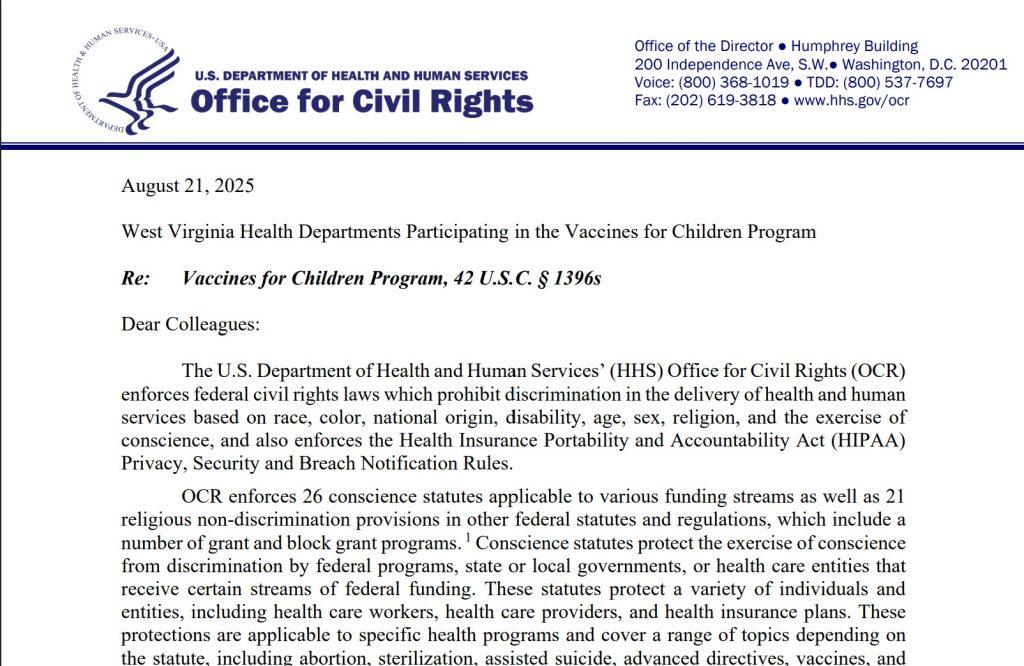
(Aug. 23, 2025) — On August 21, 2025, the U.S. Department of Health and Human Services’ Office for Civil Rights issued a letter to West Virginia’s Vaccine for Children (VFC) program providers. The message was clear: the federal Vaccines for Children statute requires states to honor religious exemptions where state law provides them – and their participation in the medicare program was mentioned, implying it may be on the line. In West Virginia, that is not a suggestion. It is now a binding mandate.
This development should be celebrated—not just by those who cherish religious liberty, but by anyone who values the Constitution as a living framework that protects the people from coercion cloaked as public health necessity.
Why This Matters
For decades, vaccine mandates have existed in a constitutional gray zone, often defended with rhetoric about “compelling interests” while trampling on conscience and religious rights. Parents have had to appeal – sometime annually – to enjoy their right safeguarded by the first Amendment. In some states, doctors were empowered to assess whether their patients held “geniune” beliefs – as if physicians are endowed with such supernatural powers.
In West Virginia, these tensions collided with hard law in 2023, when the state passed the Equal Protection for Religion Act (EPRA). EPRA established what the First Amendment already guarantees: that government cannot burden religious practice unless it proves both a compelling interest and the least restrictive means.
Governor Patrick Morrisey codified that principle with Executive Order 7-25, requiring recognition of religious and moral-belief exemptions to childhood vaccine mandates. A state court upheld the order. Now, HHS has acknowledged it: West Virginia’s VFC program must comply.
This is not a loophole. This is the Constitution in action.
Rational, Not Radical
Public health absolutists will howl that this “undermines” vaccination programs. But rational governance does not rest on the suppression of liberty for efficiency’s sake. Rational governance balances rights and responsibilities under a framework of rational law.
The U.S. Constitution is not suspended in emergencies. In fact, it exists to be used during such crises. Federal funding cannot be leveraged to erase rights that state law has expressly recognized. By affirming the interplay between West Virginia’s EPRA and the VFC program, HHS has admitted what was always true: there is no constitutional authority at the Federal OR State level to erase religious conscience when administering medical interventions.
Consistent with History and the Constitution
The Bill of Rights was written precisely to prevent government from converting citizens into subjects. From the Revolutionary struggle against imperial mandates to the Civil Rights era’s rejection of “compelling” but unjust social controls, the throughline is unmistakable: government power must yield where conscience and fundamental rights are at stake.
The Supreme Court has long held that states cannot target religion for disfavored treatment. By affirming that the VFC program must reflect state religious-exemption laws, OCR is not bending the rules—it is upholding the constitutional order.
What Comes Next
This is a win for West Virginia. But it is also a roadmap for other states. Wherever a legislature or executive has enacted laws protecting religious or moral conscience, those protections extend into federal healthcare programs by law.
This means:
States that recognize exemptions cannot be forced to abandon them to maintain federal funding.
Parents can no longer be told that participation in programs like VFC erases their religious rights.
Federal agencies, for once, are on notice: religious freedom is not negotiable.
Where Things Stand Now
The story is still unfolding, and it’s one to watch. In July, a West Virginia judge in Raleigh County granted a preliminary injunction allowing three children to attend school under the governor’s religious-exemption order. That ruling, however, applies only to those plaintiffs. Meanwhile, the State Board of Education has instructed schools to ignore the executive order and continue enforcing statutory vaccine mandates. The Board is appealing, and the issue is heading toward the West Virginia Supreme Court of Appeals for resolution.
Lawsuits have multiplied: the ACLU of West Virginia and Mountain State Justice are challenging the governor’s authority, while state officials push to consolidate cases for efficiency. The legislature, for its part, declined to codify religious exemptions into law earlier this year, leaving the executive order as the primary mechanism in play.
On the ground, more than 330 exemptions have already been granted in 2025, with public charter schools openly following the executive order. This surge far outpaces the number of medical exemptions seen in the past decade.
In short, West Virginia has become the front line in the clash between conscience rights and public health mandates. The courts, not the agencies, will decide whether this constitutional correction endures.
A Rational Celebration
This directive strengthens the rule of law. Rights not exercised are rights surrendered. And when constitutional principle is reasserted in a domain long dominated by technocratic coercion, rational citizens should take note: liberty has not been extinguished. It has merely been neglected.
West Virginia has reminded the nation that neglect is not destiny. And HHS—perhaps reluctantly—has admitted the truth.
The Constitution still governs. Rational law still holds.
And that is worth celebrating.