by Sharon Rondeau
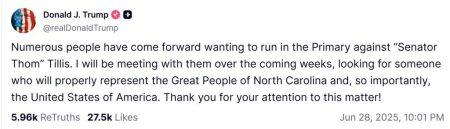
(Jun. 29, 2025) — The day after President Trump announced an effort to seek a primary challenger to U.S. Senator Tom Tillis (R-NC), the two-term senator declared he will not seek reelection.
“Numerous people have come forward wanting to run in the Primary against ‘Senator Thom Tillis,'” Trump posted on TruthSocial at 10:01 AM on Saturday. “I will be meeting with them over the coming weeks, looking for someone who will properly represent the Great People of North Carolina and, so importantly, the United States of America. Thank you for your attention to this matter!”
On Saturday night, a “test” vote was held in the Senate on whether to advance the “Big, Beautiful Bill” to the Senate floor for debate. Trump wishes to sign it by Independence Day and has urged Senate Republicans, who hold a three-seat majority in the chamber, to approve it following the House’s passage of the legislation on May 22 by the narrowest of margins.
Tillis and Sen. Rand Paul, who has also raised Trump’s ire as demonstrated in several of Trump’s recent TruthSocial posts, voted against advancing the bill, with Tillis adding he would vote against it if it survived the procedural hurdle.
At 10:20 a.m. Sunday, Trump opined Tillis is a “worse” contrarian than Paul.

According to Axios, Tillis was not considered a strong candidate for re-election in 2026. “Tillis faces one of the toughest re-election fights of any GOP senator in 2026. His vote against Trump’s signature legislation could be a central topic in a primary challenge,” the outlet reported Saturday night.
As this story goes to press (6:50 p.m. EDT), the Senate is debating various aspects of the legislation, which aims to make the 2017 tax cuts permanent and ban taxes on gratuity, Social Security and overtime income.
Trump has warned that should the bill fail, Americans will see a “68%” tax increase resulting from the expiration of the Tax Cuts and Jobs Act at the end of the year.
The House’s bill summary asserts, “This bill reduces taxes, reduces or increases spending for various federal programs, increases the statutory debt limit, and otherwise addresses agencies and programs throughout the federal government.”
It also “expands the applicability of work requirements for SNAP recipients who are able-bodied adults without dependents (ABAWDs). As background, these SNAP recipients have work-related requirements in addition to the general SNAP work registration and employment and training requirements.”
“SNAP” stands for “Supplemental Nutrition Assistance Program,” formerly known as “food stamps.”
A tightening of SNAP requirements is imposed, and one proposed change “eliminates the SNAP Nutrition Education and Obesity Prevention Grant Program (SNAP-ED).”
The bill increases funding for Pell Grants, eliminates certain accommodations for the repayment of student loans, and provides more funding for upgrading “fighter, transport, and other military aircraft,” among dozens of other items.
The Senate version, which is 940 pages, extends payments to “eligible” farmers for various losses incurred in raising crops and also addresses repayment of student loans, among many other provisions.
While the Senate version is “largely in line” with that of the House, the New York Post reported, the two differ on tax deductions and the amount the debt ceiling is to be raised.
Both versions make changes to the Medicaid program, which covers low-income families, some elderly and many disabled individuals. Frequently characterized by the media as “cuts,” the proposed changes require certain recipients to work to maintain their eligibility.
Tillis had stated the proposed reforms to Medicaid were his chief concern in voting against moving the bill to the floor.
Trump characterized Tillis’s announcement to decline seeking re-election as “Great News!”