

by James Lyons-Weiler, PhD, Popular Rationalism, ©2025
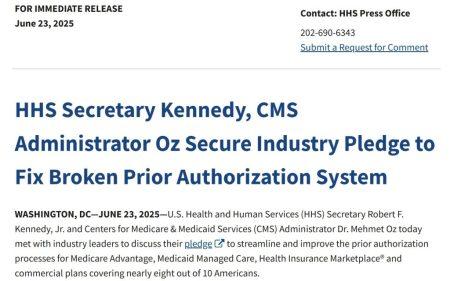
(Jun. 24, 2025) — On June 23rd, 2025, the U.S. Department of Health and Human Services (HHS), under Secretary Robert F. Kennedy, Jr., announced a major shift in national healthcare policy: the beginning of the end of bureaucratic obstructionism in the form of prior authorization delays. With support from President Donald Trump and new CMS Administrator Dr. Mehmet Oz, the federal government has coordinated with private insurers and healthcare leaders to roll out a new era of reform.
For the first time in decades, the healthcare system has taken a clear and deliberate step away from institutionalized indifference—and toward patient dignity.
Prior authorization, once pitched as a safeguard against unnecessary care, has in practice metastasized into a system of delay, deflection, and denial. Patients in need of urgent interventions—MRIs, cancer therapies, surgeries—have been forced to wait for insurers to grant approval, often with no transparency or recourse. Physicians, in turn, have spent countless hours and resources navigating the opaque protocols of insurance companies rather than treating patients.
The human cost has been enormous. And finally, federal leadership is calling it what it is: unacceptable.
“This is an important topic that has continued to be an issue for far too long,” said Senator Roger Marshall, M.D. (R-KS). “I applaud the leadership of Secretary Kennedy and President Trump for bringing us all to the table to find solutions.”
“As a physician for over 30 years, I witnessed the ridiculous and ever-increasing obstructions caused by insurance companies to delay or deny care,” added Congressman Greg Murphy, M.D. (R-NC), co-chair of the GOP Doctors Caucus. “These bureaucratic hurdles end up hurting patients and those who care for them.”
Dr. Murphy’s words cut to the heart of the issue. Behind every form faxed, every phone queue endured, every denied claim fought, stands a person—often sick, vulnerable, and afraid—waiting for a faceless system to decide whether they are worthy of timely care. Whole departments in medical practices exist for one reason: to fight with insurance companies. This is not medicine; it is clerical warfare, paid for in patient suffering.
Secretary Kennedy, by forging alignment between HHS, CMS, and private stakeholders, is not merely tweaking policy. He is drawing a moral line. The CMS reforms—already underway—require that Medicare Advantage, Medicaid Managed Care, and Health Insurance Marketplace® plans adopt interoperable, transparent systems to handle prior authorizations swiftly and uniformly. These will reduce duplicative documentation, automate real-time approvals when criteria are met, and limit unnecessary denials.
In parallel, private insurers have pledged to remove or streamline requirements that delay evidence-based care. CMS has made clear: it reserves the right to escalate enforcement through formal rulemaking if these voluntary commitments fall short.
Let’s be honest: what insurers call “utilization management,” patients experience as abandonment. What they brand as “clinical review,” doctors recognize as a stand-off between ethics and economics. The reform now underway is a repudiation of that model—a quiet revolution in favor of human-centered care.
Consider just one story: a 48-year-old woman with early-stage breast cancer who waited three weeks for approval of an MRI—time during which the tumor doubled in size. Or a child with severe epilepsy whose neurologist prescribed a new, safer medication, only to be overruled by a “fail first” policy. These are not edge cases. They are the rule. Or were.
This reform is not a cure-all. But it is a declaration: healthcare must not default to indifference. The shift signals something profound—a reassertion of clinical authority, the honoring of physician judgment, and a renewed commitment to the sacred trust between patient and provider.
We must remain vigilant. These reforms must be implemented transparently, with measurable metrics and oversight. Patients must be surveyed. Providers must be empowered to report bad actors. And regulators must act swiftly and publicly if any insurer backslides.
For now, let us mark this as a turning point—when policymakers finally listened, when doctors were heard, and when the U.S. healthcare system began to remember its purpose: not to serve margins, but to serve life.