
by James Lyons-Weiler, PhD, Popular Rationalism, ©2025
(May 23, 2025) — American children are not just unwell—they are the sickest generation in the nation’s history. Over 40% now live with at least one chronic condition. Obesity has tripled since the 1970s. Suicide is the second leading cause of death among teens. Autism, once rare, is now diagnosed in one of every 31 children. Type 2 diabetes—virtually nonexistent in youth a few decades ago—is projected to rise over 600% by 2060 if nothing changes.
This is not an abstract crisis. It is written into children’s bodies. It plays out in every school nurse’s office, in every sluggish morning and sleepless night. Behind these numbers lies a collapsing framework—one that can no longer pretend to be working.
Now, finally, comes a response worthy of the moment. The Make Our Children Healthy Again (MAHA) Commission has released a plan that does more than identify the problem—it outlines a way forward. A real one.
A Coherent Framework for National Renewal
What makes the MAHA Commission report exceptional is not just the depth of its diagnosis, but the precision of its prescription. It identifies four primary drivers of the childhood health collapse—poor nutrition, toxic environmental exposure, digital-age psychosocial dysfunction, and medical overreach—and lays out a cross-sector strategy to address them at their roots.
It starts with food. Nearly 70% of children’s calories now come from ultra-processed products—engineered substances designed for shelf life, not human nourishment. These foods displace micronutrients, dysregulate appetite, and flood young bodies with synthetic additives. The Commission envisions a sharp turn away from this industrial dependency and toward real food—nutrient-rich, minimally processed, and grown by American farmers.
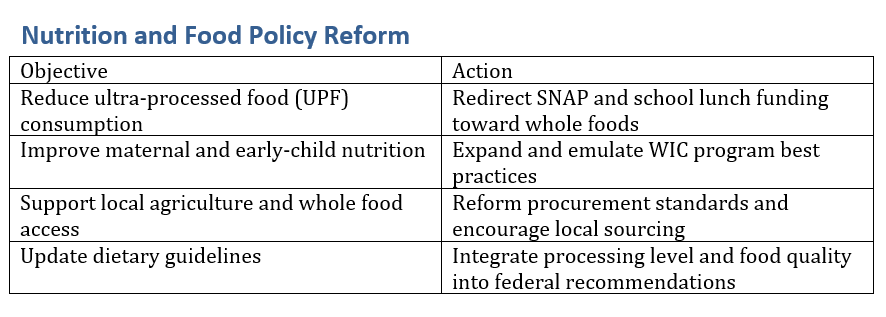
This isn’t just about telling people to “eat healthy.” It’s about aligning public policy with metabolic sanity. Programs like SNAP and the National School Lunch Program will be redesigned to favor whole foods, not refined grains and sugar-laden drinks. The WIC program—already proven to improve pregnancy outcomes and early child nutrition—will serve as a model for targeted, life-stage-specific support.
But fixing food is not enough. The second pillar of the Commission’s strategy is environmental detoxification. Today’s children are saturated with chemicals—PFAS in their water, parabens and phthalates in their personal care products, endocrine disruptors in their food packaging. The MAHA plan demands that chemical safety evaluations finally reflect cumulative exposure, mixture effects, and developmental vulnerability. Instead of pretending that every exposure occurs in a vacuum, policy will begin to recognize what pediatricians already know: early-life chemical load is a predictor of long-term health.
Read the rest here.