
by James Lyons-Weiler, PhD, Popular Rationalism, ©2025
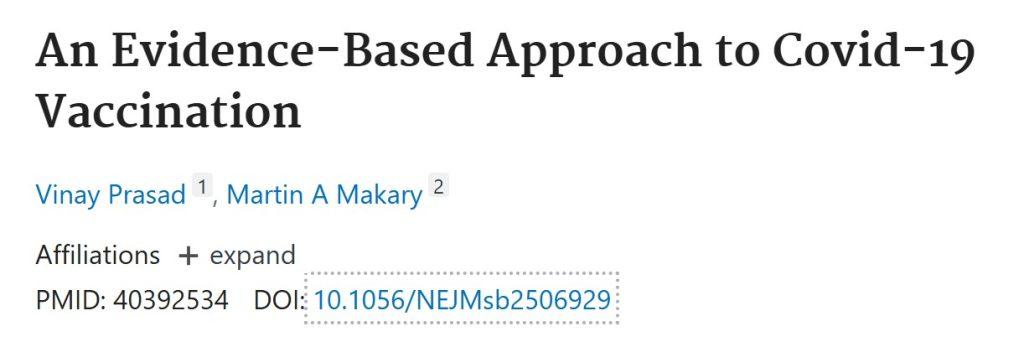
(May 22, 2025) — One day after the FDA unveiled its updated COVID-19 vaccine approval framework—and the NEJM article by Prasad and Makary detailed the reasoning—Moderna quietly withdrew its application for its mRNA-1083 combination flu/COVID-19 shot. The timing is not coincidental. It reflects exactly what the new policy is designed to do: force evidence-based accountability before granting approvals on specific segments of the population.
What Changed?
Under the prior regulatory climate, Moderna likely expected a streamlined path to market using immunogenicity bridging or real-world effectiveness data. But under the new approach:
- RCTs are now expected for healthy individuals under age 65.
- FDA said it would expect data on vaccine use in healthy children.
- Immunogenicity is not enough—safety and clinical outcome data are required.
- Combination products face heightened scrutiny due to their immunological complexity.
As a result, the FDA reportedly informed Moderna it would need additional Phase 3 trial data—and rather than proceed under a cloud of regulatory uncertainty, Moderna pulled the plug for now.
Why This Matters
The FDA didn’t ban the vaccine. It simply applied basic principles of scientific rigor: show that it works, and show that it’s safe. If a product can’t clear that bar, then delaying its approval is not obstruction—it’s protection of public health.
And this is exactly what Prasad and Makary’s policy signaled:
- No more automatic approvals for yearly reformulations.
- No more bypassing placebo controls in healthy populations.
- No more conflating antibody levels with actual protection.
What Critics Are Saying
Some, like Sayer Ji, see this as a moment of vindication, citing public distrust in “hastily developed, multi-antigen formulations.” Others, like Dr. Joseph Sansone, go further, framing this as part of a reckoning for what they view as vaccine-induced harm on a population scale.
While the rhetoric may be intense, their concern underscores a broader cultural shift: the public is demanding transparency, reversibility, and humility from regulatory science. And now, finally, the FDA is at least gesturing toward that direction.
Regulatory Significance
- Moderna’s withdrawal shows the policy shift is not just editorial—it has teeth.
- It reinforces that the new framework is already changing real-world decisions by manufacturers.
- It confirms that Prasad and Makary’s article was not theater—it was a line in the sand.
This is not a ban. It’s not censorship. It’s regulatory integrity being reintroduced into a space that lost it.
Strategic Implications
- Other manufacturers are likely re-evaluating pipeline strategies.
- Combination products, once considered efficient, may now be seen as riskier regulatory bets—especially without long-term safety data.
- The requirement for placebo-controlled trials (as recently reinforced by HHS) fundamentally alters the incentive structure for new vaccines.
In short: Moderna’s move confirms that the policy shift is operational, enforceable, and already working as intended.
See more here.
Comments
One response to “Moderna Withdraws Combo Vaccine Application: A Real-Time Validation of the FDA’s New Direction”
“Combination products, once considered efficient, may now be seen as riskier regulatory bets—especially without long-term safety data.” Uh, yeah! Considered? Hardly studied before being implemented on the guinea pig public. This is not the first occurrence.
Efficiency to the once-trustworthy health professions is getting triple payment for one syringe and injection. Efficiency – my backside.
My sense: the immune system confusion that results from combination shots, like MMR, needs to be avoided like The Plague. It may take a decade to show the autism reduction benefit. Nonetheless, worth it. We should find out there is a silver lining to the mishandled COVID response experience.
BTW: nobody stuck a COVID vaccine needle in my body. I was having none of it from the no-go.