
by James Lyons-Weiler, PhD, Popular Rationalism, ©2025
(May 18, 2025) — In today’s bureaucratic vernacular, resilience has become a euphemism for public tolerance of failure. Institutions now invoke the word to imply that a strong society absorbs harm, accepts uncertainty, and trusts authority—regardless of evidence. But this is not resilience. It’s submission.
True resilience in a free society begins with rigorous scrutiny. It demands transparent, ethical, replicable science—not theatrical affirmations of safety. When it comes to protecting children, especially through biological products, there is no excuse for neglecting the gold standard of scientific testing: randomized placebo-controlled trials (RCTs).
The False Security of Retrospective Evidence
Public health agencies, officials, and vaccine promoters routinely cite retrospective observational studies as proof of vaccine safety. But retrospective designs are inherently limited: they suffer from unmeasured confounding, reliance on administrative datasets, and post-hoc hypothesis testing. These are not hypothesis-confirming studies. They are hypothesis-generating at best.
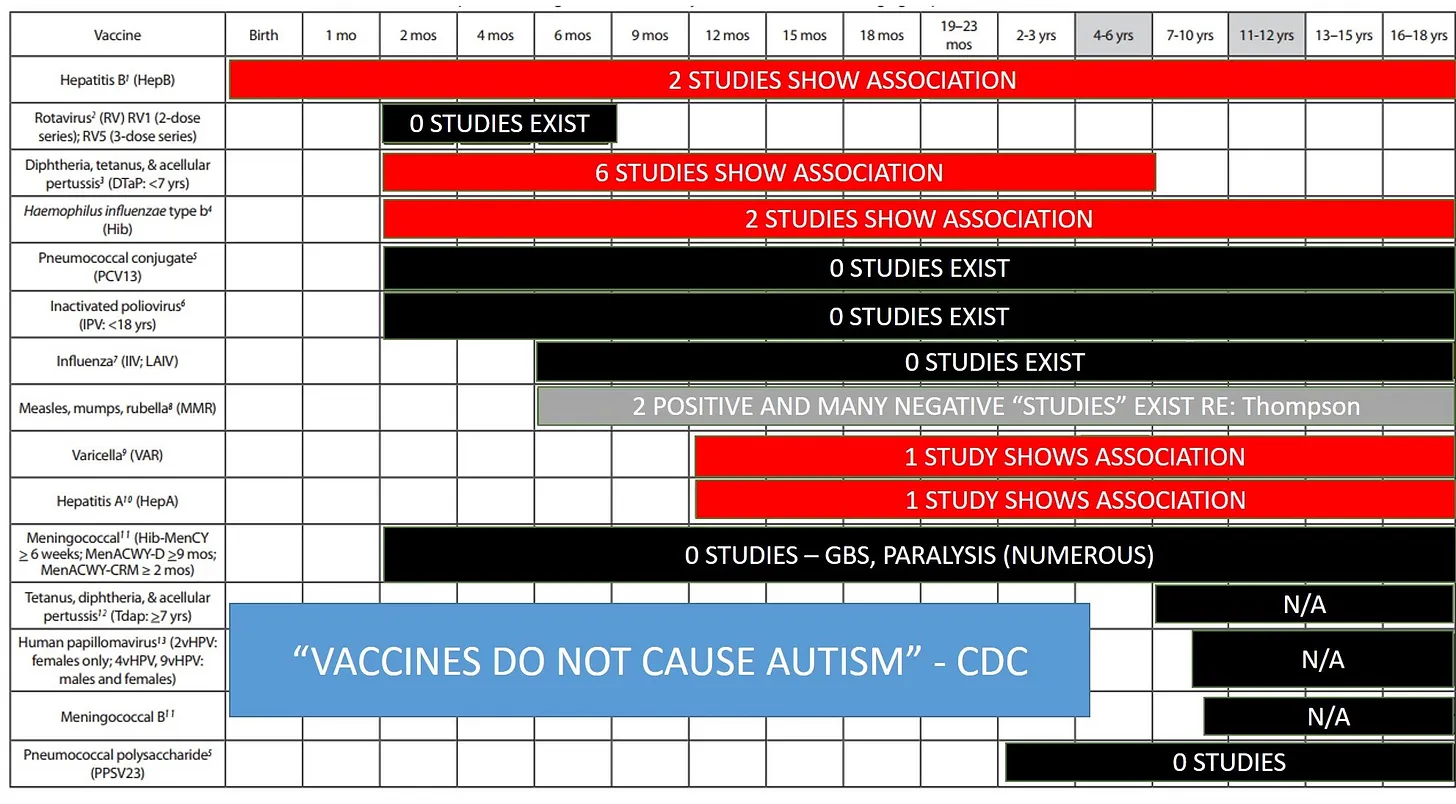
And yet, such studies are the cornerstone of the CDC’s vaccine safety platform. The proclamation “Vaccines Do Not Cause Autism” appears on CDC’s website without a single citation to any large, prospective, placebo-controlled trial evaluating each vaccine—or even most vaccines—on the childhood schedule for association with autism spectrum disorders. The evidence is simply not there.
The Placebo-Controlled Trial Myth
First: I Found the Gap. Then ICAN Found the Smoking Gun
In 2015, I conducted an exhaustive review of all available studies evaluating whether childhood vaccines were associated with autism. What I found was shocking: not all vaccines on the CDC schedule had even been studied for association with autism, despite the CDC’s sweeping claim that “Vaccines Do Not Cause Autism.”
That claim, prominently displayed on government websites and repeated by public health officials, was unsupported by data. In fact, most vaccines had never been evaluated in any study—retrospective or prospective—for this specific risk. The illusion of comprehensive science was just that: an illusion.
This realization led to the next major revelation—what we call “Placebogate.”
The Informed Consent Action Network (ICAN), following this trail, submitted a series of targeted FOIA requests to the U.S. Department of Health and Human Services and the FDA. They asked a simple, crucial question:
“What comparator groups were used in the pivotal clinical trials that led to the licensure of childhood vaccines?”
The answer confirmed what I had already suspected: With only one exception—the COVID-19 vaccine for individuals aged 12 and older—not a single routinely recommended childhood vaccine was tested against an inert placebo. Instead, the comparator groups used either other vaccines or aluminum adjuvants—both of which carry their own risk profiles.
Read the rest here.