
by James Lyons-Weiler, PhD, Popular Rationalism, ©2025
(Apr. 19, 2025) — Good Saturday Morning, Popular Rationalists! Remember – #SharingIsCaring
Time again, outbreak after epidemic after pandemic, we have heard public health authorities tell us that the only problem they had that led to their failure was the need for “better messaging”. But they did not know what you and I know: Trust is not a slogan. It is not a product you can launch. It does not come back because you have tested new language or hired better spokespeople.
Trust is earned through consistency between truth, transparency, and action. And when it’s broken—especially by the institutions tasked with protecting life—it cannot be mended by optics. It can only be repaired by accountability.
Today, those who benefited the most from regulatory capture want their trust back. They want control back, but not via objective, outcome-based reform—not a reckoning. They want a narrative reset.
You can bet that just as when they held regulatory power, they are scrambling to find their footing and trying to arrange coordinated messaging. You can bet that the messaging is being refined and rehearsed. They are trying out various strategies. They are likely planning on playing word games. Familiar faces are being reintroduced as surrogates. Public trust is being treated not as a right, but as a prize to be recaptured through repetition.
The good news for rational empiricists is that this approach misreads the moment. Trust wasn’t lost just because of the COVID-19 debacle or because the messaging was bad. It was lost because science was abandoned.
Long-established regulatory protocols were not followed during and before the COVID-19 vaccine rollout. This is not speculation; it is documented fact.
Here are some of the standards that were either bypassed, altered, or removed:
– No preclinical dose escalation studies in animals for the encoded antigens or novel excipients
– Saline placebo groups were often replaced with other biologics or adjuvants.
– Long-term human safety data was not available at the time of Emergency Use Authorization.
– No published raw trial data for independent review.
– No all-cause mortality or morbidity tracking tied to product approval.
– Complete legal immunity remained in place for manufacturers, robbing them of incentive to prioritize safety.
These were not extra layers, these were not “nice-to-haves.” These were the very guardrails that allow the public to participate in medicine with confidence. Removing them and still demanding trust is like asking passengers to board a plane after the pilot boasts about skipping the checklist. Shortcuts that cost lives.
And people noticed.
They did not all say it out loud. Many didn’t know the terminology. But the sense was visceral. Something had changed. The rituals of scientific caution had been replaced with messaging, repetition, and the coordination of authority.
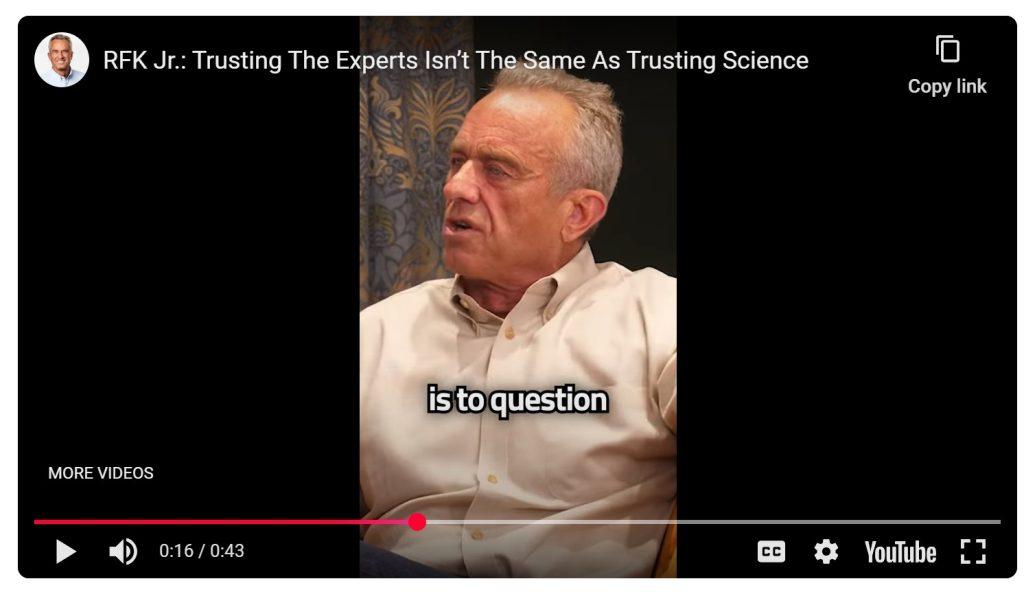
Robert F. Kennedy Jr. put it simply:
“Trusting the experts is a feature of religion…”
See the video and read the rest here.
I would love to see an expanded version of this. There is SO MUCH damage that needs to be repaired in public health from the federal to the state to the local level. OMG.
Meantime, a right step has been taken by prohibiting pharmaceutical representatives from sitting on drug review boards. It’s long overdue.
There is the fundamental problem of biomedical research: The lack of reproducibility., This has been a known fact since at least the 1980s, yet it persists. Why?
The whole incentive structure for biomedical publishing needs to change somehow.
Accountability sounds nice, but there is such an overwhelming amount of damage to repair.