
by James Lyons-Weiler, PhD, Popular Rationalism, ©2025
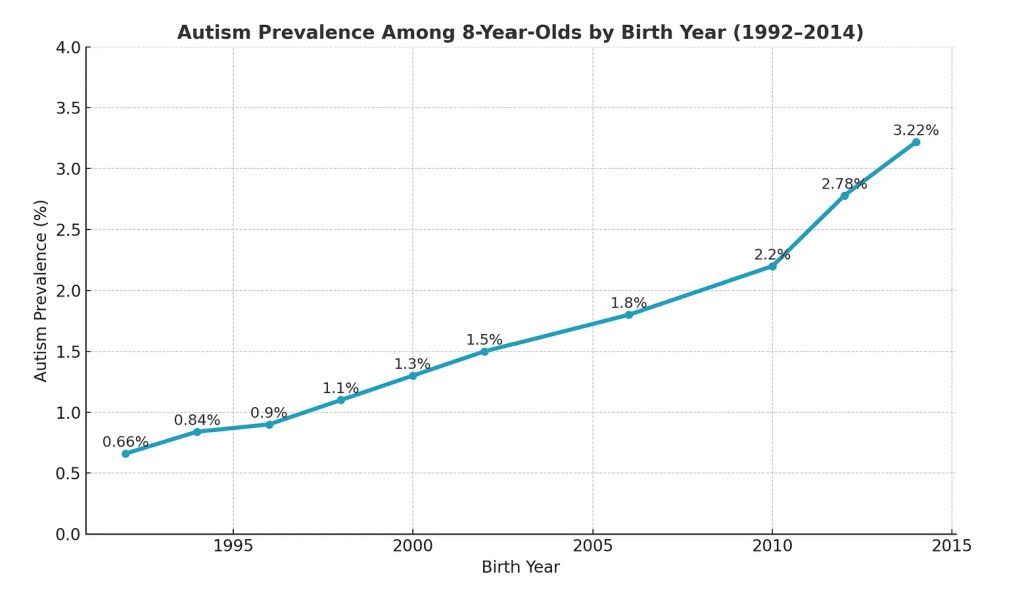
(Apr. 15, 2025) — The U.S. Centers for Disease Control and Prevention (CDC) has released its 2025 report from the Autism and Developmental Disabilities Monitoring (ADDM) Network, and the findings are alarming: autism spectrum disorder (ASD) now affects 1 in 31 American 8-year-olds—the highest rate ever recorded.
For boys, the numbers are even more staggering: 1 in 20 nationwide, and 1 in 12.5 in California. The report, which tracks children born in 2014, reveals a crisis growing in severity and complexity, yet broadly unacknowledged in the national discourse.
“Autism has become a public health crisis of urgent concern,” the report states plainly. And yet, government agencies have offered no new national action plan, and media coverage remains anemic.
Rapidly Accelerating Trends
In just two years, autism prevalence among 8-year-olds rose 17%, from 1 in 36 to 1 in 31. This is not an anomaly. Since the CDC began tracking autism in children born in 1992, prevalence has increased nearly fivefold, defying theories that attribute the rise solely to broader diagnostic criteria or increased awareness.
The Impact of SB277 on Autism Prevalence in California
In 2015, California enacted Senate Bill 277 (SB277), which went into effect on July 1, 2016. This legislation eliminated the state’s personal belief exemption (PBE) for childhood vaccinations, making it one of only three U.S. states at the time—alongside Mississippi and West Virginia—to require full compliance with the CDC-recommended vaccine schedule for school entry, except in cases of formally approved medical exemption.
While the primary intent of SB277 was to increase vaccination rates and try to reduce outbreaks of communicable diseases like measles, its implementation has coincided with a continued—and arguably accelerated—rise in autism spectrum disorder (ASD) diagnoses in the state. Data drawn from the California Department of Developmental Services (CDDS) and CDC’s Autism and Developmental Disabilities Monitoring (ADDM) Network offer a timeline of prevalence rates before and after the law’s enactment:
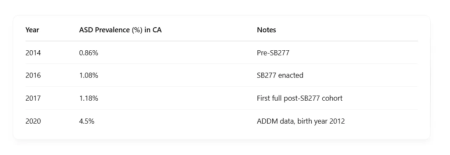
Between 2014 and 2017, ASD prevalence among young children in California increased from 0.86% to 1.18%—a 37.2% increase in just three years. By 2020, according to CDC ADDM surveillance, 4.5% of 8-year-olds in California had an autism diagnosis—the highest prevalence among all U.S. monitoring sites.
Percent Increase Post-SB277 (2016 to 2020):
From 1.08% (2016) to 4.5% (2020) = 316.7% increase
This dramatic rise cannot be definitively attributed to SB277 alone, but its temporal proximity to the policy change—which effectively compelled full vaccine schedule compliance across all demographic groups—raises serious questions. Notably, this increase occurred within California’s already robust autism tracking infrastructure (CDDS), known for conservative case identification that focuses on children with moderate to severe impairment requiring lifelong services.
While correlation does not imply causation, the magnitude and timing of California’s autism surge post-SB277 should compel further independent investigation, particularly given that:
- SB277 removed opt-out options for thousands of previously unvaccinated or selectively vaccinated children;
- The increase is most visible in 4-year-old cohorts tracked soon after the law took effect;
- California’s autism rates now exceed 1 in 12 for boys.
In light of these findings, California may now serve not only as a terrible national model for vaccine compliance—but also as a bellwether for unintended consequences of compulsory public health policy.
——————–
Read the rest here.