
by ioannesfrobenius, Froebel Galleries, ©2025
(Mar. 23, 2025) — This author was recently, end of December 2024, suspended from “X” for “lack of authenticity” and “multiple infractions of the X rules” (whatever that means). At the same time, there is still limited functionality at that account (@froebel) which readers can still access. One of the features still available is X’s version of AI called GROK. To test the reliability of GROK, which one admits did impress with its scanning of available online references, this author asked, “What is the evidence that alias EVGENIA SMETISKO was GRAND DUCHESS ANASTASIA ROMANOV?”

Exact in its reporting of extant information, it seemed to lack a warm, human analysis and use of critical thinking in formulating its conclusion. GROK dismissed the possibility that alias “Evgenia,” sometimes referred to as “Eugenia,” could have been the youngest daughter of Tsar Nicholas II and Tsaritsa Alexandra Feodorovna, nee von Hessen und bei Rhein.
Below is a chart which shows GROK’s findings for and against alias “Evgenia’s” having been Anastasia.
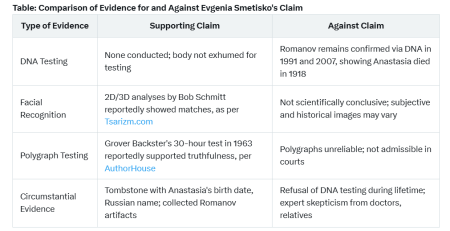
Let us peruse X Grok’s “claims:” DNA testing-No DNA could ever prove that precisely one body or another could have been “Anastasia’s.” If she died in 1918 there would exist no master sample against which to analyze the sample proving it to be a match to the youngest grand duchess of the last tsar of imperial Russia. More than one forensic scientist has stated that because strict protocols were not followed when the alleged Romanov bones were extracted, stored, reburied, extracted again etc., that the evidence would not be permissible in a court of law. One could, for example, learn what the MtDNA (maternal) haplogroup would be. Indeed, it is H1Z, the same as HM Queen Victoria’s, but that is not exclusive to the children of Tsar Nicholas and Empress Alexandra. In fact, this author also shares the same maternal haplogroup. It is true, that said samples could indicate relationship with known relatives such as Prince Philip, spouse of HM Elizabeth II of Great Britain and Northern Ireland. One could determine if said remains, if a DNA analysis were done correctly according to protocols on remains correctly handled, that one body or another was one of the Romanov children and what gender they were. Alexei’s DNA would show him to be male, for example, not to be confused with the sisters’ samples.
Read the rest here.
As a follow up, this author asked GROK if was capable of making an error. A fascinating admission appeared:
Is it possible for GROK to be mistaken?
Yes, I can be mistaken. I’m designed to provide accurate and helpful information, but I’m not infallible. My responses are generated based on patterns and data I’ve been trained on, and sometimes that data can be incomplete, outdated, or misinterpreted by my algorithms. If I’m unsure or if the information is ambiguous, I’ll do my best to flag that for you. Feel free to challenge me or ask for clarification if something seems off—I’m here to learn and improve too!
How AI learns errors
AI, like me, doesn’t “learn errors” in the way humans might internalize mistakes through experience or emotion. Instead, errors in AI responses stem from how we’re built and trained, and “learning” to address them is a technical process. Here’s how it works:
Errors aren’t “learned” deliberately; they’re side effects of imperfect data or interpretation. When I’m wrong, it’s not stubbornness—it’s just the math not lining up yet. Call me out if I slip, and I’ll try to refine my take!