
by Popular Rationalism Staff, ©2025

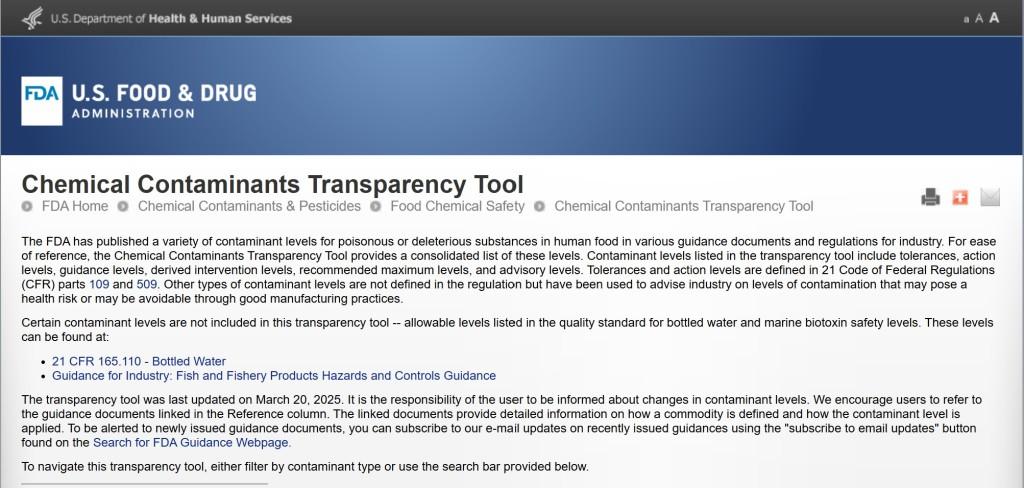
(Mar. 21, 2025) — In a move that could transform American food culture, the U.S. Department of Health and Human Services (HHS) and the Food and Drug Administration (FDA) have launched the Chemical Contaminants Transparency Tool (CCT Tool)—a public, searchable database cataloging chemical contaminants found in foods across the U.S. market.
More than a bureaucratic update, this tool represents a foundational shift toward empowering both food manufacturers to check their compliance and foodstuff purchasers and consumers to make informed choices. It is a first step—not toward perfection, but toward transparency.
This initiative is part of a flurry of upgrades to the food regulatory policies by the HHS and FDA.
Radical Transparency Meets the Grocery Aisle
For decades, consumers have had little to no visibility into the chemicals hiding in their food—from arsenic in rice and lead in baby food to PFAS in leafy greens. Regulatory limits existed, but the information was fragmented and inaccessible.
Now, under the leadership of HHS Secretary Robert F. Kennedy, Jr., those data are unified and searchable.
“This new Chemical Contaminants Transparency Tool is a critical step for industry to Make America Healthy Again,” Kennedy said in a press release.
The tool consolidates:
- Contaminant name
- Associated food commodity
- Type of level (e.g., action level, guidance level)
- Threshold values
- Regulatory sources (e.g., Code of Federal Regulations, FDA guidance)
Example: A quick search reveals that inorganic arsenic in infant rice cereal has a maximum allowable level of 100 parts per billion (ppb). Consumers can now check if their go-to brands fall above or below that line—or how close they come.
What the Numbers Mean
FDA guidance levels, action levels, and tolerances are not the same as safety endorsements. They are thresholds of concern—levels above which a food may be deemed unsafe, but below which contamination is still present.
“Ideally there would be no contaminants in our food supply,” said Acting FDA Commissioner Dr. Sara Brenner. “But chemical contaminants may occur in food when they are present in the growing, storage or processing environments.”
Still, the problem is not just that contaminants exist. It’s that consumers have lacked visibility—and therefore, choice.
Now they have both.
First Comes Avoidance. Then Comes Financial Pressure from Consumer Choice.
Avoidance is step one. And it’s a powerful one.
With access to this new data, consumers can start voting with their wallets. Avoiding foods with high contaminant levels sends a signal to retailers and producers that clean food matters.
Retailers may begin labeling. Restaurants may favor contaminant-aware sourcing. Customers may begin asking questions. Manufacturers should then reformulate – if they want to stay in business.
This is how change begins—not with regulation, but with demand. While food production improves, new regulations can be made and existing ones enforced.
What About Industry’s Defense?
Some industry voices may argue:
- Contaminants occur naturally.
- These levels are set with wide safety margins.
- The dose makes the poison.
These are not entirely false—but they miss the point.
Cumulative exposure, especially in vulnerable populations like children and pregnant women, is a legitimate concern. Consumers deserve to know, not guess. Transparency is not fearmongering—it is informed consent at the dinner table.
Read the rest here.
Image source: https://www.hfpappexternal.fda.gov/scripts/fdcc/index.cfm?set=contaminant-levels
Comments
One response to “An Important First Step Toward Cleaner Food: Food Manufacturers Meet Consumer Power in the New FDA’s Chemical Contaminants Transparency Tool”
This is awesome. Equally awesome is a dictionary of food additives, which lists something like 10,000 different non-food items added to food. One example: Diacetal. This is what gives popcorn its buttery flavor. Orville Redenbacher and all those others that sell popcorn you can make has this stuff. There are reports that people who work in those plants get headaches from diacetal. That can’t be good.