

by Dennis Gladden, By Green Pastures, ©2025

(Feb. 9, 2025) — What have you learned through the years about how life works?
The school of hard knocks taught me it has windows that let us peek into God’s kingdom. I call them living parables.
Like frosted glass, they let in light but shield what’s on the other side. To borrow from the Apostle Paul, we see through a glass darkly. We see imperfectly, but enough to glimpse how God grooms our circumstances to give us understanding.
Two people who met Jesus will show what I mean.
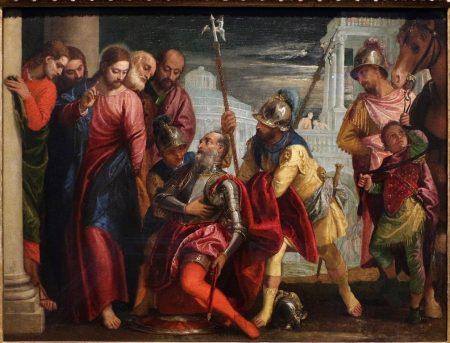
The Roman centurion saw God’s world in his
The first is a man we know only as the Roman Centurion. We meet him because he is the only one in all the Bible who was said to have unparalleled faith.
“I say to you,” said Jesus, speaking to the onlookers, “I have not found such great faith, not even in Israel.”1
The centurion approached Jesus because of his circumstances. His servant was deathly ill, which was nothing extraordinary, but he was “dear” to the officer. And that was rare—a master, to say nothing of a seasoned soldier, who valued an underling.
The circumstances drew him to Jesus and instructed him on how to approach Him.
The centurion knew his place in the world. He was a servant of Rome, a stranger to Israel; an occupier for the empire, an oppressor to the local zealots; an adherent of Rome’s pagan gods, but a respecter of the God of Israel.
Legally, he could enter any house or command any passerby to carry his gear. A hundred soldiers snapped to his orders, his servant served his wishes dutifully. He had that authority.
But Jewish law forbade him from entering any house: he was a gentile and unclean. Addressing another centurion later, Peter explained the constraint, “You know how unlawful it is for a Jewish man to keep company with or go to one of another nation.”2
The servant’s illness, however, drove the centurion to sidestep the barriers. Setting aside his Roman authority, he curried favor by sending intermediaries to Jesus—Jewish elders “pleading with Him to come and heal his servant.”3
Caught between the Roman and Jewish rivalry and knowing how things worked in his world, the centurion made his appeal.
Say the word, and my servant will be healed. For I also am a man placed under authority, having soldiers under me.4
He understood the pecking order. Restrained by his culture and constrained by his circumstances, he needed help from someone who wasn’t obliged to help.
A man of authority himself, the centurion did not exert his but appealed to the authority of Jesus. Surely, a man of God such as Jesus acted by authority. When Jesus spoke, things happened. Same as with the centurion.
What the centurion saw in his world gave him a glimpse of God’s. His life was a living parable—a window into God’s kingdom; a greenhouse where faith grew.
This understanding gave the centurion the boldness to ask and believe Jesus would heal.
That is the first example. The second is similar, also involving a gentile.
Dogs at her table made her comfortable at God’s
(As an aside, I firmly believe God’s law of confirmation: Establish matters by two or more witnesses. One can be a fluke or a liar. Two can also deceive, but getting two to agree is so challenging that their unity builds credibility. So, a second example is important.)
Jesus had left Israel for the seacoast towns of Tyre and Sidon (modern Lebanon). A desperate woman of the area approached, her need not unlike that of the centurion.
Have mercy on me, O Lord, Son of David! My daughter is severely demon-possessed.5
Jesus gave her the silent treatment, and the disciples urged Him to send her away.
She persisted.
Jesus declined. Israel had its lost souls, and she was not one.
She persisted.
Jesus declined again. His bread was for children, not for dogs.
And now the woman surprised Him. She knew the ways of children and dogs. Where the centurion approached Jesus based on his knowledge of authority, the woman clung to hope from what she knew about households. Dogs lurk around the table, certain there will be stray droppings.
“Yes,” she agreed with Jesus, “yet even the little dogs eat the crumbs which fall from their masters’ table.”6
Jesus had opened the window, and the ways of households let her peek into God’s kingdom.
God had arranged conditions throughout the lives of the centurion and the Syro-Phoenician woman that became living parables in which He sowed faith.
I have not seen such great faith, not even in Israel! Jesus said of the centurion.
Great is your faith! Jesus said to the woman. Let it be to you as you desire.7
Back to my opening question: What have you learned about how life works? Does it strike you now that God arranged living parables in everyday life to show you the ways of His kingdom? Can you connect a truth you have learned to an experience God brought you through? I’d love to hear from you in the comments.
Leave a comment here.