
by Dennis Gladden, By Green Pastures, ©2025

(Jan. 21, 2025) — Few would question that we live in times that Jesus said would come—the days of Noah all over again.
Violence stalks our homes and streets, corruption cavorts, and our imaginations run wild in the images on our screens.
As it was in the days of Noah, said Jesus, so shall it be.
Fixed on the decay, we can forget there was Noah—a man who walked with God, pleased God, and had God’s eye and favor.
Amid the deplorable discomfort of his times, Noah was a comfort.
And this is where you and I come in as we endure our own decline.
God has sent His Comforter—Jesus Christ. At Pentecost, He sent the Holy Spirit, the Comforter whom Jesus promised.
Today, He sends us forth, indwelt by Christ and filled with His Spirit, as comforters for such a time as this.
The God of all comfort comforts us in all our tribulation, that we may be able to comfort those who are in any trouble with the comfort with which we ourselves are comforted by God. (2 Corinthians 1:4).
How Noah brought comfort is what I want to explore in this final piece of my trilogy. We have looked at the conditions Noah endured and his upright character. We turn now to his work, which was more than building the ark. Noah was a comforter to God and man.
Can two walk together, unless they are agreed? —Amos 3:3
It had come to this: One man in all the world was in tune with the Creator. Noah walked with God.
And through him, God renewed a work He had begun with Adam and Eve and would perfect in Jesus of Nazareth. This work was so amazing and profound that translators of the King James Bible adapted a word to convey the Hebrew meaning: Atonement.
At-one-ment.
The descent from Adam to Noah
Noah walked with God, a lockstep unison that discomfited his neighbors because they, like all of us since Adam and Eve, were at odds with the Creator. God had called His creation “very good,” Satan insinuated it was defective, and the first couple believed him. They knew the good but lacked knowledge of evil and pursued it as Satan proposed: Eat what God forbids.
What God said would kill them, they believed would enrich them.
We have disputed what God says ever since.
Their sin broke the relationship, introduced death, stripped their innocence, and compelled them to hide. Evil had done its work: smash the whole, render it useless, and spoil it all.
Your iniquities have separated you from your God; and your sins have hidden His face from you, so that He will not hear. —Isaiah 59:2
Nine generations later, the curse God imposed on the first couple and their descendants had become unbearable. The longing for relief rested on Noah.
Like what you’re reading? This post is public so feel free to share it.
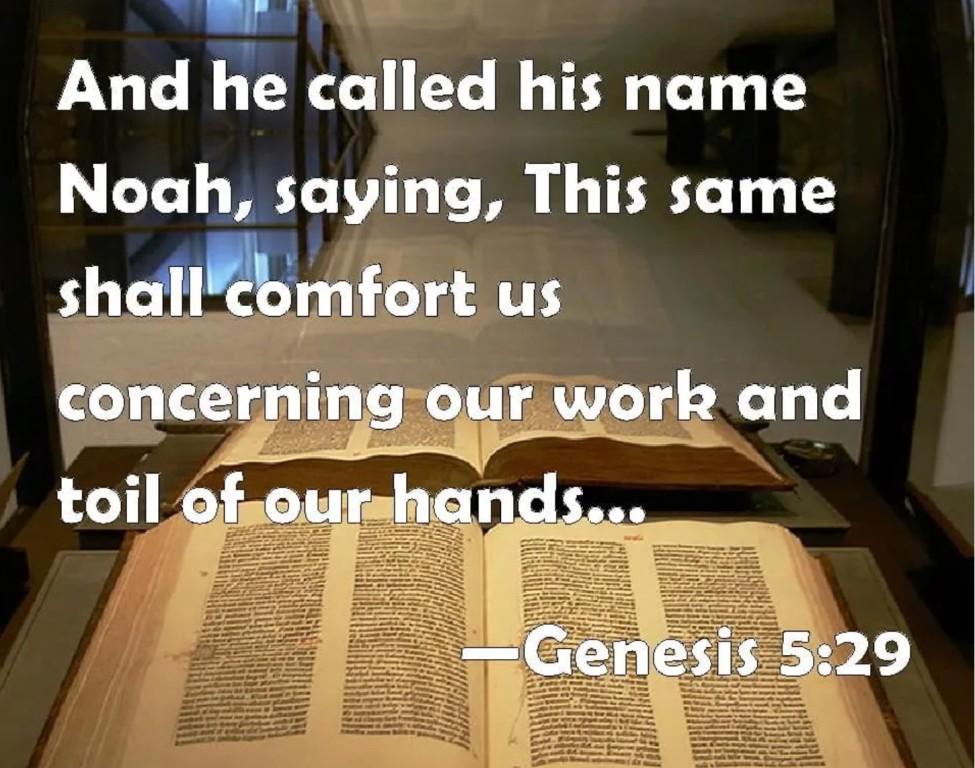
“This one,” said his father, “will comfort us concerning our work and the toil of our hands, because of the ground which the LORD has cursed” (Genesis 5:29). Lamech named his infant son Noah, the word for “rest.”
Noah indeed became the comforter his father hoped for. By his generation, our race as a whole had grieved the heart of God, but Noah touched God’s heart. Four Hebrew words tell his story—a narrative that our English translations don’t convey. It is the story of atonement and the comfort of being at one with our Creator.
1. Atonement: The comfort of God’s covering
The pitch that Noah smeared on the timbers of the Ark, inside and out, was another stroke on the canvas of God’s atonement for man’s sin1.
Make yourself an ark of gopher wood; make rooms in the ark, and cover it inside and outside with pitch. —Genesis 6:14
Two more strokes followed over the next 800 years, adding to the portrait that Jesus would bring to life in His death and resurrection.
[Jacob said] In this manner you shall speak to Esau when you find him: “Behold, your servant Jacob is behind us.” For Jacob said, “I will appease him with the present that goes before me, and afterward I will see his face; perhaps he will accept me.” —Genesis 32:19-20
Moses said to the people, “You have committed a great sin. So now I will go up to the LORD; perhaps I can make atonement for your sin.” —Exodus 32:30
I highlighted in these verses the words that translate one word in Hebrew: kâphar. They show how atonement, at its heart, is a covering but came to embrace reconciliation and forgiveness.
God’s provision of The Ark showed there was only one protection from the imminent flood of God’s wrath, and Noah was as vulnerable as his neighbors. He needed covering; he needed atonement.
True, he did not join in their violence and corruption, but in his heart, he was no better.
Before The Flood, God observed, “Every intent of the thoughts of man’s heart was only evil continually” (Genesis 6:5). After The Flood, when only Noah and his family remained, God said again, “I will never again curse the ground for man’s sake, although the imagination of man’s heart is evil from his youth” (Genesis 8:21, emphasis mine).
The Flood washed evil men from the earth, but not the evil inside men.
Despite Noah’s sinfulness, God blessed him with the covering of The Ark and its pitch. God made atonement for him.
Blessed is he whose transgression is forgiven, whose sin is covered. —Psalm 32:1
Kâphar appears for the first time in the Bible during the construction of The Ark and means “to cover.” The hull and roof sheltered Noah, his household, and the animals, but The Ark itself needed a covering to keep wind-driven torrents from seeping through the seams. God told Noah to slather the boat with bitumen. The text could be translated as, “Cover it inside and outside with a covering of pitch.”
About 500 years later, Jacob added reconciliation to the meaning of kâphar. He adapted the word to the gifts he assembled just before meeting his brother Esau after a 20-year separation. Jacob expected Esau would still be hostile for having been tricked out of the family blessing and hoped his presents would cover Esau’s anger.
To these concepts of covering and reconciliation, God added forgiveness when He gave The Law to Moses. Israel’s breach was so great that God instituted an entire Day of Atonement, accompanied by special preparation and sacrifices. The day was an annual reminder of God’s blessing: He forgave their transgressions and covered their sins.
In the periods of despair and distress that inevitably followed Adam’s estrangement, God’s at-one-ment has been our comfort.
2. Atonement: The comfort of seeing as God does
The writer of Genesis evaluated Noah’s life in one simple sentence: Noah walked with God. Another Hebrew word, translated in different ways in English, puts feet to the words: The patriarch came to agree with God about the coarse behavior of his generation.
God and Noah’s father both sighed.
He called his name Noah, saying, “This one will comfort us concerning our work and the toil of our hands, because of the ground which the LORD has cursed.” —Genesis 5:29
And the LORD was sorry that He had made man on the earth, and He was grieved in His heart. —Genesis 6:6
I have highlighted the English translations for the Hebrew nâcham. The word describes an emotional response, such as consolation or regret, depending on the context. While the emotion may vary, the physical expression is one of a deep breath or sigh.
Noah’s father needed comfort and hope. Eight generations removed from Adam, Lamech was weary of the hard labor to make a living and the violence that threatened his survival.
Noah became a persistent reminder of this hope for rest. Every time someone called him—Noah!—they were saying Rest! This one will comfort us.
Read the rest here.