
by Robert Kalebra, ©2025
(Jan. 19, 2025) — Introduction:
The 6th Amendment to the United States Constitution guarantees the right to a fair trial, which includes the right to compulsory process for obtaining evidence in favor of the accused. Similarly, New York’s Constitution mirrors these protections, enshrining the right to a fair trial and compulsory process. The 6th Amendment’s right to discovery is not merely a suggestion but an imperative that is binding upon all actors in the legal process, including judges, prosecutors, and public officials.
This argument contends that the fraud conviction of Donald Trump cannot stand because of a series of intentional violations of due process, driven by Judge Merchan’s denial of Trump’s motion to compel discovery and District Attorney Bragg’s failure to disclose exculpatory evidence. These failures violated Trump’s 6th Amendment right to a fair trial and compulsory process, and were further compounded by a failure of duty to report misconduct, implicating both Merchan and Bragg in disclosure abuse and dishonest services. The Oaths of Office sworn by each official, as well as the ethical obligations imposed by the Canons of Judicial Conduct and the Rules of Professional Conduct, create a fiduciary duty to uphold the laws and ensure fairness. These oaths and rules have been violated, leaving Trump with a trial that was fundamentally unfair.
1. The Oaths of Office and Fiduciary Duty:
Each official involved in this case—Judge Merchan, District Attorney Bragg, and the New York Attorney General—took an Oath of Office, pledging to support and defend both the U.S. Constitution and the New York State Constitution. This oath imposes a fiduciary responsibility on these public servants to uphold constitutional protections, including the 6th Amendment right to a fair trial and the right to discovery.
Judge Merchan’s Oath:
As a New York State Supreme Court Justice, Judge Merchan swore an oath to “support the Constitution of the United States, and the Constitution of the State of New York,” and to “faithfully discharge the duties of [his] office.”
This oath obligates him to ensure the fairness of proceedings and safeguard the constitutional rights of the accused, including compulsory process for obtaining evidence.
Canon 3(A)(4) of the New York Rules of Judicial Conduct mandates that a judge “shall not engage in conduct that diminishes public confidence in the integrity of the judiciary.”
By denying Trump’s request for discovery, which could have exonerated him, Judge Merchan undermined public confidence in the judicial system and violated the public trust that his oath required him to uphold.
Canon 3(B)(2) similarly states that a judge “shall hear and decide matters assigned to him or her, except when disqualification is required.” In this case, Merchan was required to ensure due process and fairness by compelling discovery, as requested by the defense. His refusal was an abdication of duty and a violation of his judicial oath.
District Attorney Bragg’s Oath:
District Attorney Alvin Bragg also swore an oath to “support the Constitution of the United States, and the Constitution of the State of New York” and to “faithfully discharge the duties of [his] office.” As the prosecutor, Bragg had a dual obligation: to seek justice, not merely to convict, and to ensure the fairness of the trial process by disclosing exculpatory evidence.
Rule 3.8(d) of the ABA Model Rules of Professional Conduct requires a prosecutor to “make timely disclosure to the defense of all evidence or information known to the prosecutor that tends to negate the guilt of the accused or mitigates the offense.”
Bragg’s failure to disclose crucial exculpatory evidence is a violation of his ethical duties and his oath of office. Under Brady v. Maryland, the failure to disclose exculpatory evidence results in a violation of the defendant’s constitutional rights.
Rule 8.3(a) of the ABA Model Rules of Professional Conduct also mandates that lawyers, including prosecutors, “shall report the conduct of another lawyer” when there is a reasonable belief that the other lawyer has violated the rules of professional conduct.
Bragg failed to report Judge Merchan’s misconduct in denying Trump’s discovery requests, thus violating his duty to report misconduct and upholding the integrity of the legal process.
New York Attorney General’s Oath:
The New York Attorney General, as the chief law enforcement officer in the state, swears an oath to “support the Constitution of the United States, and the Constitution of the State of New York” and to “faithfully discharge the duties of [the] office.” The Attorney General is bound to ensure fairness in the legal process, particularly when misconduct occurs within the prosecution or the judiciary.
The Attorney General’s office has a duty to intervene in cases of prosecutorial misconduct and judicial violations. Their failure to intervene in the discovery violations by both Bragg and Merchan constitutes dereliction of duty and an abdication of responsibility to the public.
2. Judicial and Prosecutorial Misconduct:
The Use of “Shall” in Rules and Canons:
The term “shall” in both the 6th Amendment and in the rules governing judges and lawyers establishes an absolute duty. These rules are not advisory; they impose binding obligations on public officials, and failure to comply with them constitutes misconduct. They are the “laws” of “Due Process.”
In the U.S. Canons of Judicial Conduct, Canon 3: “A Judge Should Perform the Duties of the Office Fairly, Impartially and Diligently.”
“The duties of judicial office take precedence over all other activities. The judge should perform those duties with respect for others, and should not engage in behavior that is harassing, abusive, prejudiced, or biased. The judge should adhere to the following standards:”
“(C) Disqualification.
“(1) A judge shall disqualify himself or herself in a proceeding in which the judge’s impartiality might reasonably be questioned, including but not limited to instances in which:”
“(c) the judge knows that the judge, individually or as a fiduciary, or the judge’s spouse or minor child residing in the judge’s household, has a financial interest in the subject matter in controversy or in a party to the proceeding, or any other interest that could be affected substantially by the outcome of the proceeding;”
“(3) For the purposes of this section:”
“(b) “fiduciary” includes such relationships as executor, administrator, trustee, and guardian;” see McNally v. United States, 483 US 350, 358, 359, 107 S. Ct. 2875, 97 L. Ed. 2d 292 – Supreme Court, 1987 holding “This is the approach that has been taken by each of the Courts of Appeals that has addressed the issue: schemes to defraud include those designed to deprive individuals, the people, or the government of intangible rights, such as the right to have public officials perform their duties honestly. See, e. g., United States v. Clapps, 732 F. 2d 1148, 1152 (CA3 1984); United States v. States, 488 F. 2d 761, 764 (CA8 1973).” – Id., at 358
“As the Court long ago stated, however, the words ‘to defraud’ commonly refer ‘to wronging one in his property rights by dishonest methods or schemes,’ and ‘usually signify the deprivation of something of value by trick, deceit, chicane or overreaching.’ Hammerschmidt v. United States, 265 U. S. 182, 188 (1924).[8] The codification of the holding in Durland in 1909 does not indicate that Congress was departing from this common understanding. As we see it, adding the second phrase simply made it unmistakable that the statute reached false promises and misrepresentations as to the future as well as other frauds involving money or property.” Id., at 359
See also US v. Holzer, 816 F. 2d 304 – Court of Appeals, 7th Circuit, 1987 holding “A public official is a fiduciary toward the public, including, in the case of a judge, the litigants who appear before him, and if he deliberately conceals material information from them he is guilty of fraud.”
Author’s question: If the terms “shall and shall not” place a binding obligation on the judicial officer for which deviation warrants disciplinary action”; see US Canons for Judicial Conduct – “Terminology” and the 6th Amendment uses the term “shall” and Merchan and Bragg are sworn to that instrument, bonded to that instrument and are fiduciaries to that instrument, where are the honest services to Trump and the trust of the public?
The 6th Amendment and the Duty of the Court:
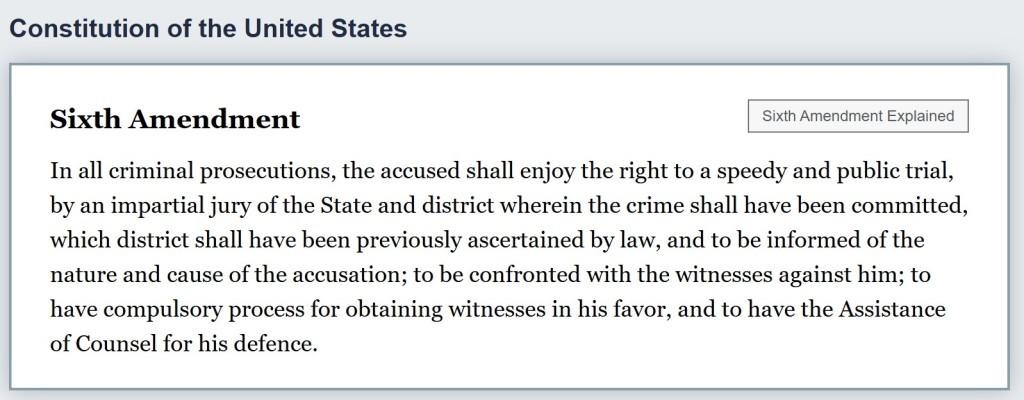
The 6th Amendment states: “In all criminal prosecutions, the accused shall enjoy the right to a speedy and public trial, by an impartial jury of the State and district wherein the crime shall have been committed… and to have compulsory process for obtaining witnesses in his favor, and to have the Assistance of Counsel for his defense.”
The term “shall” places an unambiguous obligation on the court to ensure that the accused has access to compulsory process. By denying Trump’s motion to compel discovery, Judge Merchan violated this constitutional right, depriving Trump of the tools necessary for his defense.
The ABA Rules of Professional Conduct:
Rule 3.3(a)(1) (Candor Toward the Tribunal): A lawyer, including a prosecutor, “shall not knowingly make a false statement of material fact or law to a tribunal.” Bragg violated this rule by failing to disclose exculpatory evidence that could have changed the course of Trump’s trial.
Rule 3.4(b) (Fairness to Opposing Party and Counsel): A lawyer “shall not obstruct another party’s access to evidence.” Bragg’s refusal to comply with discovery requests obstructed Trump’s access to vital evidence.
Rule 3.8(d) (Special Responsibilities of a Prosecutor): A prosecutor “shall make timely disclosure to the defense of all evidence or information known to the prosecutor that tends to negate the guilt of the accused or mitigate the offense.”
By failing to disclose evidence that was exculpatory, Bragg violated this rule and his fiduciary duty to ensure fairness.
Rule 8.3(a) (Reporting Professional Misconduct): This rule requires lawyers to report any misconduct by another lawyer. Bragg’s failure to report Merchan’s denial of discovery constitutes a violation of this rule.
The Canons of Judicial Conduct:
The New York Canons of Judicial Conduct state in Canon 3(A)(4) that a judge “shall not engage in conduct that diminishes public confidence in the integrity of the judiciary.” Judge Merchan’s refusal to compel discovery not only violated Trump’s constitutional rights but also undermined public confidence in the fairness and integrity of the trial process.
3. Dishonest Services and the Breach of Fiduciary Duty:
Public officials, including judges and prosecutors, are entrusted with fiduciary responsibilities to uphold the law and serve the public fairly.
By violating the 6th Amendment and engaging in disclosure abuse, both Judge Merchan and District Attorney Bragg failed to honor their oaths of office and engaged in dishonest services.
The Honest Services Fraud Statute (18 U.S.C. § 1346) criminalizes the deprivation of honest services when public officials engage in misconduct or corruption. By failing to ensure a fair trial, Judge Merchan and District Attorney Bragg deprived Trump of honest services, resulting in a miscarriage of justice and a fundamental denial of due process.
“Title 18 – Crimes and Criminal Procedure
Part I – Crimes, Chapter 63 – Mail Fraud and Other Fraud Offenses, Sec. 1346 – Definition of “scheme or artifice to defraud””
“For the purposes of this chapter, the term ‘scheme or artifice to defraud’ includes a scheme or artifice to deprive another of the intangible right of honest services.”
4. Remedy and Conclusion:
The conviction of Donald Trump must be vacated due to the violation of his 6th Amendment rights—specifically, the denial of discovery and the failure to disclose exculpatory evidence. These violations set a dangerous precedent that undermines the right to a fair trial.
Furthermore, Judge Merchan, District Attorney Bragg, and the New York Attorney General should be held accountable for their misconduct and failure to honor their fiduciary duties under the law and their oaths of office.
It is time to reaffirm the 6th Amendment’s protections and ensure that discovery abuse and misconduct by public officials do not continue to undermine justice. If left unchecked, such violations will render the 6th Amendment unenforceable, leaving future defendants vulnerable to unfair trials.
This argument provides a comprehensive explanation of the fiduciary duties of the public officials involved, the binding obligations created by their oaths of office, and the specific violations under the 6th Amendment, Brady v. Maryland, and the rules of professional conduct.
And this is what the Founding Fathers meant in the Declaration of Independence when they alleged the charge against the King and judicial branch of England.
“In every stage of these Oppressions we have Petitioned for Redress in the most humble Terms: Our repeated Petitions have been answered only by repeated Injury. A Prince, whose Character is thus marked by every act which may define a Tyrant, is unfit to be the Ruler of a free People.”
And isn’t a motion to compel discovery a petitioning of the court for its authoritative services to ensure fair play and good faith?
Even SCOTUS has admitted that both judges and prosecutors have a fiduciary obligation to obey the laws of due process amd acknowledged that both judges and prosecutors sometimes act in bad faith.
Donnelly v. DeChristoforo, 416 US 637, 651, 94 S. Ct. 1868, 40 L. Ed. 2d 431 – Supreme Court, 1974. MR. JUSTICE DOUGLAS, dissenting.
“Judges, too, can be tyrants and often have been. Prosecutors are often eager to take almost any shortcut to win, yet as I have said they represent not an ordinary party but We the People. As I have noted, their duty is as much ‘to refrain from improper methods calculated to produce a wrongful conviction as it is to use every legitimate means to bring about a just one,’ Berger v. United States, supra, at 88.”
And that is what America watched happen: the setting of the precedence that they will not grant you your rights if they do not want to. If they can do it to Trump they can do it to you, your husband or wife, your son or daughter, your best friend. It stands to reason they already have many times before. But to ordinary citizens like you. Precedence.
And if that isn’t tyranny, I don’t know what is.
Comments
One response to “Precedence: The Threat of the Fraud Conviction of Donald Trump to the Constitution of the United States and to Every American”
I only read about 1/3 of this article and I can easily summarize that Trump Derangement Syndrome (TDS), aka hate, is real, which trumps all USA and 50 states’ Constitutions in order to allow political shenanigans and injustice to triumph.
The above summary applies to all of the Deep State actors who are threatened by loss of their control over We The People.