
by Robert Kalebra, ©2025
(Jan. 13, 2025) — In Marbury v. Madison, 5 U.S. 137, 179 (1803), the U.S. Supreme Court famously held that any law that contradicts the Constitution is void, emphasizing that the Constitution itself is the “supreme law of the land,” referencing Article VI, Clause 2. However, over the years, Congress, federal agencies, state legislatures, and local governments have routinely enacted unconstitutional laws, and courts have often upheld them.
The Constitutional Foundations Eroded: From COVID to Elections
When COVID-19 arrived, Americans complained about the mandates, which in reality applied mainly to government employees and officials rather than the general public. Yet, most complied with mask-wearing mandates, driven by fear of government reprisal or public shaming.
Similarly, many expressed concerns over the 2020 election, which was widely criticized as being usurped—not stolen.
Nevertheless, most Americans complied with the installation of what many believed was an illegitimate government, one that favored and acted on behalf of a government that aligns more with communist principles, particularly those of China.
In Downes v. Bidwell, 182 U.S. 244 (1901), the Supreme Court discussed the Constitution’s scope, affirming that the Constitution is the supreme law of the land, restricting government actions and protecting the rights of the people.
The Constitution as Unyielding Protection
The most poignant holding in Downes, even from a divided Court, was its affirmation of something that has been largely forgotten in today’s political climate. The Downes Court’s use of Michigan Supreme Court Judge Thomas M. Cooley’s words in the case ring true not only in all matters dealing with government and in the courts, federal and states, but even in the context of the COVID-19 pandemic and other national crises:
In the language of Judge Cooley: “The Constitution itself never yields to treaty or enactment; it neither changes with time, nor does it in theory bend to the force of circumstances. It may be amended according to its own permission; but while it stands it is ‘a law for rulers and people, equally in war and in peace, and covers with the shield of its protection all classes of men, at all times and under all circumstances.’ Its principles cannot, therefore, be set aside in order to meet the supposed necessities of great crises. ‘No doctrine involving more pernicious consequences was ever invented by the wit of man than that any of its provisions can be suspended during any of the great exigencies of government.'” – Id., at 370
Indeed, COVID was a crisis, one that many argue was exacerbated by forces within China. However, the global response—or lack thereof—speaks volumes about the broader systemic issues in international governance and complicity in what some suggest may be a genocide-driven agenda to reduce the world’s population. This is not merely conjecture but part of a disturbing long-term trend toward inaction. Governments, including the United States, failed to retaliate or hold accountable those responsible for such an attack.
The 6th Amendment Under Siege: The Trial of Donald Trump
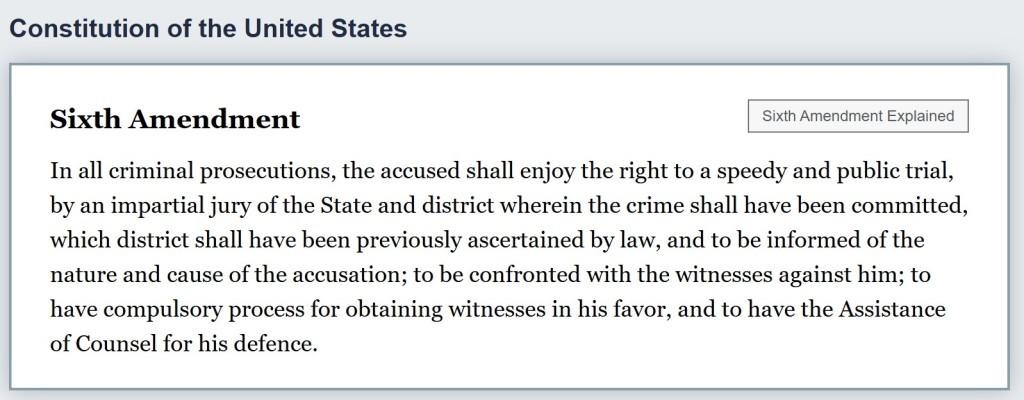
Now, with the trial of Donald Trump, a crucial part of the Constitution—the 6th Amendment—is being quietly undermined. The 6th Amendment guarantees:
“In all criminal prosecutions, the accused shall enjoy the right to a speedy and public trial, by an impartial jury of the state and district wherein the crime shall have been committed, which district shall have been previously ascertained by law, and to be informed of the nature and cause of the accusation; to be confronted with the witnesses against him; to have compulsory process for obtaining witnesses in his favor, and to have the assistance of counsel for his defense.”
The criminal allegations against Trump stem from alleged conduct that occurred prior to his presidency. The prosecution claims that these actions happened within New York’s jurisdiction, but the public perception of the case is irrelevant to the legal process. The 6th Amendment should have ensured that Trump’s rights were respected. Yet, critical violations exist within the prosecution’s conduct:
Violation of Brady v. Maryland (1963): The prosecutor has a duty to disclose exculpatory evidence to the defense, yet critical pieces of evidence have been suppressed, most notably Stormy Daniels’ letters, which negate the claim that Trump falsified financial records related to hush money.
Violation of Faretta v. California (1975): Trump’s lawyers have “tactical authority” over the presentation of his defense but must still ensure they are presenting his defense, not the State’s, and most certainly not one fabricated by them. Any deviation from this duty could result in a violation of Trump’s constitutional rights, particularly when his own defense team misleads him and the court in any manner and by any means, whether ingeniously or ingenuously, including ineptness.
Violation of Rule 3.8 of the ABA Model Rules of Professional Conduct: A prosecutor’s misconduct is also apparent in their failure to follow the ethical guidelines governing their behavior, most notably under Rule 3.8.
The Prosecutor’s Ethical Duty Under Rule 3.8
Under Rule 3.8 of the ABA Model Rules of Professional Conduct, prosecutors are bound to uphold high standards of conduct, particularly with regard to fairness and justice. Specifically, Rule 3.8 outlines the special responsibilities of a prosecutor in a criminal case.
“Rule 3.8: Special Responsibilities of a Prosecutor
The prosecutor in a criminal case shall:
(a) refrain from prosecuting a charge that the prosecutor knows is not supported by probable cause;
(b) make reasonable efforts to assure that the accused has been advised of the right to, and the procedure for obtaining, counsel and has been given reasonable opportunity to obtain counsel;
(c) not seek to obtain from an unrepresented accused a waiver of important pretrial rights, such as the right to a preliminary hearing;
(d) make timely disclosure to the defense of all evidence or information known to the prosecutor that tends to negate the guilt of the accused or mitigates the offense, and, in connection with sentencing, disclose to the defense and to the tribunal all unprivileged mitigating information known to the prosecutor, except when the prosecutor is relieved of this responsibility by a protective order of the tribunal;
(e) not subpoena a lawyer in a grand jury or other criminal proceeding to present evidence about a past or present client unless the prosecutor reasonably believes:
(1) the information sought is not protected from disclosure by any applicable privilege;
(2) the evidence sought is essential to the successful completion of an ongoing investigation or prosecution; and
(3) there is no other feasible alternative to obtain the information;
(f) except for statements that are necessary to inform the public of the nature and extent of the prosecutor’s action and that serve a legitimate law enforcement purpose, refrain from making extrajudicial comments that have a substantial likelihood of heightening public condemnation of the accused and exercise reasonable care to prevent investigators, law enforcement personnel, employees or other persons assisting or associated with the prosecutor in a criminal case from making an extrajudicial statement that the prosecutor would be prohibited from making under Rule 3.6 or this Rule.
(g) When a prosecutor knows of new, credible and material evidence creating a reasonable likelihood that a convicted defendant did not commit an offense of which the defendant was convicted, the prosecutor shall:
(1) promptly disclose that evidence to an appropriate court or authority, and
(2) if the conviction was obtained in the prosecutor’s jurisdiction,
(i) promptly disclose that evidence to the defendant unless a court authorizes delay, and
(ii) undertake further investigation, or make reasonable efforts to cause an investigation, to determine whether the defendant was convicted of an offense that the defendant did not commit.
(h) When a prosecutor knows of clear and convincing evidence establishing that a defendant in the prosecutor’s jurisdiction was convicted of an offense that the defendant did not commit, the prosecutor shall seek to remedy the conviction.”
In Trump’s case, the prosecutor violated many of these ethical guidelines by suppressing evidence favorable to the defense either by withholding them from the grand jury or failing to resubmit them to the same grand jury to see if they would sustain the indictment, particularly the confession letters from Stormy Daniels denying any such payments made that could have undermined the State’s entire case. If the prosecutor knew that no “hush money” was paid, then it stands to reason that no falsified financial records exist.
This critical evidence was either overlooked or deliberately withheld from the grand jury, potentially amounting to prosecutorial misconduct and even criminal culpability.
Moreover, if Judge Merchan denied the admission of these critical letters, he, too, is complicit in the violation of Trump’s constitutional rights. As both a judge and a lawyer, Judge Merchan is obligated under Rule 8.4 to refrain from misconduct that prejudices the administration of justice.
Fiduciary Obligations of Lawyers and Judges in Criminal Proceedings
All lawyers involved in the case, including the New York Attorney General and the judge presiding over the trial, have fiduciary obligations to uphold the law and ensure a fair trial. This includes the duty to act in the best interest of justice, rather than any political or personal motives. To abstain from this is honest services fraud. – McNally v. United States, 483 US 350, 107 S. Ct. 2875, 97 L. Ed. 2d 292 – Supreme Court, 1987
The New York Attorney General, as a representative of the people, holds a special responsibility in ensuring that justice is served fairly and impartially. This means refraining from prosecuting cases based on political pressure or public opinion, but rather only when the evidence supports the charges. Prosecutors are forbidden from pursuing cases lacking probable cause, and they must ensure that no constitutional rights of the accused are violated during the proceedings.
The judge, in turn, holds a fiduciary responsibility to ensure that the trial is conducted fairly, that the rights of the accused are respected, and that no external pressures influence the legal process. Judges are required to remain impartial and to prevent any actions that would compromise the integrity of the trial, including suppressing critical evidence or allowing prosecutorial misconduct to go unaddressed. In this case, if Judge Merchan has allowed evidence favorable to the defense to be excluded, he may be breaching his fiduciary duties and should be held accountable.
Rule 8.4: Misconduct and Judicial Complicity
Rule 8.4 addresses professional misconduct for lawyers and judges. Remember: Judges are lawyers too. Under this rule, it is misconduct for a lawyer to:
“(a) violate or attempt to violate the Rules of Professional Conduct, knowingly assist or induce another to do so, or do so through the acts of another;
(b) commit a criminal act that reflects adversely on the lawyer’s honesty, trustworthiness or fitness as a lawyer in other respects;
(c) engage in conduct involving dishonesty, fraud, deceit or misrepresentation;
(d) engage in conduct that is prejudicial to the administration of justice;
(e) state or imply an ability to influence improperly a government agency or official or to achieve results by means that violate the Rules of Professional Conduct or other law;
(f) knowingly assist a judge or judicial officer in conduct that is a violation of applicable rules of judicial conduct or other law; or
(g) engage in conduct that the lawyer knows or reasonably should know is harassment or discrimination on the basis of race, sex, religion, national origin, ethnicity, disability, age, sexual orientation, gender identity, marital status or socioeconomic status in conduct related to the practice of law. This paragraph does not limit the ability of a lawyer to accept, decline or withdraw from a representation in accordance with Rule 1.16. This paragraph does not preclude legitimate advice or advocacy consistent with these Rules.”
If Judge Merchan or Trump’s lawyers, in my opinion, have violated these duties, they should be held accountable. The failure to admit exculpatory evidence—especially if it would have negated the falsification of financial records—undermines the entire trial process. Should Trump’s case have been dismissed at the outset, once this evidence was brought to light? The answer is unequivocally yes.
Conclusion: The Erosion of the 6th Amendment and the Constitution
What we are witnessing in the case of Donald Trump is not just a political battle—it is the erosion of constitutional protections afforded by the 6th Amendment. The Constitution guarantees a fair trial, yet this trial is being marred by ex post facto laws, prosecutorial misconduct, and a failure to honor basic due process rights. This creates a dangerous precedent that may lead to the further undermining of constitutional rights.
The result is the unknowing destruction of the 6th Amendment by the American public, who, spurred on by misrepresentations from all sides, may be advocating for the death of the very constitutional protections they believe they are defending. Trump’s legal team, in misrepresenting the law to both him and the public, the conduct by the New York Attorney General’s office and it’s prosecutors, and even Trump in his ignorance stemming from either the misinformation from his legal team or from his legal team’s incompetence, are complicit in this destruction.
The Constitution’s safeguards—specifically the rights guaranteed under the 6th Amendment—are being slowly eroded by those entrusted to uphold them. The death of the 6th Amendment is not just a matter of law but a matter of political consequence, and Americans must ask: when did we stop honoring the rule of law in favor of political expediency?
Although I have not seen all of the evidence against Trump or all of the case files, from what I have seen in the media and online, this is the conclusion I have reached. And if true and this is the case, all of America should worry because we have also seen the trend where governments, state and federal hold that “the laws apply to thee (We the People) and not to me (government and its officials).
Do I believe they, including Trump’s attorneys, have and are depriving Trump his due process rights and his right to the equal protection of those rules and decisional laws? Yes, I do.
What is more egregious in my opinion is the glaring spectre of a conspiracy not merely against Trump’s constitutional rights, but against the rights of all Americans. These are your rights as well, not just Trump’s.
Opinion of the Author:
It is highly possible Trump has standing to sue Merchan, Bragg, and the AG of New York. How so?
None of them, including Judge Merchan, have subject matter jurisdiction, executive, legislative or judicial in the appellate standard of review granting them personal jurisdiction of the cause (see Muskrat v. United States 219 US 346, 358, 31 S. Ct. 250, 55 L. Ed. 246 – Supreme Court, 1911 citing and affirming Osborn v. Bank of United States, 9 Wheat. 819) to abrogate, nullify, suspend, or amend the Constitution of the United States, the Rules of Professional Conduct, the Canons of Judicial Conduct or Supreme Court decisional law. – see Mireles v. Waco, 502 US 9, 11-12, 112 S. Ct. 286, 116 L. Ed. 2d 9 – Supreme Court, 1991 affirming Bradley v. Fisher, 80 US 335, 351 20 L. Ed. 646, 20 S. Ct. 646 – Supreme Court, 1872
The judicial decree in Bradley at 351 holds that when a government official acts without authority and knows they lack authority yet acts as if they possess it, the exercise of such authority is “usurped authority.” Neither judicial immunity or even prosecutorial immunity can save them. How so?
“no excuse is permissible” – Id., Bradley at 351. And 42 USC 1983 provides, in applicable part, “Every person who, under color of any statute, ordinance, regulation, custom, or usage, of any State or Territory or the District of Columbia, subjects, or causes to be subjected, any citizen of the United States or other person within the jurisdiction thereof to the deprivation of any rights, privileges, or immunities secured by the Constitution and laws, shall be liable to the party injured in an action at law, suit in equity, or other proper proceeding for redress, except that in any action brought against a judicial officer for an act or omission taken in such officer’s judicial capacity, injunctive relief shall not be granted unless a declaratory decree was violated or declaratory relief was unavailable. “
I submit the declaratory decrees cited above were violated and that all parties save Trump knew it.
The only guilt I can tell falls on Trump was he trusted yet forgot to verify. He forgot he is an outsider and not part of the “Good Ole Boys Club.”
He isn’t an attorney.