
by Sharon Rondeau
(Nov. 26, 2024) — On Saturday, former Florida Rep. Matt Gaetz, who some members of the U.S. Senate immediately rejected as President-Elect Donald Trump’s attorney general, appeared to suggest on “X” he could instead serve as “Special Counsel.”
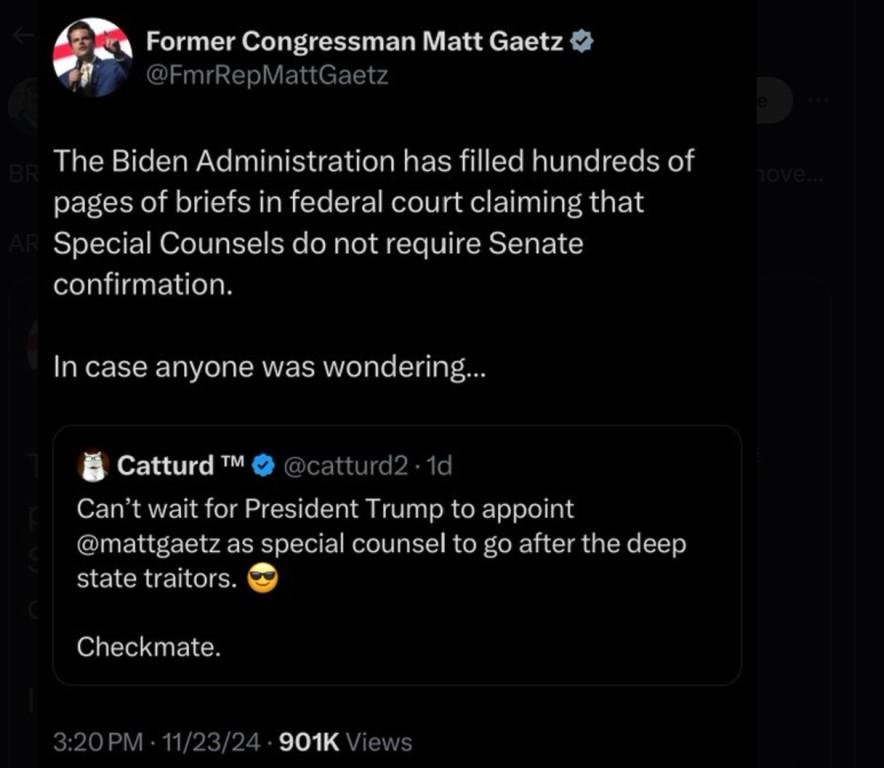
Gaetz’s post responsive to one from X and TruthSocial personality “Catturd,” who opined Friday he would like to see Gaetz serve in that capacity.
“Can’t wait for President Trump to appoint @mattgaetz as special counsel to go after the deep state traitors,” Catturd wrote on X. “Checkmate.”
In reply, Gaetz posted, “The Biden Administration has filled hundreds of pages of briefs in federal court claiming that Special Counsels do not require Senate confirmation. In case anyone was wondering…”
Under Article II, Section 2, clause 2 of the U.S. Constitution, the Senate must provide “Advice and Consent” of the president’s choices for “Ambassadors, other public Ministers and Consuls, Judges of the supreme Court, and all other Officers of the United States, whose Appointments are not herein otherwise provided for, and which shall be established by Law…”
Last December, former Attorney General Edwin Meese and two law professors argued to U.S. District Court Judge for the Southern District of Florida Aileen Cannon, a Trump appointee, that Special Counsel Jack Smith’s appointment by Biden’s attorney general, Merrick Garland, was unconstitutional on the grounds that it violated the Appointments Clause, which designates only the president with the authority to nominate “Officers of the United States.”
An exception would be if Congress were to pass a statute authorizing other government entities to appoint “inferior Officers,” the section additionally states.
At the time of his appointment by Garland, Smith was not serving as a confirmed “officer” of the Justice Department.
Smith prosecuted two criminal cases against Trump, one claiming he mishandled classified documents after leaving office in January 2021 and the other for allegedly illegally attempting to overturn the results of the 2020 presidential election.
On July 15, Cannon dismissed the documents case after concluding Smith’s appointment was, in fact, unconstitutional.
Smith’s office appealed but on Monday requested both federal cases he was pursuing against Trump be dismissed given that Justice Department protocol prohibits criminal prosecution of any sitting president and, by extension, a president-elect.
U.S. District Court for the District of Columbia Judge Tanya Chutkan acceded to Smith’s motions but left an opening for another prosecution to take place once Trump finishes his second term in January 2029.
Writing for The Heritage Foundation in January, Hans von Spakovsky opined of Meese’s amicus brief:
Meese, Calabresi, and Lawson argue that Garland lacked the power to appoint Smith because the attorney general has no authority to appoint a “private citizen to receive extraordinary criminal law enforcement power under the title of Special Counsel.”
First, they point out that there is no federal statute establishing an “Office of Special Counsel in DOJ.” Second, even if one ignores the absence of such a specific statute, there is also no statute authorizing the “Attorney General, rather than the President by and with the advice and consent of the Senate, to appoint such a Special Counsel.”
According to the congressional annotation of the section:
The focus of the Court’s analysis in cases addressing the difference between principal and inferior officers has varied over time. The Court’s early Appointments Clause cases did not present a clear picture of the differences between principal and inferior officers, often focusing on the method Congress prescribed for a given officer’s appointment or the duration of an officer’s tenure.7 When questions concerning the principal-inferior officer distinction surfaced again in the second half of the twentieth century, the Court applied a functional, mulit-factor analysis, which emphasized that inferior officers, relative to principal officers, had more constrained duties and less discretion.8 In 1997, the Court took a more formalist approach in defining the line between principal and inferior officers, holding that an inferior officer is one
whose work is directed and supervised at some level by others who were appointed by presidential nomination with the advice and consent of the Senate.9“
On July 10, just days before Cannon’s ruling, in a different but related case involving Smith, U.S. Supreme Court Associate Justice Clarence Thomas wrote, “If this unprecedented prosecution is to proceed, it must be conducted by someone duly authorized to do so by the American people.”
On October 19, 2020, then-U.S. Attorney General William P. Barr elevated U.S. Attorney for the District of Connecticut to Special Counsel to investigate the origins of the “Russia collusion” allegations against the 2016 Trump campaign.
Both U.S. Attorneys and Special Counsels require presidential nomination and Senate confirmation, according to a 2017 report by the Congressional Research Service (CRS).
The same day Trump nominated Gaetz for attorney general, he resigned his congressional seat from Florida’s first district and announced he would not be seated in the 119th Congress to which he was re-elected on November 5.
On November 21, Gaetz withdrew his name from consideration for AG, and a special election will be held to fill his former congressional seat.
According to Trump supporter and longtime Republican presidential adviser and strategist Roger Stone, if appointed Special Counsel, Gaetz’s mission would be “to investigate federal corruption.”