
by James Lyons-Weiler, PhD, Popular Rationalism, ©2024

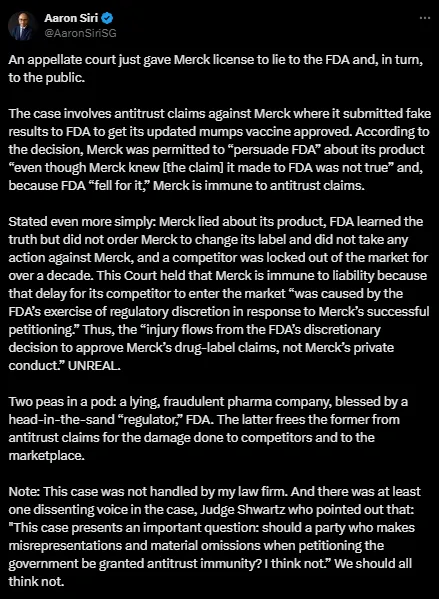
(Oct. 11, 2024) — The recent U.S. Third Circuit Court of Appeals ruling in the Merck mumps vaccine antitrust litigation has revealed a profoundly unsettling reality: Merck can legally misrepresent critical data in its vaccine trials and face no antitrust liability, all under the protection of the Noerr-Pennington doctrine. This decision is a profound failure to protect public health and a failure of our judiciary to uphold corporate accountability.
Timeline of Key Events:
- 1967: Merck becomes the sole manufacturer of the mumps vaccine in the U.S., with no domestic competitors.
- Late 1990s: The FDA raises concerns about the end-of-shelf-life potency of Merck’s mumps vaccine, specifically that doses may not maintain the minimum potency required as they near the end of their shelf life.
- Early 2000s: Merck attempts to fix the issue by boosting the initial potency of its vaccine doses. When this approach fails, Merck conceals these results from the FDA. Instead, it relies on flawed clinical trials—such as Protocol 007, which used rabbit antibodies instead of human data—to claim high vaccine efficacy.
- 2010s: A class-action lawsuit is filed by scientists involved in the alleged fraud at Merck, alleging that Merck engaged in monopolistic practices by concealing potency issues and inflating the vaccine’s effectiveness, keeping prices artificially high.
- 2024: The Third Circuit Court of Appeals rules that Merck’s actions, while misleading, are protected under the Noerr-Pennington doctrine, leading to widespread criticism of the pharmaceutical company, the FDA, and the courts.
Merck’s Misconduct and FDA’s Failure to Regulate
Per the trial information, Merck manipulated clinical trial data and used rabbit antibodies in place of human data to overstate the efficacy of its mumps vaccine, concealing its true potency problems. These actions allowed Merck to maintain its monopoly on the U.S. market for over a decade, delaying competition. The FDA, despite knowing about these issues, continued to approve Merck’s labeling claims and took no action to hold the company accountable.
Even more troubling, the courts have ruled that these actions are legally protected under the Noerr-Pennington doctrine. This legal doctrine, which originally safeguarded the right to petition the government, now shields companies like Merck from antitrust liability, even when their petitions are based on fraudulent or misleading data.
Public Health and Trust Erosion
This ruling sets a dangerous precedent for public health and regulatory integrity. If pharmaceutical companies are allowed to falsify data and manipulate clinical trials without consequences, how can we trust that vaccines and medications are safe and effective? Public trust in vaccines is already fragile, and this decision will only deepen skepticism, especially concerning the mumps component of the MMR vaccine.
FDA’s Regulatory Failure
The FDA’s role in this case cannot be overlooked. The agency is responsible for ensuring the safety and efficacy of vaccines, yet it allowed Merck to submit manipulated data and maintain false labeling claims for years. Despite being aware of the issues, the FDA failed to act, allowing millions of Americans to receive vaccines that may not have met the required potency standards. This regulatory failure solidifies to many that the FDA is not genuinely safeguarding public health but is. instead both actively colluding to hide fraud and is merely rubber-stamping corporate interests.
U.S. ex rel. Krahling & Wlochowski v. Merck & Co., Inc..
The original case involving Merck and the alleged fraud over the mumps vaccine is formally titled U.S. ex rel. Krahling & Wlochowski v. Merck & Co., Inc.. It was first filed in 2010 by two former Merck virologists, Stephen Krahling and Joan Wlochowski, who blew the whistle on the company’s handling of the mumps component of the MMR vaccine. The case alleged that Merck falsified data to overstate the vaccine’s efficacy and prevent competitors like GlaxoSmithKline (GSK) from entering the U.S. market.
The whistleblowers claimed that Merck used improper testing methods, including reliance on rabbit antibodies instead of human data, to inflate the vaccine’s efficacy and retain its monopoly. These allegations led to a False Claims Act lawsuit against Merck. However, much of the proceedings were sealed, and the case dragged on for years without public transparency.
Despite the severe nature of the allegations, the lawsuit faced challenges in court. Ultimately, the court ruled in favor of Merck, partly because the CDC and FDA continued to recommend Merck’s MMR vaccine and took no action to change its approval despite being aware of the lawsuit. The court found that the fraud claims did not materially affect the government’s decision to continue purchasing the vaccine. In other words, if government agencies collude with corporations, the corporations can break laws and commit fraud.
Read the rest here.
Comments
3 responses to “Appellate Court Rules That Merck Can Falsify Data and Not Be Found Guilty of Conducting Sham Studies and Misleading the FDA and the Public”
Aside from the astonishingly corrupt ruling and all that implies for the destruction of health care as we know it, I would like Professor Zorkophsky to explain that sentence. Technically, it is a mirror image of the ruling.
Depends if you got the COVID “clot shot”, to start.
Secondly, if you believe that the 2020 was the most honest ever.
Lastly, if you believe that judges can’t be bought and paid for, as politicians.
Okay, now that we got the ground rules out, a lie is a lie no matter who tells it, including the CDC and the FDA.
I used to work at the VA as a psychiatrist attending combat-related PTSD, patients and I can assuredly state that the government will lie to your face while thrusting a knife in your back, giving you some methadone, or giving you a “clot shot.”
As stated often on “The Pulse of the Nation” show, the weak link in our Republic is the morally corrupt judges.
Now, to your observation: you’re right but I’d say, it depends on who’s lying.
Professor ‘Trash the masks’ Zorkophsky
Individuals need to become legal corporations to deal with whomever they desire and be free to take whatever actions they need to achieve beneficial results, such as forcing judges to take early permanent retirement.