

by Joseph DeMaio, ©2024

(Aug. 15, 2024) — The recent letter to Elon Musk by Monsieur Thierry Breton – “Il Duce” of the European Union’s (“EU”) speech police charged with enforcing that cabal’s “Digital Services Act” (“DSA,” i.e., arbitrary censorship law) – is interesting. Mercifully, the higher-ups in the EU have smacked Breton upside the head for his unapproved letter, but that does not alter the fact that he composed it and fired it off to Musk.
Moreover, at minimum it surely reveals the mindset of Breton and likely tens of thousands of other governmental bureaucrats intent on censoring free speech on the Internet…, on the way to censoring it earlier yet in people’s minds, even before hitting “send” or “enter.” The “thought police” are closer than originally imagined.
Apart from the threatening tone of the missive to multi-billionaire Elon Musk – warning him to be wary of unacceptable discourse in his Internet X-platform discussion/interview with President Trump – the letter presents some interesting options in the context of analyzing the perennial issue here at The P&E: yes, Virginia, the “natural born Citizen” (“nbC”) eligibility issue.
Because in Breton’s view, the EU’s DSA prohibits the dissemination and “amplification” of Internet content deemed to be “disinformation,” and providing for the censorship and/or punishment of such dissemination and amplification “worldwide,” the question becomes: does the knowing repetition and dissemination of the indisputably wrong, yet uncorrected disinformation contained in United States v. Wong Kim Ark, 169 U.S. 649 (1898) (“WKA”), violate the EU’s DSA? And if not…, why not?
Specifically, as addressed by your humble servant here, in describing the legislative history of two early naturalization statutes passed by the First Congress – 1 Stat. 103 in 1790 and 1 Stat. 414 in 1795 – Associate Supreme Court Justice Horace Gray claimed in his opinion that in 1795, Congress “reenacted, in the same words, the 1790 statute…,” with alterations not germane to the central question. See WKA, 169 U.S. 649, at 672-673. That central question under 1 Stat. 103 was the status of persons who purportedly would be “considered” as a “natural born citizen” if born to U.S. citizen parents “beyond sea,” or, stated otherwise, outside the geographic boundaries of the United States.

Less than five years later, Congress – seemingly realizing that it could not by a naturalization statute such as 1 Stat. 103, expand or contract the restrictions of the Constitution’s presidential eligibility clause, Art. 2, § 1, Cl. 5, thereby purporting to amend it – repealed, in toto, 1 Stat. 103 when enacting 1 Stat. 414. While some of the non-germane provisions of 1 Stat. 103 were included in 1 Stat. 414, the central provision regarding who could be “considered” a “natural born citizen” was not “reenacted, in the same words” as claimed by Justice Gray. Indeed, the 1795 law did just the opposite. While a person born to U.S. citizen parents beyond sea was still to be “considered” a “citizen,” that individual would no longer be deemed to be a “natural born citizen.”
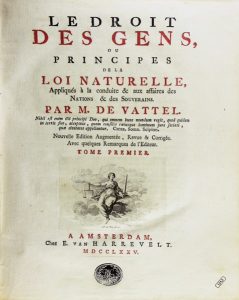
This is no small detail in the continuing debate over who the Framers of the Constitution intended to be – and intended not to be – eligible to the presidency. Given the Founders’ concerns over preventing even the potential for insinuation of “foreign influence” into the office and their desire to erect the highest possible existing barrier to that disfavored infection – as warned by Publius Alexander Hamilton in Federalist 68, – it is highly likely that they selected the term “natural born citizen” derived from Book 1, Ch. 19, § 212 (“§ 212”) of the seminal treatise The Law of Nations by Swiss attorney, jurist and international law scholar Emer de Vattel. Long-time P&E readers will immediately recognize the § 212 definition as referring to a person born in a country to two parents who were already at the time of birth citizens of that country. It is that simple.
But I digress.
Since those who reject the de Vattel § 212 definition as the one likely selected by the Framers as a restriction on the presidency usually cite and rely on the WKA decision and interject the additional “enactments-of-the-First-Congress-are-particularly-persuasive” rationale as “settling” the question in favor of an nbC definition based on being merely a “citizen at birth” or “citizen by birth,” regardless of place of birth or citizenship status of both parents, must those arguments now be censored under the EU DSA rules as being premised on the disinformation found in Justice Gray’s opinion? And again, if not…, why not?
The nbC definition found in § 212 stands in stark contrast to the “concept” fashioned in WKA as premised upon Justice Gray’s statement that Congress purportedly preserved by “re-enacting” in 1 Stat. 414 the “natural born” modifier of “citizen” found in 1 Stat. 103. Congress did no such thing, but instead, it repealed the modifier.

Justice Gray’s claim to the contrary is, at best, careless and erroneous misinformation. But if simple research which could be performed by a first-year law student at the Mr. Magoo College of Law would reveal the disparity – and it was nonetheless ignored and marketed as truth – it would be difficult to characterize that narrative as consisting of anything other than the intentional propagation of disinformation.
Furthermore, because Justice Gray’s “mistake” is being repeated and “amplified” by the United States Senate in places like Sen. Res. 511 (the 2008 resolution attempting to “confirm” John McCain’s questionable nbC status) and in the 2015 essay by Messrs. Paul Clement and Neal Katyal, seeming to ratify the error of Sen. Res. 511, is not a violation of the DSA implicated?
As to the Clement/Katyal essay, it claims that “[t]he proviso in the Naturalization Act of 1790 underscores that while the concept of ‘natural born Citizen’ has remained constant…,” other things have changed. The “misinformation” or “disinformation” involved here lies in the fact that the “concept” of “natural born Citizen,” as carelessly included in 1 Stat. 103, has not remained constant. Indeed, it can be argued that the “born beyond sea to citizen parents” provision of 1 Stat. 103 remained constant only during the 58 months of its existence, until 1 Stat. 414 repealed that “concept” in 1795. The only thing remaining constant thereafter is the ghost of the error Congress corrected less than five years after committing it.
Accordingly, one must ask: is the Clement/Katyal essay subject to censoring because it continues to propagate and “amplify” the disinformation that the “ghost” of an nbC “concept” – eradicated by Congress 229 years ago – is somehow operative and still alive? Once more: if not…, why not?

There is another “concept” which captures the irony of the situation: “What’s good for the goose should also be good for the gander.” These questions need answers. Perhaps one or more commenters at The P&E who harbor a different nbC definitional view than does your humble servant will supply an explanation.
Comments
One response to “The EU DSA Letter”
Well Said Humble Servant, but we are dealing with people who think the US Constitution is a LIVING BREATHING document that can be changed at their whim ! Forgetting the FACT it takes a Constitutional Amendment to change any part of the US Constitution and then it take 2/3ths of the states to RATIFY said Amendment ! Clement/Katyal Essay does NOT change that FACT !