

by Sharon Rondeau
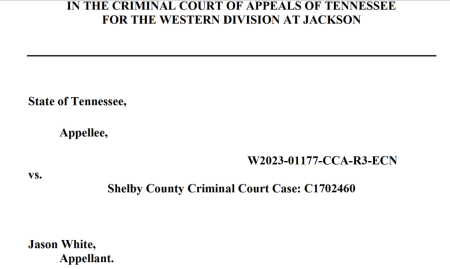
(Jul. 10, 2024) — Last August, a Writ of Error Coram Nobis filed by Tennessee inmate Jason L. White in his own defense was denied by Shelby County, TN Criminal Court judge James Jones, Jr.
In 2017, White, already a state prisoner from an unrelated conviction years before and completing his 21-year sentence, was given 60 more years in prison without the possibility of parole for having allegedly participated in a scheme to sell and distribute methamphetamine in a school zone.
The main evidence against White was a package containing the drug delivered to the home of a co-defendant, Kristina Cole, a single mother of three with no criminal history.
According to Cornell Law School and the Legal Information Institute (LII), “The writ of coram nobis is a Latin term applied in common law to call to the court’s attention facts that would have changed the judgment but were outside the record and unknown to the court at the time of judgment. The writ of coram nobis is intended to correct a final judgment by the same court in which it was rendered by redressing a fundamental error, such as a deprivation of the right to counsel in violation of the Sixth Amendment.”
White has denied involvement in the “conspiracy” the state alleged and has sought a review of his conviction on numerous levels over the years.
In May 2019, he was relocated to the State of New Mexico, making Tennessee law, court proceedings and related documents significantly more difficult to access.
The Writ of Error Coram Nobis arose after Cole was released early from prison through executive clemency in April 2023. As she worked to rebuild her life, become employed and reconnect with family and community, Cole provided White with an affidavit (p. 6 here) asserting that contrary to key claims made by then-Bartlett Police Department Detective Mark Gaia, she “did not track the FedEx package that Detective Gaia placed on the porch of my residence of 2552 Jenwood St, Bartlett TN. 38134 on February 3, 2016.”
Further, her affidavit stated, she did not send three text messages, as Gaia initially testified, to White about the package since she was in police custody at the time without access to her phone.
As the appellate court noted in its June 20 opinion (see below), Gaia later admitted to sending one of the text messages.
After her release on parole last year, Cole told her story here professing her innocence and filed a Writ of Error Coram Nobis with the trial court which Jones denied last September. Subsequently, she and White hired Attorney Terrell Tooten of Memphis to represent them in appealing the court’s denials.
On December 4, 2023, Tooten filed an appeal on White’s behalf with the Court of Criminal Appeals at Jackson on the basis that Jones’s denial of the Coram Nobis was issued without a hearing. A similar filing was made on Cole’s case on April 23, 2024, with oral argument taking place on July 9.
Tooten’s request for a hearing in White’s case was granted by a three-judge appellate panel for which Tooten presented his argument of the case on May 1, 2024.
In his brief on White’s behalf, Tooten wrote, in part:
At trial, 3 text messages were sent from co-defendant Cole’s phone to Petitioner, and these text messages were the material evidence that convicted Petitioner, along with the testimony of Detective Gaia. Vol. 1, Pages 1-11.
At trial, Detective Gaia admitted to sending the third text message, but not the first two. Id.
In addition, co-defendant Cole acknowledged that she did not make this information available to Petitioner earlier, out of fear that she would be moved away like they did Petitioner, who was moved to New Mexico.
On June 20, the panel issued an opinion affirming the trial court’s ruling, though acknowledging that “At Petitioner’s post-conviction hearing, trial counsel acknowledged that Detective Gaia was impeached on cross-examination by admitting that he sent the third text message from Co-defendant Cole’s phone. Trial counsel noted that this fact was omitted from the detective’s direct examination, and made the detective look ‘shady.’ White, 2023 WL 6142444, at *21. Petitioner raised the claim at the post-conviction hearing that Detective Gaia sent all three text messages. Therefore, Petitioner has had information about the text messages since his trial, and Co-defendant Cole’s affidavit does not qualify as newly discovered evidence.”
The panel concluded that the “petitioner is not entitled to relief” and “remanded to the Criminal Court for Shelby County for execution of the judgment of that court…”
White’s “indigent” status as a prisoner rendered the costs of the litigation to be “paid by the State of Tennessee,” the appellate court wrote.
On July 1, Tooten filed a Petition to Rehear under Rule 39 of the Tennessee Rules of Appellate Procedure, Section “(a)” of which states and Tooten cited:
(a) On Petition; Grounds. Rehearing may be granted by the Supreme Court, Court of Appeals, or Court of Criminal Appeals on its own motion or on petition of a party. In determining whether to grant a rehearing, the following, while neither controlling nor fully measuring the court’s discretion, indicate the character of reasons that will be considered: (1) the court’s opinion incorrectly states the material facts established by the evidence and set forth in the record; (2) the court’s opinion is in conflict with a statute, prior decision, or other principle of law; (3) the court’s opinion overlooks or misapprehends a material fact or proposition of law; and (4) the court’s opinion relies upon matters of fact or law upon which the parties have not been heard and that are open to reasonable dispute. A rehearing will not be granted to permit reargument of matters fully argued.
On page 4, Tooten further contended:
Appellant asserts that representations made by the affiant that she witnessed
Detective Gaia using her phone is significant.This information was not previously known, so it was not previously alleged. If affiant along with Detective Gaia were allowed to testify at a new Hearing, and her testimony was found to be true, then that would completely change the facts and the outcome of the case.