
by Joseph DeMaio, ©2024
(May 5, 2024) — INTRODUCTION
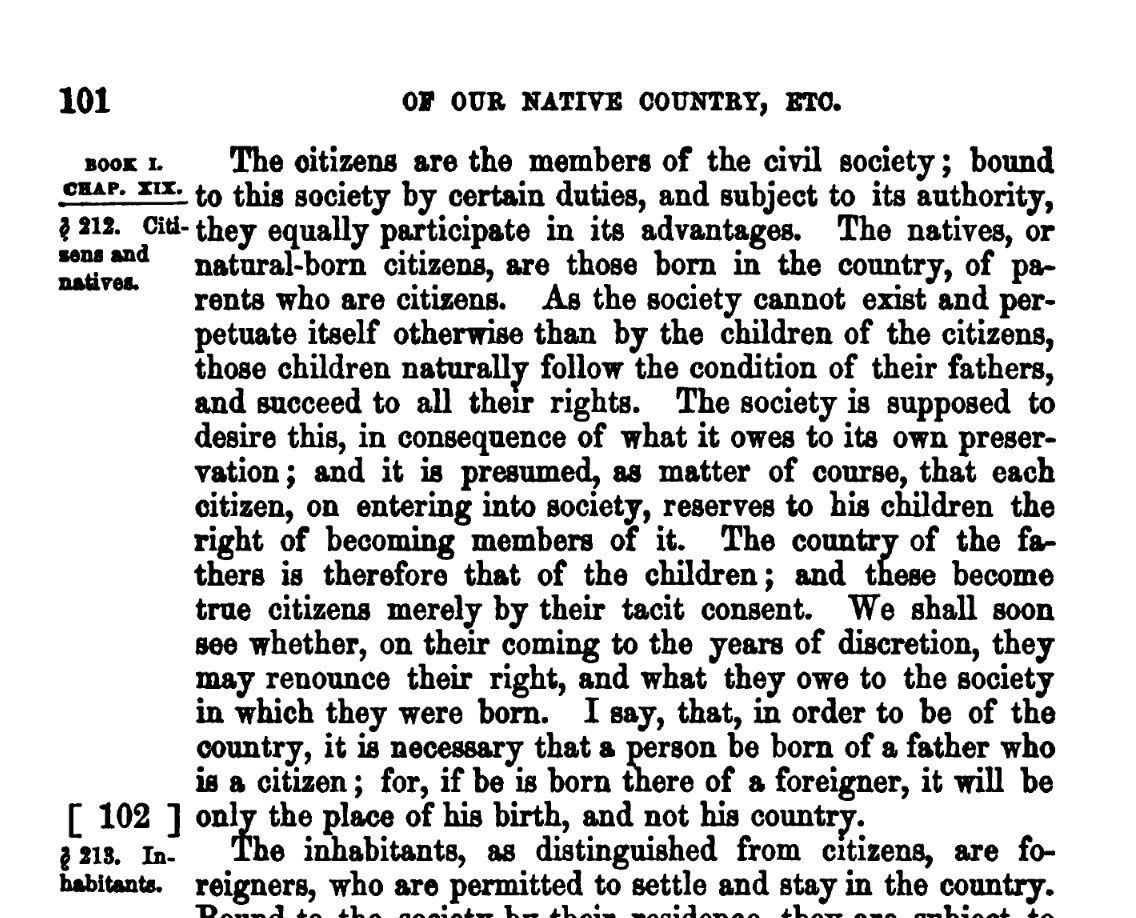
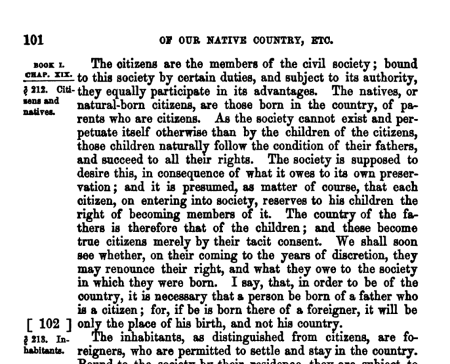
It is frequently argued by opponents of the “two-citizen parents” requirement of Emer de Vattel’s definition of a “natural born Citizen” (“nbC”) found in Book 1, Ch. 19, § 212 of The Law of Nations (1758), that the requirement “is nonsense.” Indeed, the 2015 article purporting to “resolve” the meaning of the nbC term (“C&K article”) by former high officials in the Department of Justice – Solicitor General Paul Clement and Acting Solicitor General Neal Katyal – completely rejects the relevance of the de Vattel nbC definition by ignoring any discussion of de Vattel or the definition in his 1758 treatise altogether. Ignoring facts, however, does nothing to eradicate them.
Instead, the C&K article deploys ipse dixit (“it is so because I say it is so”) to merely declare that “someone born to a [i.e., singular] U.S. citizen parent generally becomes a U.S. citizen without regard to whether the birth takes place in Canada, the Canal Zone, or the continental United States…,” adding, cryptically, that “a ‘natural born Citizen’ means a citizen from birth with no need to go through naturalization proceedings.” (Emphasis added)
Stated otherwise, the C&K article announces, ex cathedra, that as long as “a” parent – in the singular – is a U.S. citizen, that alone will suffice to render the child born abroad to that parent a “citizen from birth with no need to go through naturalization proceedings [thereafter].” The C&K article then somersaults to the non-sequitur conclusion that therefore, purportedly, “a person born abroad to a U.S. citizen parent is generally a U.S. citizen from birth with no need for naturalization. And the phrase ‘natural born Citizen’ in the Constitution encompasses all such citizens from birth.” (Emphasis added)
Stated otherwise, the C&K definition posits that, in addition to being seen as a 14th Amendment “citizen,” the person must also be recognized as fitting the definition of a “natural born Citizen” as intended by the Founders in Art. 2, § 1, Cl. 5 of the Constitution. Respectfully, your humble servant posits that this simplistic definition is unsupported by the history of the nbC provision and plainly not what the Founders intended or adopted in the Constitution. Accordingly, the C&K conclusion requires closer analysis.
ANALYSIS: The Founders’ Concern

First, it is an undisputed historical fact that in crafting the eligibility standards for the “Chief Magistracy” – the President –, the Founders sought to construct the highest practicable barrier to the potential for insinuation of “foreign influence” into the highest office of the new Republic. As admonished by Alexander Hamilton (one of the Publius triplets) in Federalist 68: “Nothing was more to be desired, than that every practicable obstacle should be opposed to cabal, intrigue and corruption…,” (emphasis added) which acknowledged evils could arise “chiefly from the desire in foreign powers to gain an improper ascendant in our councils. How could they better gratify this, than by raising a creature of their own to the chief magistracy of the union?” (Emphasis added)
While Hamilton was primarily addressing the concept and utility of the Electoral College in Federalist 68, his warning regarding the desire of foreign powers to “raise a creature of their own” to the presidency rings as true with respect to Art. 2, § 1, Cl. 5 today as it did in 1787.

.jpg)
.jpg)
In fact, Hamilton’s warning was repeated and fortified by Supreme Court Associate Justice Joseph Story in his Commentaries on the Constitution of the United States (1853). There, in § 1473 – and addressing the nbC clause and the exclusion of foreigners as well as naturalized citizens from eligibility to the presidency – Justice Story states:
“It is indispensable, too, that the President should be a natural born citizen of the United States; or a citizen at the adoption of the constitution, and for fourteen years before his election. This permission of a naturalized citizen to become President is an exception from the great fundamental policy of all governments, to exclude foreign influence from their executive councils and duties.” (Emphasis added).
Justice Story’s reference to the “permission of a naturalized citizen” provision refers to the exception embodied in the “Citizen-Grandfather” clause within Art. 2, § 1, Cl. 5, and without which the first seven presidents could not have constitutionally served. Justice Story then adds (id.) with regard to the wisdom and function of the Constitution’s exclusion of foreigners under the nbC clause the cogent observation that:
“[i]t cuts off all chances for ambitious foreigners, who might otherwise be intriguing for the office [of the President]; and interposes a barrier against those corrupt interferences of foreign governments in executive elections, which have inflicted the most serious evils upon the elective monarchies of Europe.” (Emphasis added)
Plainly, Justice Story was echoing Hamilton’s admonition that every practicable obstacle – not just a few convenient ones – should be identified and interposed to preclude the insinuation of foreign influence into the presidency. Moreover, the Founders sought to exclude not only “foreigners,” as people, but “foreign influence” as well, whatever the source of that “influence.” Stated otherwise, Justice Story’s “all chances” and Hamilton’s “every practicable obstacle” observations mirror each other: each and every and all chances for the insinuation of foreign influence into the presidency were to be, as much as practicable, foreclosed.
More succinctly, “all” and “every” are terms expressing the same concept and objective. And parenthetically, the C&K “one-citizen-parent-is-sufficient” theory purports to extend its “rationale” without regard to the “happenstance” of actual birthplace, whether here in the United States or anywhere else on the planet. Your servant posits that this theory is precisely what the Founders sought to preclude when drafting the Constitution’s nbC Eligibility Clause.


ANALYSIS: 2 citizen parents > 1 citizen parent
Second, if the exclusion of “all” and “every” potential for foreign influence was the goal of the Founders, one must ask: which definition of a “natural born Citizen” more closely aligns with their intent? Does the C&K definition – positing the need for only one parent to be a U.S. citizen – satisfy the nbC requirement? Or does the de Vattel § 212 definition, requiring both parents to be U.S. citizens when their child is born better address the Founders’ concerns and meet their goal of erecting the “highest practicable barrier” to foreign influence?
Rocket science, this is not: the latter, de Vattel § 212 definition interposes a much higher and thus better barrier than the C&K “one-parent-is-close-enough-for-government-work” definition. There are several reasons for this conclusion, obvious to most, but obscure to others, even former high officials in the Solicitor General’s Office.
To begin with, not only were the Founders intent on requiring that the president be a person of unquestioned fidelity and allegiance to the United States, they also demanded that such fidelity and allegiance be sole and exclusive. The goal was for the “Chief Magistrate” – the President –to be a person of undivided allegiance, not one of shared or dual allegiance.
A person born to parents, only one of whom is a U.S. citizen but the other is a foreigner – or even a dual-citizen foreigner – may be seen to have multiple allegiances. And even if the subject person renounces or disclaims such non-U.S. allegiances – as Senator Ted Cruz attempted – that does nothing to “undo” the national character of the person when born. This “when born” requirement was emphasized by John Jay in his July 25, 1787 “hint” letter to Constitutional Convention Chairman George Washington. There, Jay emphasized the importance of birth here by underscoring the term “born” when referencing the character of the person who would be the Commander in Chief of the “[A]merican army.”

Stated otherwise, if the person at birth is born to two parents, with, say, only the mother being a U.S. citizen and the father being, say, a citizen of Jamaica, the father – or, for that matter even the nation of Jamaica itself – could in the future potentially claim that the child was at minimum of dual U.S. and Jamaican citizenship. Even if the child renounced its part-Jamaican citizenship, that would not preclude Jamaica from contending that, at birth, the child had dual U.S./Jamaican citizenship. And the same problems would exist, potentially even more complex, if the father possessed dual or even tri-national citizenship.
Many nations of the world in 1787, as well as today, subscribe to one or the other – and sometimes a blend of both – citizenship by blood or parentage (jus sanguinis) and citizenship by birthplace (jus soli). Moreover, would a future renunciation of Jamaican citizenship have any effect on the shared citizenship of the child, assuming, of course, that the child remained a “minor” at the time of the father’s renunciation?
Under the de Vattel § 212 “two-citizen parents” definition, the myriad permutations, complications and debates over “sole,” “undivided,” “dual” and/or “shared” allegiance are rendered moot and eliminated. Additionally, in today’s exponentially faster-paced world as compared to 1787, there would be no time to “sort out” or adjudicate the nuances of competing allegiance claims in court. It is far better that those debates be resolved at the outset, which is precisely what the § 212 definition does. Accordingly, the argument that the Founders would have consciously adopted a definition fraught with doubts, inconsistencies and uncertainties regarding sole and exclusive allegiance to the United States is both counter-intuitive as well as ill-reasoned.
ANALYSIS: 1 Stat. 103 and 1 Stat. 414
Third, independently and in addition, the “two-citizen parents” definition was recognized by the First Congress in 1790 when it passed 1 Stat. 103. That statute, of course, asserted that “children of citizens of the United States that may be born beyond sea, or out of the limits of the United States, shall be considered as natural born citizens.” (Emphasis added) This language plainly contemplates that the “citizens of the United States” to which children are born if “beyond sea” are the parents – a plural-component union of a mother and a father – who are, at the time of the birth, both U.S. citizens.
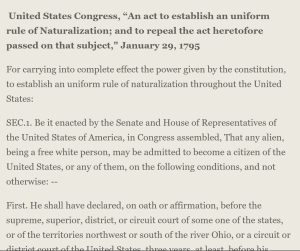
1 Stat. 103, of course, was repealed – not “reenacted “in the same words” as erroneously claimed by Associate Justice Horace Gray in the Wong Kim Ark case (“WKA”) – less than five years later in January, 1795 by 1 Stat. 414.
The reason for the repeal was likely because the Congress realized that 1 Stat. 103 conflicted with the nbC definition of Art. 2, § 1, Cl. 5 (the presidential eligibility clause) and constituted a prohibited “ersatz” constitutional amendment via statute. This potential is discussed in a law review article which is cited with approval in the C&K article, “Presidential Eligibility: The Meaning of the Natural-Born Citizen Clause,” 36 Gonzaga Law Review 349, 372-73 (2000/01), by one Christina S. Lohman. Lohman states: “… one could certainly posit that the [Congress] recognized a possible constitutional conflict and sought to correct it. Further, the omission of ‘natural-born’ makes the statute look more like one devolving citizenship by naturalization.” (Emphasis and bolding added) See Lohman, 38 Gonz. L. Rev. at 372-373.
1 Stat. 414 repealed the words “natural born” that had modified the immediately following term “citizen” in 1 Stat. 103, thus making such children “considered” to be “citizens,” but no longer “natural born citizens.” But aside from that issue, the Congress preserved its recognition that those children born “beyond sea” still had to be the product of two parental citizens in order to be even “considered” to be themselves “citizens.”
Had the Founders, many of whom were also members of the First Congress, intended that only one parent needed to be a U.S. citizen to bestow U.S. citizenship upon a child born beyond sea, it could easily have so stated. Instead, it used language compelling the conclusion that both parents – described as “citizens” in the plural – were required.
Indeed, the Lohman law review article – again, cited approvingly in the C&K article – states with regard to the meaning of “natural born citizen” that “… the common law, at least with regard to foreign-born children, appears to contemplate only children of two citizen parents.” (Emphasis added) See Lohman, id., at 368. This, of course, was the thrust of 1 Stat. 103, even before its repeal in 1795 by 1 Stat. 414. Furthermore, no rational reason exists for differentiating between children born “here” as opposed to “beyond sea” insofar as the “two-citizen parents” requirement for an nbC is concerned.
This language, of course, parallels the definition in de Vattel’s § 212, where de Vattel defined, in French, natural born citizens in the plural as “ceux qui sont nés dans le pays, de parens citoyens…,” and in English, also plural, as “those who are born in the country of citizen parents.” (Emphasis added) This conclusion is further ratified upon recognition that in both 1 Stat. 103 and 1 Stat. 414, Congress separated the mother and father when conditioning the citizenship of the child born “beyond sea” to the parental union with the proviso that: “[T]he right of citizenship shall not descend to persons whose fathers have never been resident in the United States.” (Emphasis added)
That proviso, included in both 1 Stat. 103 and 1 Stat. 414, only fortifies the conclusion that the Founders considered the “two-citizen parents” definition in de Vattel’s § 212 to be the one creating a higher, rather than a lower, bar to the potential for the insinuation of foreign influence regarding the presidency.
Moreover, the fact that Congress in both 1 Stat. 103 and 1 Stat. 414 addressed the separate issue of the father’s residency in the United States as bearing upon the child’s citizenship confirms that Congress was aware of and took into consideration the principles of both birthplace or the “law of the soil” (“jus soli”) as well as parentage or bloodline (“jus sanguinis”) in determining the citizenship of children born to U.S. parents “beyond sea.”
ANALYSIS: Senate Resolution 511 (2008)
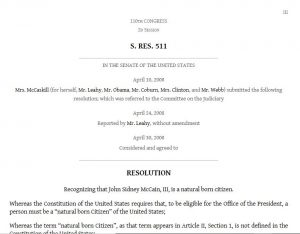
Fourth, further confirmation of the relevance of the “two-citizen parents” requirement is found in Senate Resolution 511 (2008). That resolution – having, by the way, zero precedential weight on the eligibility topic – sought to validate the nbC eligibility in 2008 of Senator John McCain. According to the C&K article, the Senate purported to “define” the nbC term by incorporating the language of 1 Stat. 103.
Apart from the undisputed fact that 1 Stat. 103 was repealed in toto 213 years earlier – including its “considered as natural born citizens” language – the Senate blundered (including at the time Senators Barack Obama and Hillary Clinton) into asserting that Senator McCain was purportedly an eligible nbC because, among other things, he was “born to American citizens on an American military base in the Panama Canal Zone in 1936.” (Emphasis added)
Quite apart from the other factual anomalies existing in the resolution’s “Whereas” clauses, the factual reality that McCain was “born to American citizens…” seems clearly to confirm that the Senate was accepting and adopting the “two-citizen parents” requirement of 1 Stat. 103 and § 212 of the de Vattel treatise. Indeed, the Senate included in two of its “whereas” clauses the following:
“Whereas there is no evidence of the intention of the Framers or any Congress to limit the constitutional rights of children born to Americans serving in the military nor to prevent those children from serving as their country’s President; [and]
“Whereas such limitations would be inconsistent with the purpose and intent of the natural born Citizen clause of the Constitution of the United States, as evidenced by the First Congress’s own statute defining the term natural born Citizen;” (Emphasis added)
Where to start, where to start?
First, as discussed here, the reliance on 1 Stat. 103 by S. Res. 511 – which law had been repealed over two centuries before the resolution was a twinkle in the eye of its sponsors, including Barack Hussein Obama II and Hillary (“BleachBit…, what BleachBit?”) Clinton – was garden-variety dumb. No one ever confused a U.S. Senator with a Nobel laureate.
Most likely because Congress realized in 1795 that 1 Stat. 103 improperly (i.e., unconstitutionally) attempted to amend by a statute the constitutional restrictions of the nbC Eligibility Clause, it enacted 1 Stat. 414, repealing 1 Stat. 103. And as noted here, the manifestly wrong conclusion of Supreme Court Associate Justice Horace Gray in the WKA case that 1 Stat 103 was “reenacted, in the same words…” by 1 Stat. 414, eviscerates the core rationale of S. Res. 511.
Second, the claim in the resolution that 1 Stat. 103 constituted “the First Congress’s own statute defining the term natural born Citizen…” is also clearly wrong. 1 Stat. 103 merely categorized certain people who were born “beyond sea” as being “considered as” natural born citizens, but provided no additional definition of the term. That said, both 1 Stat. 103 and the resolution again recognized that in any event, the birth “beyond sea” had to be to two American citizens, not just one.
Third, on a collateral but related point proving that in any event, the resolution was likely legally wrong, a law professor contended at the time that McCain became a U.S. citizen pursuant to a specific 1937 law granting citizenship to children born to American parents (plural) in the Panama Canal Zone after 1904. The law was adopted about one year after McCain was born there, but because it conferred citizenship after McCain’s birth, and because it was a naturalization statute, the professor argued (cogently) that McCain was not a natural born citizen.
Hah-vahdh law professor Laurence Tribe disagreed, and the Senate adopted Tribe’s opinion. Nonetheless, McCain lost. Recall as well that Tribe is the Hah-vahdh professor emeritus who assured everyone that there was absolutely no question that President Trump would be disqualified by the U.S. Supreme Court and excluded from the 2024 Colorado ballot as an “insurrectionist.” That did not happen. Ummm…, so how much does a law degree from Hah-vahdh now cost?
ANALYSIS: Minor v. Happersett
Finally, further ratifying the conclusion that the Founders intended to adopt the “two-citizen parents” definition of § 212 as the nbC restriction in Art. 2, § 1, Cl. 5, is the Supreme Court’s unanimous decision in Minor v. Happersett, 88 U.S. 162 (1875). There, the Court specifically stated (88 U.S. at 167-168):
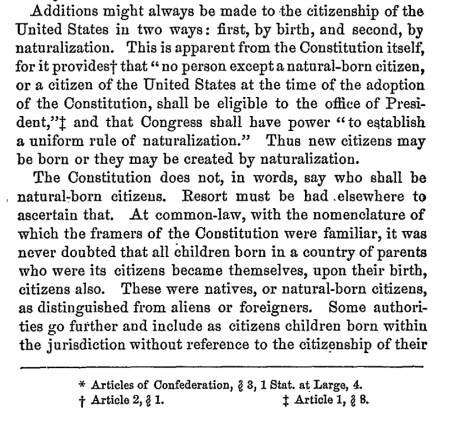
“The Constitution does not, in words, say who shall be natural-born citizens. Resort must be had elsewhere to ascertain that. At common-law, with the nomenclature of which the framers of the Constitution were familiar, it was never doubted that all children born in a country of parents who were its citizens became themselves, upon their birth, citizens also. These were natives, or natural-born citizens, as distinguished from aliens or foreigners. Some authorities go further and include as citizens children born within the jurisdiction without reference to the citizenship of their parents. As to this class there have been doubts, but never as to the first.” (Emphasis and bolding added)
The unambiguous import of the Court’s words is clear: if a child was born to two U.S. citizen parents within the jurisdiction, the child was an nbC. If the child was born to parents other than both being U.S. citizens, there were “doubts” as to the child’s status as a “citizen,” whether “natural born” or not.
If the Founders had the objective of erecting in their new Constitution a 100% impenetrable barrier – rather than a 50%, or a 75% barrier or even a 99% barrier – against the insinuation into the presidency of “foreign influence” as warned by Hamilton in Federalist 68 and repeated by Justice Story in his treatise, is it more likely that they would have selected: (a) a high barrier requiring both birth “in” the nation (jus soli) coupled with the requirement that the birth be to two parents who were already its citizens (jus sanguinis) as known from § 212 and as to which barrier there have never been any doubts, as noted in Minor; or (b) a lower barrier not requiring birth “in” the nation and without regard to whether one, both or neither of the parents were citizens and as to which “there have been doubts”? This is not a difficult question.
Moreover, the fact that the Minor decision was abrogated, but not overruled, by the 19th Amendment – after being allowed to remain “the law” for 45 years until 1920 regarding the issue of women’s’ suffrage rights – has zero effect on the Court’s recognition that the Founders understood the term “natural born” to be that articulated in § 212, and had “no doubts” about it, instead of a definition like the C&K theory, as to which there “have been doubts.”
That recognition remains the same today as it was in 1875. And even if, as “de Vattel Deniers” claim, the recognition is deemed to be “dictum,” it is judicial dictum binding on lower courts to this day rather than obiter dictum having no precedential weight. In addition, it is manifestly counter-intuitive to posit that the Founders would have intended to adopt a definition of an nbC which was burdened with “doubts” when the de Vattel § 212 definition, bereft of any such doubts, was available.
The C&K theory espousing that place of birth is a mere “happenstance” rather than a “requirement” and that only one parent need be a U.S. citizen at the time of birth runs counter to all historical evidence that the Founders would have purportedly adopted that theory. Instead, all historical evidence points to the Founders’ acceptance and adoption of the nbC definition found in § 212 requiring as a sine qua non of the definition a birth to “parens citoyens” (emphasis added), or in English: “citizen parents.” For the grammatically impaired: “parents” denotes more than one.
CONCLUSION

There is no historical evidence or logical argument that the Founders, many of whom served in the First Congress, harbored a “one-U.S.-citizen-parent-is-good-enough-for-the-presidency” theory to define an nbC for purposes of Art. 2, § 1, Cl. 5. In point of fact, there is abundant evidence that they favored, and thus adopted, the more restrictive, de Vattel § 212 definition of an nbC, including its “two-citizen-parents” requirement.
On the other hand, if competent contrary historical or logical evidence exists, your humble servant would be pleased to receive it, as it may assist in resolving these questions which the Supreme Court persists in “evading.”
Distilled to its essence, the “two-citizen-parents” requirement embedded in the de Vattel § 212 definition presents a much higher – and thus preferred – barrier to the potential for insinuation of foreign influence into the presidency than does the C&K “one-citizen-parent” (birthplace aside) alternative. The contention that the Founders would have intentionally adopted the lower, inferior definition is, to state the matter politely, unsupported and, respectfully, intellectually unsupportable.
natural
born
Citizen
not U.S. citizen alone
not born-in-U.S.A.-citizen alone
natural, not naturalized, not rescinded citizenship(s), not amnesty U.S. citizen, not dual citizen, etc. because those are man-decreed-U.S.-citizens, rather, “natural”, as in a 100% nature’s-laws-U.S.- citizen with no need for any man-laws to “naturalize away” any inherited, parent-derived foreign-citizenship(s) with their attendant foreign allegiances, obligations, traditions, preferences, foreign jurisdictions, etc.
100%-sole-nature’s-laws-U.S.-citizen with 0% additive man-made-citizenship-laws.
Like 100% natural Florida orange juice with no man-made additives or preservatives = squeezed fresh oranges-juice placed directly into a clean see-thru container
So, New York State Board of Elections and other defiant non-compliant nbC-DENIER-ATTORNEY-CRIMINALS can keep relying on lying, with their wise guys’ wise guise of authenticity, to no avail, because “100% natural” is an insurmountable obstacle for them, being that “natural” law is 100% irrespective of the flimsy, repealable, contemporary, imaginary, criminally-ignorable laws of man.
To criminally alter “natural born Citizen” to “Born a citizen” is an exclusive laws-of-man-decree without the non-negotiable forever laws of Nature even considered, and that is 100% contrary to what the Founding Fathers intended 1787 -TODAY!
https://www.thepostemail.com/2024/02/14/ny-governor-replies-to-laity-on-election-boards-intransigence/
Demand the US Supreme Court and US Congress review Article ll Section 1 Clause 5 of the US Constitution . US Supreme Court case Minor V Happersett , Court found Unanimously that a Natural Born Citizen is one born in the United States to PARENTS who are both US Citizens themselves ! This court reaffirmed that Page 12 7 Unanimously decided definition of what a “Natural – Born Citizen ” is in US V Wong Kim Ark !
I believe that at the time our Founders discussed this issue they were focused on protecting this new country from ever being stolen from them. It is unfortunate that we as a country would be trying to degrade their clear intention. This issue has been argued many times and especially during a presidential election. Why will the Supreme Court not pick up this issue? I have had this discussion with a family member and we are in total disagreement. My belief is a nb citizen is one born to two American citizens.I wish I could go back for a day and had the opportunity to listen and speak to our Founders. Naturalized, NB, born to one American Citizen parent, born abroad to two American Citizens the discussion is always discussed at the time of an election. At the time of a Presidential election it depends on what party and who they are running for the highest office of the country and what their beliefs are to suit their agender.
Presuming–as is only reasonable, given the huge volume and many vectors through which it may be understood–that Barry’s Hawai’i Long Form Birth Certificate (LFBC) is forged, fraudulent, and invalid through delay and subsequent alteration of birth data, the Hawai’i Administrative Rules and Revised Statutes make clear that that document (presented to the public 4/27/2011) may not be used FOR ANY LEGAL PURPOSE.
Substantiation of the US Constitutional requirements for its presidents has therefore not been met for the person now commonly known as “Barack Hussein Obama, II.”
Tim Adams’ affidavit, The Hawai’i Democratic Party’s declining to certify Barry’s Constitutional qualification, a belated, hasty attempt by Nancy Pelosi attest in unsupported fashion to those qualifications to the Hawai’ian government–in light of no Hawai’ian hospital birth record as was claimed by 2008, alongside Pelosi’s insufficient certification to all other 49 states “reflect the true tale” of Barry’s lack of being properly qualified.
No one may reasonably or legally rely on the data printed on what C_A asset “Loretta Fuddy” was “successfully” tasked to procure after Governor Abercrombie confessed to not being able to find after looking high and low through the Hawai’i Department of Health (HDOH) and State Archive records, despite the previous HDOH Director having said that she had held that document. At the time, she said it was “half typed and half handwritten.” Those are also features that don’t comport with the layered PDF document that legal courier Judith Corley and her mentor, then-White House Counsel brought forth publicly on 4/27/2011.
Fuddy’s attempt to produce three requested verifications of Barry’s LFBC in 2012 all resulted in invalid Verification documents, as well.
Even at this late date, it can easily be proved through a double-blind DNA test that Barry’s LFBC is a fraud, inasmuch as Stanley Ann Dunham was not his birth mother and his belated (at ~19 years of age) male name donor and supposed biodad, BHO, Sr., was not his birth father. These facts, I’m told, have long ago been verified by comparison of Malik Obama, Maya Soetoro Ng and Barry’s DNA for familiar closeness. There is reportedly no close, familial relationship.
That C_A “Fuddy” was given a faked death and a fat pension for her Estate is yet another intel community fingerprint of a “job well done,” despite so many indicia of forgery.
Circling back, the endlessly-discussed minutiae of whether a two citizen parent situation applies (or WOULD BE REQUIRED for a situation not demonstrated) or whether a single, 18-year old American mother and and admittedly British Protectorate subject, claimed-to-be biodad are sufficient to be result in a legally natural born citizen is quite moot when who his parents really are is a complete unknown. That owes to many false and fraudulent document representations that have been made about whoever those biological parents might actually have been.
Other than the official US Passport that was administratively made for newly-minted US Senator Barack Hussein Obama II in 2008 through the agency of State Department contractor, John O. Brennan, President of Analysis Corp. at the time, one is actually left with a complete dearth of sufficient, confirmed, valid evidence that would show that Barry is ANY KIND of American Citizen.
Author – “if competent contrary historical or logical evidence exists, your humble servant would be pleased to receive it”
William Rawle:
“Therefore every person born within the United States, its territories or districts, whether the parents are citizens or aliens, is a natural born citizen in the sense of the Constitution, and entitled to all the rights and privileges appertaining to that capacity. It is an error to suppose, as some (and even so great a mind as Locke) have done, that a child is born a citizen of no country and subject of no government, and that he so continues till the age of discretion, when he is at liberty to put himself under what government he pleases. How far the adult possesses this power will hereafter be considered, but surely it would be unjust both to the state and to the infant, to withhold the quality of the citizen until those years of discretion were attained. Under our Constitution the question is settled by its express language, and when we are informed that, excepting those who were citizens, (however the capacity was acquired,) at the time the Constitution was adopted, no person is eligible to the office of president unless he is a natural born citizen, the principle that the place of birth creates the relative quality is established as to us.”
https://press-pubs.uchicago.edu/founders/print_documents/a1_8_4_citizenships23.html
We’ve already heard this.
From the author:
————————–
The intrepid P&E Editor correctly notes that the commenter is offering up old narrative…, and unlike wine, it has not improved with age.
The commenter ignores the condition of the invitation: “if competent contrary historical or logical evidence exists, your humble servant would be pleased to receive it” (Emphasis added).
The citation by the commenter to William Rawle’s 1829 book underscores the incompetent nature of Rawle’s claim regarding the meaning of the term “natural born Citizen (“nbC”) in the Constitution.
William Rawle was an American lawyer from Philadelphia who served as United States district attorney in Pennsylvania from 1791 to 1800. He was not a delegate at the Constitutional Convention, nor did he ever serve in Congress, but he is credited with founding in Philadelphia the oldest remaining law firm in America.
Those facts aside, in his book A View of the Constitution of the United States, Rawle asserts: “Therefore every person born within the United States, its territories or districts, whether the parents are citizens or aliens, is a natural born citizen in the sense of the Constitution.” (Emphasis added)
Really? Every person?
Rawle’s blanket, unqualified assertion that “every person” born within the United States, its “territories” or “districts,” regardless of parental citizenship, is eligible to the presidency is absurd, as it would thus include numerous persons that even crazed OBOTS and lawyers at the Congressional Research Service would reject.
Specifically, such an “every person” would presumably include the children of foreign nation diplomats as well as the children of those offspring. Rawle’s blanket nbC concept would also deem as eligible the children of officers and soldiers of any hostile invading army, even if the child were the result of rape. In addition, an Iranian mullah’s child born in Dearborn, Michigan would be eligible. Does the commenter really believe that this would be a result intended by the Founders?
Rawle may have founded the “oldest remaining law firm” in America, but the notion that the Founders would have agreed with Rawle’s blanket definition is, respectfully, both fatuous and ill-reasoned.
Joe Leland has been told before that William Rawle’s thoughts and opinions published circa 1831 in his guide stating that simply being born in the USA was all that was needed to be a “natural born Citizen” of the new United States was not generally accepted and was not endorsed by any of the key founders and framers when Rawle was actively arguing his position in the 1817 time frame. Yet Leland continues to spew his disinformation deception by omission of that fact here.
The arguments proffered by William Rawle, a Pennsylvania attorney, regarding who is a “natural born Citizen” were totally rejected by the Pennsylvania Supreme Court in his arguments before them. The PA Supreme Court instead cited Emer de Vattel’s definition in their decision as to who is a “natural born Citizen”. See pages 18-27 of this report and in particular footnote 12 on page 26: “A-Digest-of-Select-British-Statutes-Still-in-Force-in-PA+in-1817-by-Samuel-Roberts” at this link: http://www.kerchner.com/protectourliberty/A-Digest-of-Select-British-Statutes-Still-in-Force-in-PA+in-1817-by-Samuel-Roberts.pdf
CDR Charles Kerchner (Ret)
Lehigh Valley PA USA
http://www.ProtectOurLiberty.org
Do you have a citation for that Pennsylvania Supreme Court case that defined natural born citizen?
Lew:
See the link in my comment – in the last paragraph. Everything you seek is therein. Read that 1817 report from the PA Supreme Court to the PA State Legislature. Here it is again:
“The PA Supreme Court instead cited Emer de Vattel’s definition in their decision as to who is a “natural born Citizen”. See pages 18-27 of this report and in particular footnote 12 on page 26: “A-Digest-of-Select-British-Statutes-Still-in-Force-in-PA+in-1817-by-Samuel-Roberts” at this link: http://www.kerchner.com/protectourliberty/A-Digest-of-Select-British-Statutes-Still-in-Force-in-PA+in-1817-by-Samuel-Roberts.pdf ”
Download that PDF copy of the full 1817 report and then see the pages numbered in the document 18-27, especially page numbered 26 and footnote 12 on that page.
CDR Kerchner said “See the link in my comment – in the last paragraph. Everything you seek is therein.”
I read the entire piece on aliens from page 19 through page 28 including footnotes. There are two Pennsylvania Supreme Court cases cited:
Collet v Collet, 2 US 294 (1792)
https://supreme.justia.com/cases/federal/us/2/294/
Jackson v. Burns, 3 Binney 75 (Pa 1810) has described on page 376.
https://www.google.com/books/edition/Laws_of_the_Commonwealth_of_Pennsylvania/Ia84AQAAMAAJ?hl=en&gbpv=1&bsq=Binney%2075
Neither involves people born in the US and the questions were about whether they were naturalized (Collet) or could inherit (Jackson). Neither discusses natural born citizenship.
The chapter mostly discusses English laws (25 Edward III STAT. 2. A.D.1350; 11 & 12 William III CAP 6. A.D. 1700; and 7 Anne CHAP. 5. A.D. 1708) all of which appear to be naturalization acts. The last one 7 Anne CHAP 5 does mention natural born subjects.
Could you check on your source for the Pennsylvania Supreme Court case that defines natural born citizen?
If everyone is a natural born Citizen according to your bible, why does Congress refuse to include the adjective words “natural” and “born” to the word “citizen” where applicable into the US citizen laws?
It’s all about singular loyalty to the United States and if one just looks at the actions of the founders it’s crystal clear. They exempted people at the founding for the founders new it would take a generation to start creating Natural Born Citizens.
A lot of people are not aware of rules that US dual citizens are required to follow that are still in play today. Those rule state that dual citizens owe allegiance to both nations to which they hold citizenship and are subject to the jurisdiction of both nations laws to which they have citizenship, does that sound like something the founders would have been good with?
it actually sounds like the very thing they were afraid of we know this because of John Jay’s letter to George Washington.
Dual citizens aren’t Natural Born Citizen and unless both of one’s parents are US citizens that child is going to have dual citizenship.