
by Joseph DeMaio, ©2024
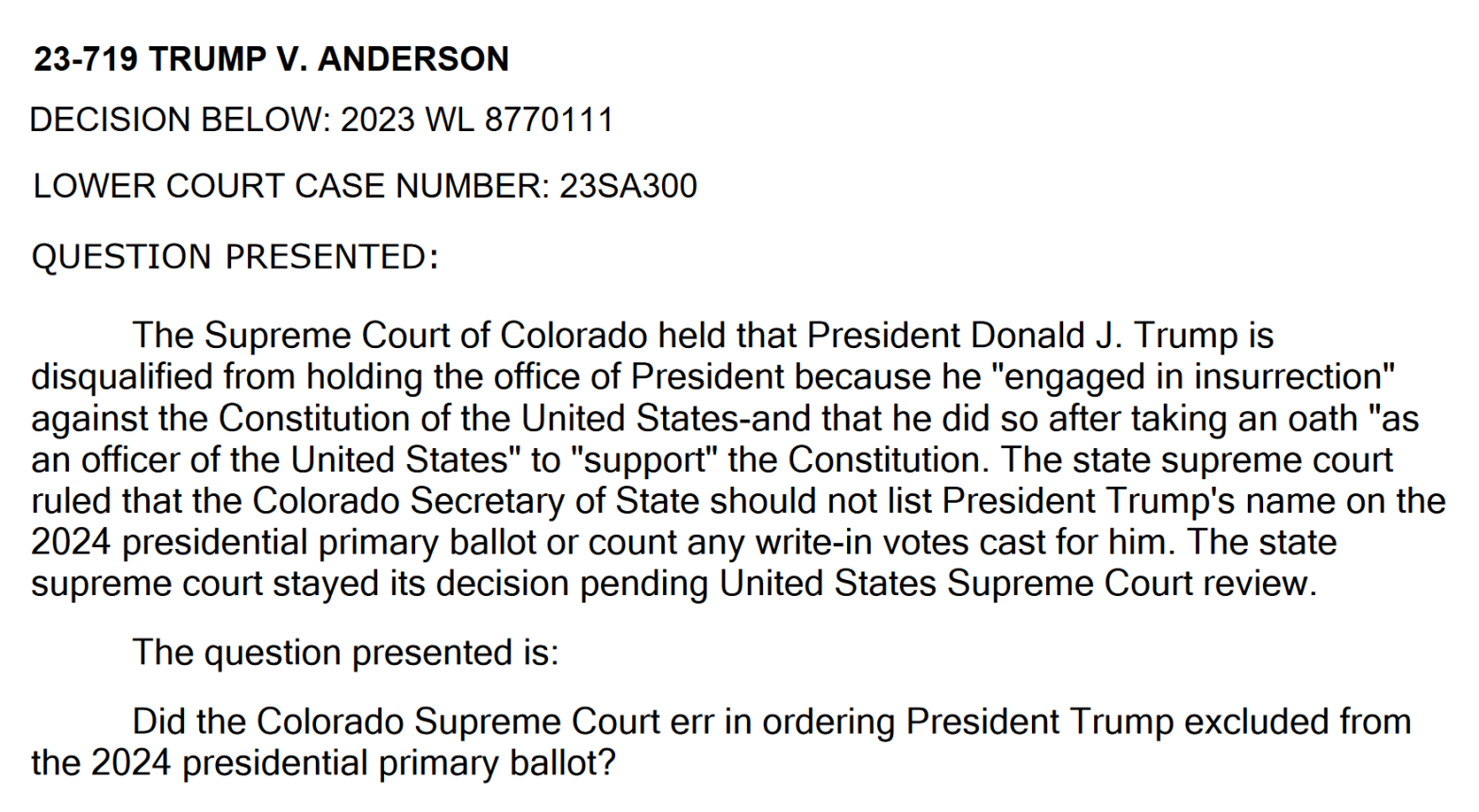
(Feb. 9, 2024) — Well, oral arguments have been heard in the Supreme Court in the case of Trump v. Anderson (USSC Doc. 23-719). The case addresses the question of whether President Trump can be excluded from the primary election ballot in Colorado on the claim that Clause 3 of the 14th Amendment (the “Insurrectionist Clause”) disqualifies and precludes him from serving as president in the future as held by the Colorado Supreme Court and addressed here and here. The oral arguments were interesting and a decision of the Court is expected soon.
However, as pointed out here, perhaps one of the more significant and relevant issues that came up at the oral arguments were the discussions by the attorneys and questions from the Justices regarding – faithful P&E readers knew this was coming – the natural born Citizen (“nbC”) issue. For those interested, the transcript of the oral arguments can be found here and will hereafter be referenced as “O/A transcript, p. __.”
None of the exchanges between the Justices and the attorneys resulted in a “universe shattering” or “aha!” revelation that, in fact, the nbC argument that your humble servant, along with many others here at The P&E have been offering for years, is either correct or incorrect.
On the other hand, there were certain anecdotal “hints” about where certain of the Justices might presently sit on the nbC issue. Candidly, they are not in your humble servant’s view particularly encouraging…, but if he is wrong in that evaluation, it would not be the first time.
The relevance of the exchanges on the nbC issue during the Anderson oral arguments lies in the fact that, as with Clause 3 of the 14th Amendment – the “Insurrectionist Clause” being deployed by Colorado to preclude President Trump from again serving as president – the “Eligibility Clause” of the Constitution precludes any person other than an nbC from serving as president.
While not directly controlling, the forthcoming decision of the Court in Anderson could well preview what a similar decision might be in an nbC case actually brought before the Court…, or maybe not. It is usually risky to predict with any certainty how the Court will actually rule in any particular case. One “reads the tea leaves” of the oral argument for any insight into final Supreme Court rulings at one’s own peril, particularly in polarized times such as at present.
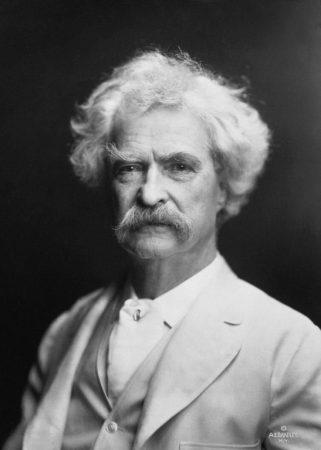

Mark Twain wisely noted that words are important and precision in language is critical, stating: “The difference between the almost right word & the right word is really a large matter – it’s the difference between the lightning bug and the lightning.” His observation takes on even greater importance when the words are uttered by Supreme Court Justices. And the words uttered in the Trump v. Anderson case may give some small hint as to why the Court has not, as yet, squarely addressed the nbC issue, apart from its “radioactive” nature.

The final written decision in the Anderson case, of course, may give additional hints, but for now, the following points are offered for consideration against the backdrop of the “tea leaves” caveat already noted.
To begin with, several of the Justices carelessly referred to the nbC definitional restriction as a “qualification” provision. Observing Twain’s advice, and with respectful deference to the Justices, the better term is “eligibility.” A person may be well-qualified for a task or calling, but yet be ineligible.
As but one example, there are probably many naturalized U.S. citizens who by virtue of intelligence, character and reverence for the Constitution are more than well “qualified” to be president, particularly as contrasted with the current one. Yet they are still “ineligible” by virtue of the restrictive language of Art. 2, § 1, Cl. 5 of the Constitution, a fact already confirmed by the Supreme Court itself in Schneider v. Rusk, 377 U.S. 163, 165 (1964).
There, the Court stated: “We start from the premise that the rights of citizenship of the native born and of the naturalized person are of the same dignity, and are coextensive. The only difference drawn by the Constitution is that only the ‘natural born’ citizen is eligible to be President.” (Emphasis added)
Importantly as well, the Rusk Court correctly avoided use of the term “citizenship” when referring to that restrictive category of persons “eligible” to the presidency: those persons are both “native-born” and constitute “natural born citizens,” but the term “natural born citizenship” appears nowhere in the Constitution; nowhere in the 27 Amendments to the Constitution; and nowhere in any Supreme Court decision. In short, it is a concocted neologism without meaning or purpose – other than obfuscation and deception – in any serious analysis of the nbC issue.
And yet in the Anderson oral argument, Justice Sotomayor references (O/A transcript, p. 23) “other qualifications” in the Constitution bearing upon one’s presidential eligibility, including age and “citizenship.” Again, while her words may be imprecisely chosen, it is clear that she was referring to Art. 2, § 1, Cl. 5 and the “nbC” eligibility definitional restriction.
Recall that while all natural-born citizens are also native-born “citizens” and both enjoy United States “citizenship” under the 14th Amendment, not all native-born citizens meet the definitional restrictions placed by the founders on those who would be president, i.e., the “natural born Citizen.” See Schneider v. Rusk.
As consistently posited by your humble servant, the Founders manifested a clear intent to adopt the highly restrictive definition of an nbC provided by § 212, Book 1, Ch. 19 of the 1758 legal treatise by Swiss jurist, lawyer and scholar Emer de Vattel, “The Law of Nations.” That treatise, in both French and English, was available to the Founders as they drafted the Constitution, including the Eligibility Clause.
The de Vattel § 212 definition – a person born in a country to two parents who were already citizens of that country – presents a much higher barrier to the potential for insinuation of “foreign influence” into the presidency than the lower barrier of the 14th Amendment “citizen at/by birth” narrative currently in vogue, including perhaps in Justice Sotomayor’s mind. One problematic and unfortunate conclusion to be possibly drawn from her imprecise language during oral argument is that she may already believe that mere 14th Amendment “citizenship” suffices to deem one a “natural born Citizen” for presidential purposes. Not good. Bad.
That belief is akin to the default narrative “close enough for government work” and as purportedly “settled” by the decision in United States v. Wong Kim Ark (“WKA).” Respectfully, if that is her belief, your servant posits that she is wrong.
Parenthetically, and respectfully as well, she was also wrong when she misstated (O/A transcript, p. 23) that the 22nd Amendment “doesn’t permit anyone to run for a second term.” (emphasis added) In fact, that amendment precludes a person from being “elected” more than twice – rather than “running” more than twice – thus prohibiting the person from “serving” as president for a third term. As noted by Twain, words are important, a reality particularly true when they are used carelessly by Supreme Court Justices.
But Justice Sotomayor was not the only jurist utilizing less-than-precise language to describe the nbC personage. Justice Gorsuch, in addressing whether a state could remove or ignore certain requirements from those listed in the Eligibility Clause, Art. 2, § 1, Cl. 5, referred (O/A transcript, p. 82) to “age and citizenship.”
Justice Gorsuch, in questioning the attorney for the Colorado parties, stated (id.): “Nobody’s talking about whether he’s [i.e., Trump] 35 years old or a natural born, whatever, right, not at issue, okay.” (Emphasis added). Again, clearly when Justice Gorsuch was referencing a “whatever,” he was referring to a “natural born Citizen” as set out in the Eligibility Clause. As with Justice Sotomayor, Justice Gorsuch was plainly referring to the Eligibility Clause and the “nbC” restriction, again, there being no “natural born citizenship” neologism in that clause or, for that matter, anywhere else in the Constitution.

Justice Gorsuch also refers (O/A Transcript, p. 79) to the requirements set out in Art. 2, § 1, Cl. 5 as elements of the “Qualifications Clause.” Again, the preferred nomenclature would be the “Eligibility Clause,” because that is what it is, and certainly not a “Natural Born Citizenship” provision as deceptively labeled by the Congressional Research Service (“CRS”) in its 2016 report R42097-2016. That CRS “product” is woefully mislabeled as “Qualifications for President and the ‘Natural Born’ Citizenship Eligibility Requirement” and is dissected here.
But again, I digress.
As with Justice Sotomayor, Justice Gorsuch’s use of the term “citizenship” might also be interpreted as “hinting” that he too believes that all that is needed to satisfy the Constitution’s nbC restriction is that one be possessed of U.S. “citizenship” under the 14th Amendment consistent with the Court’s flawed decision in the WKA case. Again, with due respect, if that is his belief, your servant posits that he is wrong as well.
Accordingly, the oral arguments in the Anderson case reveal several anecdotal “hints” or “suggestions” that at least Justices Sotomayor and Gorsuch may already think that the nbC issue is controlled by WKA and that the “citizen at/by birth” standard narrative is “close enough for government work.”
That said, it should be noted that in responding to a question from Justice Alito, one of the attorneys for the Colorado parties commented on the differing criteria used by different states in determining ballot access to candidates. The lawyer stated (O/A transcript, p. 134): “Just this election, there’s a candidate who Colorado excluded from the primary ballot, who is on the ballot in other states even though he is not a natural-born citizen. And that’s just – that’s a feature of our process. It’s not a bug.” (Emphasis added)
Well, if it is not a “bug” in the sense that Mark Twain would think of “bugs,” it could be a problem on two fronts: (1) if State “A” determined to exclude Kamala Harris from the ballot because she is likely not an nbC, as frequently noted by your servant here at The P&E, but State “B” determined to keep her on in the belief that she was an nbC…, the nationwide inconsistencies and wholesale voter disenfranchisements which Justice Alito feared could result would be wide and chaotic; and (2) the nbC constitutional eligibility question would remain unresolved. Not a great outcome.

Stated otherwise, the present situation is a bug – whether a cockroach or a ladybug is yet to be determined – and the time fast approaches when the “Supreme Court Pest Control” service must be called…, and that outfit must respond. Some indication of how it will respond may be gleaned after the Anderson decision is handed down.
Interesting times…, no?
Comments
10 responses to “The USSC Oral Arguments in “Trump v. Anderson””
3/3
in his 1916 book “Fear God and Take Your Own Part” former President Roosevelt wrote about the case of Mr. P. A. LeLong. LeLong was born in New Orleans to an alien father (a French citizen) and a US citizen mother. Mr. le Long wished to travel to France was afraid he could be drafted into the French military. In commenting on the case, President Roosevelt described Mr. LeLong as having been “born in this country”, served in the US military and being “eligible to the Presidency of the United States.” (Page 291)
https://www.google.com/books/edition/Fear_God_and_Take_Your_Own_Part/-REFAAAAMAAJ?hl=en&gbpv=1&bsq=lelong
It would appear then that the US Solicitor General, Chief Justice Fuller, William Dameron Guthrie, Alexander Porter Morse and Theodore Roosevelt all viewed the majority decision in the Wong Kim Ark case as making Wong a natural born citizen.
And apparently the current Justices of the SCOTUS and a number of lower court judges agree with them.
2/3
Alexander Porter Morse was prominent 19th century lawyer who in 1881 wrote a famous treatise on citizenship – “A Treatise on Citizenship, by Birth and by Naturalization”
In the treatise, Morse supported the Vattel definition of citizenship (“§7. Under view of the law of nations, natives or natural-born citizens, are those born in the country, of parents who are citizens”) while recognizing that in the United States the 14th Amendment was law (“§5. In the law of nations, ‘citizen’ is a term applicable to every member of the civil society. …This character is acquired in various ways, according to the laws of each state. In many states birth is sufficient to confer it; so that the child of an alien is a citizen from the fact of having been born within the territorial limits and jurisdiction.²”). His footnote 2 says “It is so in England and the United States [but the births must be within the jurisdiction]”
https://www.google.com/books/edition/A_Treatise_on_Citizenship/GijrAAAAMAAJ?hl=en&gbpv=1&bsq=vattel
Several years after the WKA decision, Morse commented on the case,
“Under decision of the Supreme Court of the United States, a child of domiciled Chinese parents, if born in the United States, would seem to be eligible to the office of President and to all the privileges of the Constitution, while the child of American parents and grandparents, born on shipboard or in foreign territory in travel or transit, might be excluded from similar rights and privileges.”
“A natural-born citizen has been defined as one whose citizenship is established by the jurisdiction which the United States already has over the parents of the child, not what is thereafter acquired by choice of residence in this country.”
“The conclusion is, that the child of citizens of the United States, wherever born, is “a natural-born citizen of the United States,” and, as such, if possessed of the other qualifications, would be eligible for the office of President of the United States.” 1903, The Washington Law Reporter Volume 31.
https://books.google.com/books?id=_cUZAAAAYAAJ&pg=PA823&dq=natural-born+subject+citizen&hl=en&sa=X&ei=_JQxVbrrNoTuoASumoDQBw&ved=0CFsQ6AEwCQ#v=onepage&q&f=false
Ms Rondeau – “Links?”
Trying this again.
In 1895 the Supreme Court ruled in the case of Pollock v. Farmers’ Loan & Trust Co., 157 U.S. 429 (1895) on the question of whether income taxes were constitutional. Chief Justice Fuller wrote the majority opinion in favor of the appellant Charles Pollock. Arguing for the appellant was a group of prominent 19th century lawyers including William Dameron Guthrie.
https://supreme.justia.com/cases/federal/us/158/601/
In May 1898, William Guthrie gave a lecture on the 14th Amendment. In that lecture, he discussed the Wong Kim Ark decision.
“This decision [Elk v Wilkins] left in uncertainty the legal status of all others born in the United States of alien parentage. Was their citizenship to be determined by the common-law principle of locality of birth, or was the rule of the civil law as to allegiance of the parents to control? This question was not settled until a few weeks ago, thirty years after the amendment was adopted, thus showing how slowly constitutional law develops in the life of a nation. The common-law rule has been finally affirmed by the Supreme Court in the recent case of the United States v Wong Kim Ark. The Supreme Court held that a child born in the this country of Chinese parents domiciled here is a citizen of the United States by virtue of the locality of his birth. The whole subject is discussed at length in the opinions in this case. The effect of this decision is to make citizens of the United States by virtue of the Fourteen Amendment all persons born in the United States of alien parents permanently domiciled and residing here, except the children of the diplomatic representatives of foreign powers; and, therefore, a male child born here of Chinese subjects is now eligible to the office of President, although his parents could not be naturalized under our laws.” on Page 57
https://www.google.com/books/edition/Lectures_on_the_Fourteenth_Article_of_Am/4sUlAAAAMAAJ?hl=en&gbpv=1&bsq=wong%20kim
BTW in Pollock v. Farmers’ Loan & Trust Company, Chief Justice Fuller cites this passage from Alexander Hamilton
“Where so important a distinction in the Constitution is to be realized, it is fair to seek the meaning of terms in the statutory language of that country from which our jurisprudence is derived.”
1/3
Author – “Moreover, all of the other “dozen recent lower court judges” the commenter references did not rule on the nbC status of Obama. Instead, the challenges to his claimed nbC status were virtually always dismissed for lack of “standing” in the challengers.”
Here is a list of court decisions that decided Obama’s eligibility based on his being a natural born citizen (first two pages).
https://tesibria.typepad.com/whats_your_evidence/BIRTHER%20STRING%20CITE.pdf
Author – “The only lower court judicial appellate “case” to have thus far so concluded was the deeply-flawed decision of the 5th District Indiana Court of Appeals (3 judges) in Ankeny v. Governor of Indiana”
A second example is the case of Tisdale v Obama. Judge Gibney wrote, “It is well settled that those born in the United States are considered natural born citizens. (citing WKA and Perkins v Elg).”
The United States Court of Appeals for the Fourth Circuit denied Tisdale’s appeal writing, “We have reviewed the record and find no reversible error. Accordingly, we affirm for the reasons stated by the district court. Tisdale v. Obama, No. 3:12-cv-00036-JAG (E.D. Va. Jan. 23, 2012).”
The appeals court had no reason to write a further opinion they based their decision on the “reasons stated” by Judge Gibney.
Author – “The only lower court judicial appellate “case” to have thus far so concluded was the deeply-flawed decision of the 5th District Indiana Court of Appeals (3 judges) in Ankeny v. Governor of Indiana”
Yes, the Indiana Court of Appeals is the only appeals court to write their own opinion discussing the meaning of the term natural born citizen. Other appeals courts simply relied on the opinions written by the lower court judges.
For example in Purpura v Obama in New Jersey, Administrative Law Judge Masin after reviewing both US v Wong Kim Ark and Ankeny v Governor of Indiana wrote, “The petitioners’ legal position on this issue, however well intentioned, has no merit in law. Thus, accepting for the point of this issue that Mr. Obama was born in Hawaii, he is a ‘natural born Citizen’ regardless of the status of his father.”
https://www.scribd.com/doc/88936737/2012-04-10-NJ-Purpura-Moran-v-Obama-Initial-Decision-of-ALJ-Masin-Apuzzo
The New Jersey Superior Court Appellate Division affirmed ALJ Masin’s opinion writing,
“In addition, appellants claim that the ALJ and the Secretary erred in finding that President Obama was born in Hawaii and that he is a ‘natural born citizen.’”
“We have carefully considered appellants’ arguments and conclude that these arguments are without merit. R. 2:11-3(e)(1)(E). We affirm substantially for the reasons set forth in ALJ Jeff S. Masin’s thorough and thoughtful written opinion of April 10, 2012, as adopted by the Secretary on April 12, 2012.”
https://law.justia.com/cases/new-jersey/appellate-division-unpublished/2012/a4478-11.html
New Jersey rule R. 2:11-3(e)(1)(E) reads “(E) that some or all of the arguments made are without sufficient merit to warrant discussion in a written opinion;
then and in any such case the judgment or order under appeal may be affirmed without opinion and by an order quoting the applicable paragraph of this rule.”
https://casetext.com/rule/new-jersey-rules-of-court/new-jersey-rules-of-court/njr-ct-part-ii/part-ii-rules-governing-practice-in-the-supreme-court-and-appellate-division-of-the-superior-court/rule-211-argument-determination-costs-rehearing
Under that rule, the appeals court does not have to write an opinion as the case is without merit especially given ALJ Masin’s “thorough and thoughtful written opinion.”
Purpura appealed to the New Jersey Supreme Court. Sending them a reply letter that outlined their natural born citizen arguments.
https://www.scribd.com/document/102405635/Purpura-Moran-Reply-Letter-Brief-to-NJ-Supreme-Ct-FILED-8-8-12
The SCONJ denied the petition after considering it.
https://www.scribd.com/document/105512594/2012-09-07-NJ-Purpura-Moran-v-Obama-ORDER-Denying-Petition-for-Certification-to-NJSC
You can view the oral arguments in the appeals court here:
Author – “the oral arguments …Justices Sotomayor and Gorsuch may already think that the nbC issue is controlled by WKA”
It would put them in the company of about a dozen recent lower court judges who ruled that President Obama was a natural born citizen. In almost every case they relied on US v Wong Kim Ark as precedent.
The Justices’ understanding of the Wong Kim Ark would also agrees with the understanding of late 19th century legal scholars. For example both the US government’s appellant brief and Chief Justice Fuller’s dissenting opinion (notwithstanding the author’s interpretation of CJ Fuller’s opinion). And also the opinions of several prominent 19th century legal professionals.
Links?
I tried posting a longer comment with links.
There appears to be an unknown word limit to comments.
From the author:
—————-
Commenter Leland is back, claiming that Justices Sotomayor and Gorsuch in the Trump v. Anderson case may be in the same camp of “about a dozen recent lower court judges who ruled that President Obama was a natural born citizen. In almost every case they relied on US v Wong Kim Ark as precedent.”
Really?
The only lower court judicial appellate “case” to have thus far so concluded was the deeply-flawed decision of the 5th District Indiana Court of Appeals (3 judges) in Ankeny v. Governor of Indiana (Ankeny v. Governor of State of Indiana, 916 N.E.2d 678 | Casetext Search + Citator).
The commenter ignores, of course, the dissection of the equally-flawed Wong Kim Ark (“WKA”) and Ankeny decisions found here (Of Presidential Eligibility, Doubling Down and Linguistic Torts, Part 3 – The Post & Email (thepostemail.com)). The contention that WKA constitutes “precedent” on the natural born Citizen (“nbC”) issue and thus purportedly “settles” it is, respectfully, both wrong and absurd on its face.
Moreover, all of the other “dozen recent lower court judges” the commenter references did not rule on the nbC status of Obama. Instead, the challenges to his claimed nbC status were virtually always dismissed for lack of “standing” in the challengers. And where “even if” standing questions were ignored, direct pontifications on the nbC issue, as happened in Ankeny, are obiter dictum. Pure and simple.
A dismissal of a case for lack of standing is not a decision on the merits and is not controlling precedent. Furthermore, obiter dictum on the nbC issue strewn throughout and littering the WKA majority decision, as well as other cases where the nbC issue was mentioned in passing, does not count as controlling precedent. Full stop.
If the commenter (or anyone else) has the courage to learn how a unanimous Supreme Court – unlike the split-decision Court in WKA – has treated the nbC issue on the merits, read Minor v. Happersett (MINOR v. HAPPERSETT. | Supreme Court | US Law | LII / Legal Information Institute (cornell.edu)) at pp. 167-168 of the decision. There, one will discover what the Founders – who, unlike current-day legal soothsayers, drafted the Constitution’s presidential eligibility clause – actually understood the term to mean.
Truly, few are to be more pitied than the willfully uninformed, particularly when the condition persists indefinitely…