

(Jun. 29, 2023) — Will artificial intelligence (AI) wipe out mankind? Could it create the “perfect” lethal bioweapon to decimate the population?1,2 Might it take over our weapons,3,4 or initiate cyberattacks on critical infrastructure, such as the electric grid?5
According to a rapidly growing number of experts, any one of these, and other hellish scenarios, are entirely plausible, unless we rein in the development and deployment of AI and start putting in some safeguards.
The public also needs to temper expectations and realize that AI chatbots are still massively flawed and cannot be relied upon, no matter how “smart” they appear, or how much they berate you for doubting them.
George Orwell’s Warning
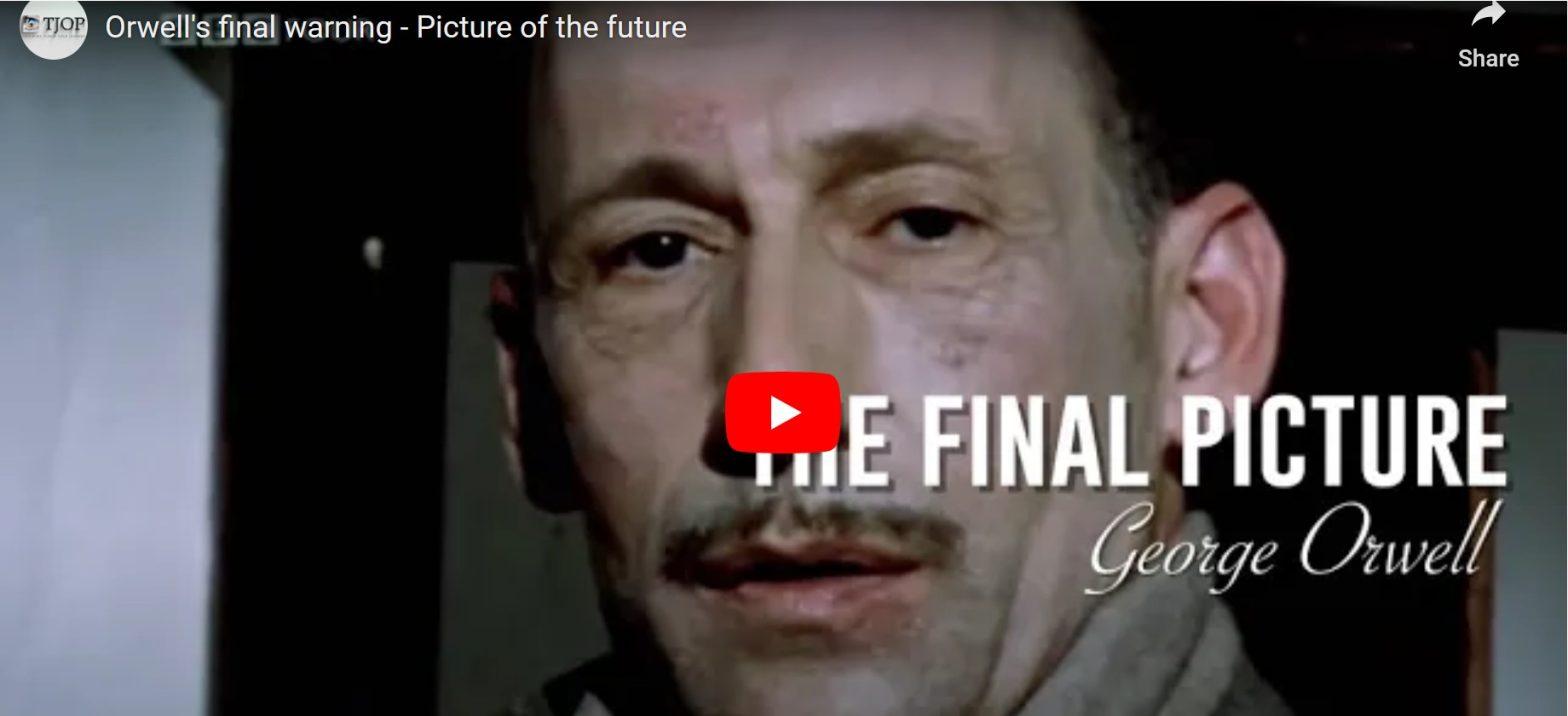
The video at the top of this article features a snippet of one of the last interviews George Orwell gave before dying, in which he stated that his book, “1984,” which he described as a parody, could well come true, as this was the direction in which the world was going.
Today, it’s clear to see that we haven’t changed course, so the probability of “1984” becoming reality is now greater than ever. According to Orwell, there is only one way to ensure his dystopian vision won’t come true, and that is by not letting it happen. “It depends on you,” he said.
As artificial general intelligence (AGI) is getting nearer by the day, so are the final puzzle pieces of the technocratic, transhumanist dream nurtured by globalists for decades. They intend to create a world in which AI controls and subjugates the masses while they alone get to reap the benefits — wealth, power and life outside the control grid — and they will get it, unless we wise up and start looking ahead.
I, like many others, believe AI can be incredibly useful. But without strong guardrails and impeccable morals to guide it, AI can easily run amok and cause tremendous, and perhaps irreversible, damage. I recommend reading the Public Citizen report to get a better grasp of what we’re facing, and what can be done about it.
Approaching the Singularity
“The singularity” is a hypothetical point in time where the growth of technology gets out of control and becomes irreversible, for better or worse. Many believe the singularity will involve AI becoming self-conscious and unmanageable by its creators, but that’s not the only way the singularity could play out.
Some believe the singularity is already here. In a June 11, 2023, New York Times article, tech reporter David Streitfeld wrote:6
“AI is Silicon Valley’s ultimate new product rollout: transcendence on demand. But there’s a dark twist. It’s as if tech companies introduced self-driving cars with the caveat that they could blow up before you got to Walmart.
‘The advent of artificial general intelligence is called the Singularity because it is so hard to predict what will happen after that,’ Elon Musk … told CNBC last month. He said he thought ‘an age of abundance’ would result but there was ‘some chance’ that it ‘destroys humanity.’
The biggest cheerleader for AI in the tech community is Sam Altman, chief executive of OpenAI, the start-up that prompted the current frenzy with its ChatGPT chatbot … But he also says Mr. Musk … might be right.
Mr. Altman signed an open letter7 last month released by the Center for AI Safety, a nonprofit organization, saying that ‘mitigating the risk of extinction from AI. should be a global priority’ that is right up there with ‘pandemics and nuclear war’ …
The innovation that feeds today’s Singularity debate is the large language model, the type of AI system that powers chatbots …
‘When you ask a question, these models interpret what it means, determine what its response should mean, then translate that back into words — if that’s not a definition of general intelligence, what is?’ said Jerry Kaplan, a longtime AI entrepreneur and the author of ‘Artificial Intelligence: What Everyone Needs to Know’ …
‘If this isn’t ‘the Singularity,’ it’s certainly a singularity: a transformative technological step that is going to broadly accelerate a whole bunch of art, science and human knowledge — and create some problems,’ he said …
In Washington, London and Brussels, lawmakers are stirring to the opportunities and problems of AI and starting to talk about regulation. Mr. Altman is on a road show, seeking to deflect early criticism and to promote OpenAI as the shepherd of the Singularity.
This includes an openness to regulation, but exactly what that would look like is fuzzy … ‘There’s no one in the government who can get it right,’ Eric Schmidt, Google’s former chief executive, said in an interview … arguing the case for AI self-regulation.”

Download this Article Before it Disappears
Generative AI Automates Wide-Ranging Harms
Having the AI industry — which includes the military-industrial complex — policing and regulating itself probably isn’t a good idea, considering profits and gaining advantages over enemies of war are primary driving factors. Both mindsets tend to put humanitarian concerns on the backburner, if they consider them at all.
In an April 2023 report8 by Public Citizen, Rick Claypool and Cheyenne Hunt warn that “rapid rush to deploy generative AI risks a wide array of automated harms.” As noted by consumer advocate Ralph Nader:9
“Claypool is not engaging in hyperbole or horrible hypotheticals concerning Chatbots controlling humanity. He is extrapolating from what is already starting to happen in almost every sector of our society …
Claypool takes you through ‘real-world harms [that] the rush to release and monetize these tools can cause — and, in many cases, is already causing’ … The various section titles of his report foreshadow the coming abuses:
‘Damaging Democracy,’ ‘Consumer Concerns’ (rip-offs and vast privacy surveillances), ‘Worsening Inequality,’ ‘Undermining Worker Rights’ (and jobs), and ‘Environmental Concerns’ (damaging the environment via their carbon footprints).
Before he gets specific, Claypool previews his conclusion: ‘Until meaningful government safeguards are in place to protect the public from the harms of generative AI, we need a pause’ …
Using its existing authority, the Federal Trade Commission, in the author’s words ‘…has already warned that generative AI tools are powerful enough to create synthetic content — plausible sounding news stories, authoritative-looking academic studies, hoax images, and deepfake videos — and that this synthetic content is becoming difficult to distinguish from authentic content.’
He adds that ‘…these tools are easy for just about anyone to use.’ Big Tech is rushing way ahead of any legal framework for AI in the quest for big profits, while pushing for self-regulation instead of the constraints imposed by the rule of law.
There is no end to the predicted disasters, both from people inside the industry and its outside critics. Destruction of livelihoods; harmful health impacts from promotion of quack remedies; financial fraud; political and electoral fakeries; stripping of the information commons; subversion of the open internet; faking your facial image, voice, words, and behavior; tricking you and others with lies every day.”
Defense Attorney Learns the Hard Way Not to Trust ChatGPT
One recent instance that highlights the need for radical prudence was that of a court case in which the prosecuting attorney used ChatGPT to do his legal research.10 Only one problem. None of the case law ChatGPT cited was real. Needless to say, fabricating case law is frowned upon, so things didn’t go well.
When none of the defense attorneys or the judge could find the decisions quoted, the lawyer, Steven A. Schwartz of the firm Levidow, Levidow & Oberman, finally realized his mistake and threw himself at the mercy of the court.
Read the rest here.