
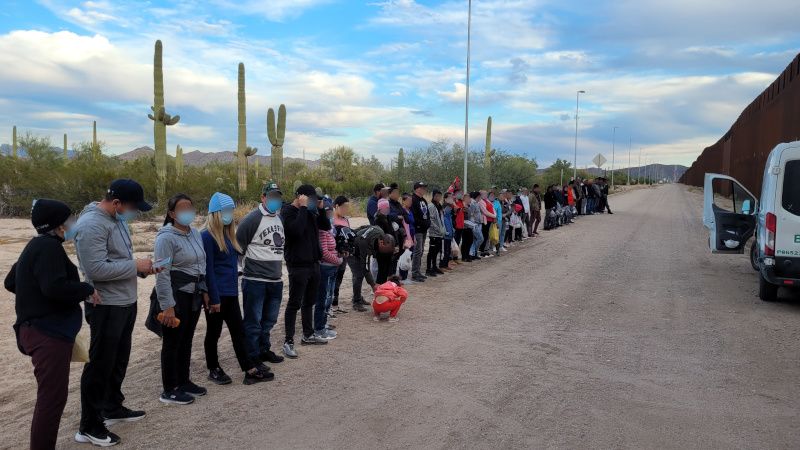
by Allan Wall, Border Hawk, ©2022

(Dec. 2, 2022) — In the month of October, Customs and Border Protection reported 230,678 “encounters” with illegal aliens.
This term refers to both apprehensions and expulsions, including multiple “encounters” with the same individuals.
Besides the raw numbers, we have to ask, where are all these illegal aliens coming from?
In October, the largest nationality represented was Mexican, accounting for over a quarter of the encounters.
In descending order, Mexico was followed by Cuba, Venezuela, Nicaragua, Colombia, Guatemala, Honduras, Peru, Ecuador and Haiti.
All of these nations are in the Western Hemisphere and nearly all are Spanish-speaking countries, with the exception of Haiti.
El Salvador President Nayib Bukele proudly tweeted that his country was not on the list.
“After being in the top 3 of the countries sending the most migrants to the United States… Now we don’t even enter the top 10!” he wrote.


A recent article on the Migration Policy Institute website by Ariel G. Ruiz Soto discusses the nationalities of people entering during the Biden Border Rush.
This article, published in October, reviewed data from Fiscal Year 2022, which concluded on September 30, 2022.
“Migrant and asylum seeker flows have become increasingly hemispheric in nature,” Ruiz Soto reported.
More specifically, “For the first time in history, more Venezuelans, Cubans, and Nicaraguans were encountered by U.S. Customs and Border Protection (CBP) during FY 2022 than migrants from El Salvador, Guatemala, and Honduras.”
Nicaragua is in Central America, but not in the “Northern Triangle” (Guatemala, El Salvador and Honduras), which is traditionally the part of Central America that sends the most immigrants. But these proportions change over time.
“The year also saw significant arrivals of Brazilians, Ecuadorians, Haitians, and from countries further afield, including Ukraine, India, and Turkey.”
The big story here is the drastic increase of migrants from outside Mexico and the Northern Triangle.
“Migrants from beyond Mexico and Northern Central America accounted for 43 percent of those encountered between ports of entry at the U.S.-Mexico border in FY 2022—compared to 4 percent just five years ago.”
From 4% to 43% in five years!
Read the rest here.