
by ProfDave, ©2022

(Jun. 16, 2022) — [Editor’s Note: See previous world history articles from the author here.]
“Fascist” is a word still used in the twenty-first century for people we don’t like – a weapon word. Fascism was the dominant political movement of the two decades following World War I, growing out of the crucible of war, societal collapse, and democratic failure. It took World War II and the atom bomb to put the genie back in the bottle – or is it? We need to know what that genie really was, lest democracy be tested again.
Fascism is typically associated with conservatism and nationalism, but contemporary European conservatives and nationalists had very different social and ideological origins. Rather, Fascism sought to co-opt (to absorb and exploit) traditional ideologies (like Conservatism and Nationalism) into a mass movement focused on one charismatic leader in a one-party totalitarian state. It differed from previous forms of authoritarianism in being thoroughly based in modern mass society, in which each citizen relates directly to state – as embodied in its head. Latin American caudillos represented established elites. Medieval kings were responsible to God and ruled in the context of a universal religious structure. Fascist dictators came from outside the elite, from the most alienated elements of society, and attempted to co-opt religious structures. In the end, they supplanted God in claiming ultimate allegiance to their own person.
- The Post-War West
The West never fully recovered from World War I before World War II. Something of a guilt complex afflicted Britain. The conduct of the war and of the treaty, which economist John Maynard Keynes called The Carthaginian Peace in his famous book, had been dead wrong. The French were deeply resented for “the crime of the Somme” – the useless sacrifice of British manhood to French stubbornness. A whole generation had been lost. In future, Britain would maintain a “blue water” strategy and never commit an “Expeditionary Force” to the continent again. Pacifism was very popular, and cooperation with France to enforce the provisions of Versailles was nearly out of the question. Besides, these decades saw the decline and fall of the once great British Empire. It was mortgaged to the USA, its industry obsolete, its markets lost (to the USA), its naval superiority lost (also to the USA), and Imperial industries were now competing with, rather than supporting, the home industries. And there was a civil war raging in Ireland.
France lived in terror of Germany. France had been saved by a miracle at Verdun and still felt vulnerable. Twice German troops had overrun northern France in the last half century, and even though disarmed, there were still two young Germans for every young Frenchman. France maintained a million-man army and engaged in constructing the massive and “impregnable” Maginot line along the border. It pursued alliances in Eastern Europe with Poland and the “Little Entente” of Czechoslovakia, Rumania and Yugoslavia. France also had colonial issues: a war in Morocco, attempts to assimilate Algeria, and to exploit Indo China. France enjoyed a measure of prosperity, but the government depended on German reparations, rather than taxation for its revenue. Germany should pay every red centime of the damage of the war [See Duiker & Spielvogel 694-96].
All nations suffered economic and social disruption after the war. The costs of total war were still due. Production that had been swollen by war orders was now cut back, just as the soldiers came back home looking for jobs. The situation in Germany was particularly dire: subject to reparations payments and cancellation of war bonds while threatened by Bolshevik and separatist revolutions. Germany defaulted on reparations in 1923. France invaded the Ruhr to seize their due in kind. German passive resistance drove the Deutschmark to four trillion to the dollar, wiping out all savings and pensions [See Duiker & Spielvogel 692-93].

The international economic system was upset by the war and by the peace. Although recovery seemed to be achieved by 1926, there were contradictions between London and Wall Street. The primary problem, however, was inter-governmental debt: 9.5 billion owed to USA, 8.5 to Britain, 2 to France – and 7.5 billion coming from Germany [billions back then would be trillions today]. The difficulty was that no one was willing to take payment in goods – in order to protect their own industries. Thus, all had to borrow in order to make payments, promoting a cycle of credit rather than trade. To pay reparations, Germany had to borrow from American investors so that France could pay Britain and Britain could pay the United States so that US could loan to Germany and round and round it went until Wall Street crashed and stopped investing. Ooops! You guessed it: then Germany could not make its payments to France, France could not make its payments to Britain and Britain couldn’t make its payments to America [See Duiker & Spielvogel 693-94].
The Soviet experiment led through even deeper waters to a somewhat different result. War Communism (1917-21) was a revolution by decree. The Central Committee abolished private property, whereupon the peasants, taking things into their own hands, seized the land. This was not exactly what the party had in mind. The attempt to enforce collective farms upon all of Russia, compounded by drought and bad weather, led to an agrarian crisis. Starvation was widespread in the cities by 1918 as peasants withheld crops for their own use. Government commissars fanned out to seize foodstuffs and the peasants rioted and destroyed them. Cities were depopulated looking for food.
In industry, the Soviets proceeded cautiously at first, but management resisted. So, the Politburo decreed nationalization of industry. Then there were no competent managers! The solution (of sorts) was to pair old capitalist managers with political commissars, as in the army. But still, by the winter of 1921, the Soviet economy was past the point of collapse. Industrial production was 16% what it had been in 1912! Millions had died of starvation or execution or civil war.
War Communism had failed, so Lenin ordered a retreat: a New Economic Policy. Peasants were allowed freedom to keep or sell 90% of their crops in the open market. Small-scale private business and something like true labor unions were allowed. Starvation eased by 1922-23, stability was reached by 1924, and pre-war production levels by 1927.
Meanwhile, Lenin had died in January 1923. Textbooks tell the story of the rise of Stalin, “the outstanding mediocrity of the party.” The rise of Stalin represented a turning away from the focus of world revolution to “socialism in one country,” and from the ideologically based intra-party democracy – of revolutionary days – to a bureaucratic state based on the will and the fear of one man.
The first Five Year Plan began in 1928. A State Planning Commission organized every aspect of the Soviet economy. In agriculture, the Stalin set out to reverse the NEP and break the power of the successful private farmers. This led to civil war in the countryside, crop destruction, and famine: five million died! In manufacturing, heavy industry was to be built from scratch at the expense of consumer goods, working hours, living conditions, and internal terror. A 236% increase was achieved, but even this was short of plan. More five-year plans followed.
The results gave the appearance of a modern industrial state, unscathed by the depression. The Constitution looked democratic. There was extremely high participation in the political process, but only one party. Abroad, the Communist parties, remotely controlled by Stalin, cooperated with socialists and liberals in the governments of France, Spain, and China. Stalin’s paranoia however, led to massive purges, 1934-38, of the old Bolsheviks from the party and the army. The military was decapitated, losing half the officer corps and 90% of the generals just before World War II. Why was this endured? The rising new elite of a-political technocrats supported Stalin without question. They were building a new society, a new socialist humanity! [See Duiker & Spielvogel 694-97]
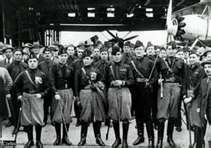
II. The Italian Example
Now take a closer look at Italy. The war brought nothing good to Italy. The bribes offered by the allied powers to induce Italy to enter the war against Austria had been renounced at the peace table under the influence of Woodrow Wilson. The promises of wartime propaganda were unfulfilled. Visions of gain and glory had turned to revulsion, frustration, debt and loss. Both German and Italian veterans felt a sense of national humiliation and a civilian stab-in-the-back. The war was followed by violent strikes and “the red menace” of Bolshevism. Political parties failed to rise to the challenge. The Socialists were divided, the Catholics lacked direction (the Pope forbade participation in the Italian republic), the liberals were laissez faire (wishing to do nothing), and all parties were now anti-war. Landowners, industrialists, nationalists all felt alienation from the parliamentary regime. Veterans particularly felt alienated from civilian life and that their sacrifices were unappreciated. Many were unemployed.
By March 1919, groups of veterans, youth, Romantics and crack-pot extremists began to gather in paramilitary political vigilante units, called fascio di combattimento. They styled themselves as guardians of order – against socialist demonstrations. By November 1921, they had found a renegade socialist journalist, Benito Mussolini, as a leader (Il Duce). Over the next months the movement and the party grew rapidly, gaining attention and popularity by breaking up socialist demonstrations with paramilitary discipline. The army and the king were sympathetic because they were doing what the conventional forces of law and order were not able to do.


Mussolini got his big chance when the Socialists called a general strike in August 1922. It proved suicidal. The response was like a military campaign and Socialist mobs were no match for Fascist formations. Demonstrations were dispersed, party headquarters attacked and destroyed, cities taken over, and a Fascist March on Rome launched, October 27 – 30. The Italian parliament appealed (at last) to the King for martial law. The King refused to grant it, the government resigned, and the King appointed Mussolini as Prime Minister. He won the ensuing elections.
Mussolini was not a very decisive leader, but over time what he called a “corporate state” emerged. By 1925 it could be called an authoritarian, totalitarian state. The “fasci,” or party army, was put on the state payroll. Labor peace was secured by organizing businesses into syndicates, with equal representation of labor, management and party bureaucrats. Mussolini negotiated a Concordat with the Pope – peace with the church for the first time since 1871. Social disorder was eliminated, lavish public works launched, and a huge military establishment built. “The trains ran on time.” Ideologically, Fascism was a void – a loyalty without content. It projected vague ideas of community, the glory of Rome and co-opted both socialism and business interests. It mobilized and channeled the frustrations of the veterans, the unemployed, and the bored. More than any other single idea, it embodied Futurism: action for action’s sake was more important than philosophy [See Duiker & Spielvogel 732-34].

III. Fascism as a European Phenomenon
Fascism was an international phenomenon. There were no less than five Fascist parties in France, some of them inspired by renegade Royalist rejection of the French Revolution. There were two in Belgium and one in Great Britain. In Turkey, Poland, Lithuania, Latvia, Estonia, and Bulgaria they formed the government [Nolte 27ff]. Yugoslavia was similar but led by the King himself. Austria was very close to a Fascist regime [Nolte 30-33]. In the desperate times of the post-war years there was a general retreat from democracy all across Europe.
In Germany, the “Beer Hall Putsch” of 1923 combined Bavarian separatists, retired General Ludendorff, and ex-soldier Adolf Hitler (“the German Mussolini”) in an abortive March on Berlin. When the Great Depression hit, there was a second wave of Fascism. Spain and Germany joined the list, and some say America’s New Deal moved in the direction of Mussolini’s “corporate state.” Indeed, even Stalin’s Five-Year Plan had some of the marks [Nolte 23].
What are the basic characteristics of the Fascist State?
1. An end is made of government by law and constitution. They remain on the books but become insignificant. The will of the Leader trumps everything.
2. Some degree of personal tyranny. The Leader embodies the movement and the nation. He persuades himself and others of his infallibility.
3. The destruction of individual freedom. There are no inalienable rights. The individual is an atom of the state.
4. Totalitarianism. All initiative is state sponsored, all activity state coordinated, and there are no autonomous organizations. Even the chess club is state sponsored.
5. Persecution of autonomous groups and minorities (for example Jews). Anything that resists coordination must be eliminated. Religion is problematic.
6. Terror. Fascism thrives on continuous revolution and crisis. It cannot survive peace and stability.
7. Media control. All sources of information and means of communication must be controlled.
8. Imperialism. There is usually a commitment to Darwinist expansion. War is seen as ennobling and a validation of the Leader [Deutsch 1968].
There are other features that are probably circumstantial, rather than fundamental to Fascism. Two circumstances attended the rise of the most successful versions: the human debris of an unsuccessful war and the seriousness of a “red menace.” Fascists were not the first or the last to have a party army, but the prominence of unassimilated veterans, uniforms, and military techniques became a trademark. Further, anti-bolshevism was perhaps the most popular plank in the Fascist platform. Fascism fought revolution with revolution [Nolte 19]. This feature gave critical access to the deep pockets of industrialists on the way to power. And their very visible street battles with Socialism gave them free publicity. Even in 1945, the German General Staff was offering to ally itself with the West to continue the war against Communism [Deutsch]. For these reasons, we have come to regard as Fascist the use of systematic violence and intimidation as political weapons, and to regard Fascists as right-wing extremists. However, please note that both Italian and German Fascists attempted to co-opt socialism into their movement (both wings?), and that violence, intimidation and many other “Fascist” techniques were incorporated into the Soviet Union and Communist movements worldwide. Right and Left meet on the other side of the circle [Nolte 40]! Both, however, were and are anti-democratic.
Sources: The above is primarily an interpretation of my own research unless otherwise noted. References are made to your text for comparison.
Deutsch, Harold. “World War II,” lectures at the University of Minnesota, c. 1968-69.
Duiker, William L. and Spielvogel, Jackson J. World History, 6th edn., Boston:
Wadsworth, 2010
Heughins, David W. “Nazis in the News,” unpublished, in partial fulfillment of MA, University
of Minnesota, 1969 (a survey of German newspapers, 1930).
—————. “Roots of Tragedy: a survey of some of the interpretations of the Origins of National Socialism,” unpublished, 1970.
Hitler, Adolf. Mein Kampf, edited by J. Chamberlain et al. (New York: Raynal & Hitchcock, 1941)
Nolte, Ernst. Three Faces of Fascism. Trans by Leila Vennewitz (New York: New American Library, 1965).
David W. Heughins (“ProfDave”) is Adjunct Professor of History at Nazarene Bible College. He holds a BA from Eastern Nazarene College and a PhD in history from the University of Minnesota. He is the author of Holiness in 12 Steps (2020). He is a Vietnam veteran and is retired, living with his daughter and three grandchildren in Connecticut.