

by ProfDave, ©2022

(Jun. 1, 2022) — Good morning, ladies and gentlemen. We have been circling the globe to see the impact of Europe on the rest of the world around the end of the 19th century. We have skipped a couple chapters on early modern Asia. I would like to focus this lecture on the critical encounter between Europe and Islam, the Eastern Question. But first, we need to go back and look at the Islamic Empires: the Ottoman, the Safavid, and the Mughal.
The Ottoman Turks. The Turkish people emigrated from central Asia between the 9th and the 11th century. The Seljuk Turks took over and revived the Abbasid Caliphate in Baghdad earlier. They had taken over much of the Byzantine (or East Roman) Empire. A tribe of Muslim Turks led by Osman (1280-1326) was settled in northwestern Anatolia – just south of modern Istanbul – in return for their help against the Mongols. His descendants, the Osmanli dynasty – hence the Ottoman name – replaced the Seljuks. In the mid-14th century Orkhan I crossed the Bosporus into Europe, intervened in Byzantine affairs, and took up territory in the Balkans. There were now Turks on both sides of Constantinople. A century later it fell to Mehmet II and the Roman Empire was no more.
Expansion continued, as the Ottomans displaced other Muslim principalities. Selim I defeated the Safavids and took Mesopotamia (Iraq) in 1514, the Mamluks took Egypt in 1516, and then (gradually) the Narids dominated Morocco. The Ottoman Empire reached its height under Sulieman I, the Magnificent (1520-66). He defeated the Serbs at Belgrade in 1521, subdued Hungary at Mohacs in 1526, and laid siege to Vienna in 1529! This would happen again in 1683, but that’s another story. Meanwhile, the Ottoman navy and North African pirates seriously bid to make the Mediterranean an Islamic lake – until the battle of Lepanto in 1571.
The Turkish system is interesting and distinctive. Originally, the Turkish tribesmen had been led by beys, or chieftains – who were the first among equals. Tribal leaders collected tax or booty from territory under their control and sent a fifth on up the chain. Later they became subject to a Sultan, who also held the title of Caliph – the Sunni successor to Mohammed. The Sultan adopted Persian and Byzantine absolutism and centralization. Succession was hereditary, but with a twist. Sultans did not marry but maintained a harem (or household) of concubines whose main qualification was the production of sons – among whom the best was supposed to succeed to the throne. There was never a lack of heirs, but often too many. The rest would either be executed or kept in captivity. The harem was not a Hugh Heffner sort of place, but a nest of relatives and hangers-on of both sexes that came to be a hotbed of intrigue and to exert considerable influence in Ottoman affairs. The central administrative body was the Imperial Council, headed by a Grand Vizir.
While the countryside was administered by an aristocratic class who served as spahis or cavalrymen – much like feudal knights – the elite of the Ottoman army and administration were the Janissaries. These were a special class of slaves, captives and minority peoples, taken from their families at an early age, converted to Islam, and specially trained to use modern arms and methods. The process of selection, by merit, was called devshirme, or collection. The same principle of selection by merit, not blood, was applied throughout the Ottoman system at its height.
The Empire included significant non-Muslim minorities: Orthodox Greeks and Slavs, Catholic Slavs and Hungarians, Jews, Armenian Christians, and other ancient Christian sects. Each was organized in a self-governing millet under its own religious leaders. Notice: there is no church and state in Islam, but the religious leader was responsible for the community. It was a toleration of separation and containment with modest disabilities – conversion was only allowed to Islam.
During the 1700’s decline set in. There were problems with succession and palace coups. The Sultans became ineffective figureheads behind the Vizirs. The devshirme became corrupted and the bureaucracy hereditary. The Ottomans did not keep up with western science and technology and fell into economic decline as the center of commerce shifted to the Atlantic.
The Safavid Empire (not to be confused with the pre-Islamic Sassanids) came to power in Persia at the beginning of the 16th century when Shah Ismail led a militant Shi’ite Turkish tribe out of Azerbaijan to conquer Iran and Iraq. Forced out of Mesopotamia by the rival Ottomans, they remained dominant in Iran, with Isfahan as their capital. Their Shah, unlike the Ottoman Sultan, was venerated as a spiritual leader, a descendent of the original Shi’ite Imams. This led to conflicts with minorities but was also a source of unity. The Shahs were active in commerce and manufacturing. Administrative positions, as among the Ottomans, were based on merit. The empire disintegrated under invasion from Afghan tribes in the 18th century.
The Mughal Empire of India was perhaps the greatest of all, and certainly the highpoint of traditional Indian culture. It has been called a gunpowder empire, because it rested on conquest and military technology. Perhaps. And war and gunpowder led to its fall. It was founded by Babur, a Muslim descendent of both Tamerlane and Genghis Khan, who inherited a fragment of the former’s empire in the mountains north of the Ganges. By all accounts, he was a man of great vigor and magnetic personality. Driven out by first the Uzbeks, then the Safavids, he seized Kabul in 1504 and led his followers into India in 1517 as a warrior for hire equipped with both cavalry and modern artillery. Against all odds, he captured Delhi in 1526 and conquered most of northern India before his death in 1530.
Babur’s son was brilliant, but lazy, and spent most of his life in exile in Persia, but his grandson, Akbar (1556-1605) extended the Mughal realm to most of India, except the south, with a skillful blend of diplomacy, propaganda, and heavy artillery. Despite being a Muslim, he ruled as a god-like Emperor over semi-autonomous principalities. He was tolerant of the Hindu majority, applying shari’a law to the Muslims and Hindu law to the Hindus. Higher offices, however, were mostly held by his fellow Muslim tribesmen. Mughal prosperity was based on the land and internal trade. Foreign and oceanic trade was left in the hands of the Arabs, later to fall to the Portuguese and finally the British.
Shah Jahan (1627-58) is remembered in the West primarily for building the Taj Mahal, perhaps the most beautiful building in the world. But thirty years of constant warfare and lavish projects, coupled with the neglect of the economy, drained the Empire. Reminds me of Louis XVIth of France.
Aurangzeb (1658-1707) followed up with controversial efforts at moral and social reform. As a devout Muslim, he attempted to suppress gambling, alcohol, prostitution, and certain Hindu customs, such as sati – burning widows on their husband’s funeral pyres. His anti-Hindu policies sparked something of a Hindu revival.
After Aurangzeb, the Mughal Empire began to fall apart, as much from internal turmoil as from outward pressure. It suffered from centrifugal forces of rebellion and local autonomy, an empty treasury, and incompetent rulers. There was a short war with England in 1686. The Persians sacked Delhi in 1739. The French seized Madras 1746. Foreigners became involved in interior trade and conflicts. In the battle of Plassy, 1757, a small detachment of British troops and 3,000 Sepoy allies met and defeated an imperial army of 30,000. A few years later, the British East India Company seized the emperor and ruled India in his name. In 1858, Victoria was crowned Empress of India.
The British Raj, as it was called (for the Rajas and Maharajas – princes) through whom it operated, brought change to India – both positive and negative. At first, it seemed only to replace the Islamic Mughal elites with Christian British ones. It brought western social reform and education, internal peace, and modern infrastructure. But there was a high cost to the arrangement.
The Eastern Question is a diplomatic history term for an impossible maze of geopolitical problems in the Middle East. They may have been there all along but have become acute in the collision and decline of three great multinational empires: the Habsburg (Austrian), the Ottoman, and the Romanov (Russian). Or the clash of three great faiths: Christian, Muslim, and Jewish. The match that lighted the tinder was nationalism. And the mess has not been untangled yet. In fact, that is where the Good Book says it is all going to wind up. Listen up: this is the navel of the world.
The last great forward movement of Islam was in the late 17th century. The Sultan was a cipher, but the Grand Vizir Mohammed Kaprili and his son Kaprili II Ahmed built an unprecedented military realm including most of Hungary, the lower Danube, the shores of the Black Sea and the Caspian, and much of the Ukraine. Ahmed, with an army of 250,000, drove deep into Poland, Moravia, and Silesia. He carried off 80,000 slaves. Pope Alexander VII tried to form a Holy League of all Christian kings, but Emperor Leopold of Austria was more afraid of Louis XIV sending troops through his lands than he was of the Turks. Ahmed was checked at Saint Gothard in 1664, but the settlement favored the Turks. The Greek island of Crete fell to the Turks after a siege of 21 years. Wars with Poland and Russia ensued.
Kara Mustapha, the next Vizir, having set up his own king in Hungary, launched another great army of 250,000 against Austria in December 1683. The siege of Vienna began July 16, 1683. The defending general Stahrenberg had only 13,000 regular troops. For two months Mustapha attempted to reduce the city by artillery, famine and disease. He almost succeeded. But Polish general Sobieski surprised the besiegers on September 12 with an allied force of about 70,000 and routed them. Imperial forces followed up their victory by taking Hungary and Croatia while the Venetians invaded Greece – and accidentally blew up the Parthenon. The Ottoman Empire never again threatened the heart of Europe.
Where did the problems of the Middle East and the Balkans come from? First of all, a divergence of East and West in the region goes all the way back to Alexander the Great. The western limits of Hellenistic culture run right through the Balkans. When the Roman Empire split, east and west – when Christianity split, catholic and orthodox – these all followed roughly the same lines. Then came Islam. One valley converted, one valley remained Orthodox, and another valley Catholic. And each retained the local memory of feud and battle and massacre at the hands of the others going back for centuries. And everywhere there were Christian or Islamic and Jewish minorities.
Secondly, the Ottoman Empire was called the “sick man of Europe.” Both its neighbors and its subject peoples saw it as a declining civilization whose collapse was inevitable, if not imminent. The Austrian, Turkish, and Russian empires were all multinational states floundering in a sea of nationalism, with overlapping minorities. The Ottomans were the weakest, but the Habsburgs were also on the defensive while Russia was expansionist and unpredictable.
The Turkish Sultan possessed absolute power in theory and could – and did -decapitate unsuccessful Vizirs at will. But the Sultans were usually inactive, removed from actual business and controlled by irresponsible households. The administration was riddled by corruption and disorganization. Even the janissaries were compromised. Modernization had fallen afoul of Islam: the pious would not soil themselves with modern business or administrative practices. Thus the Empire had become economically dependent on the west. It was a conquest state that had ceased to conquer and was now preying upon itself. Conflicting national and religious groups became more and more restive. Balkan agricultural labor was being forced into serfdom to mollify restive nobility while, simultaneously, a commercial revolution was taking place under the leadership of Greek minorities. Indeed, Greeks were being used as administrators throughout the Balkans. North Africa was semi-independent and Arabia, though Muslim, was becoming acutely aware that it was not Turkish.
Thirdly, nationalism is a mortal threat to a multinational state. The Russian position was particularly corrosive. Russia had two major interests in the middle east. Preeminent was the age-old need of a warm water port in order to engage in international trade. Archangel and St Petersburg are frozen for major parts of the year and potentially blocked by British, German, and Scandinavian rivals. Since Peter the Great the Russian objective had been to obtain a port on the Black Sea, then to obtain passage of the Dardanelles – past Istanbul. [Part of the current conflict?] Every few years a war was fought between Russia and Turkey for that purpose. They reached Azov in 1739, Sevastopol (Crimea) on the black Sea 1783 and Odessa in 1792. Russia hoped to gain by the weakening or collapse of Turkish power. The other interest was the protection of Orthodox religion and its access to the holy sites of Palestine. This provided a perennial excuse to meddle in Turkish affairs.
Related to this was the rising Pan-Slav movement. This was a new, less gentle, less cosmopolitan, social Darwinist form of nationalism. Agitators saw Russia as having the divine destiny of bringing all Slavic peoples together in one great realm. Did I mention that there were large Slavic minorities in both the Turkish and the Austrian Empires? The Romanov dynasty played a dangerous game, encouraging and exploiting this movement. By so doing, they exported subversion that could destabilize both Ottomans and Habsburgs.
The Habsburg Empire in the 19th century, was centered primarily in Austria, Hungary, Bohemia, and a varying amount of neighboring Slavic territory – even a bit of Italy. We call it Austria. After 1866 it was the “Austro-Hungarian Empire.” It had serious nationality problems. The dominant nationality was German, but they were by no means a majority. The Magyars were distinct and pretty much self-governing, then there was everybody else, more or less in subjection. Their major fear was to be surrounded by Russian armies on three sides. With ethnic cousins on both sides of the Turkish frontier in the Balkans, Russian sympathy towards pan-Slavism was a mortal threat. Either Russian patronage of Slavic national aspirations or Turkish collapse leading to Slavic successor states would be fatal. Finis Austria. So Habsburg policy was to prop up the Ottomans as long as possible and to absorb any Balkan pieces as they fell off.
Other nations in the concert of Europe had contradictory interests. Britain had a large naval presence in the Mediterranean and a vital overland route to India. She was concerned with Russian and French interference and forces in the way. The aim of British policy was to maintain the status quo, but the government was vulnerable to public opinion. The public objected to what they regarded as criminal Turkish treatment of their Christian subjects. So the Ottomans must be encouraged to reform and good behavior. France, on the other hand, had a special relationship with Egypt (a semi-autonomous part of the Turkish empire) and found trouble in the east a welcome distraction from domestic problems. Finally, Prussia had nothing to gain and everything to lose. As Bismarck said, the Balkans were “not worth the bones of one Pomeranian grenadier.” His concern was a war in which Prussia might have to face both France and Russia at the same time. At all costs, the two must be separated.
Now you know the players, let us see how it worked, crisis by crisis, 1820 – 1913. The Concert of Europe had no sooner been set up to enforce the legitimacy and stability of Europe than Greek nationalists rose in rebellion. Their cause aroused a lot of sympathy among European elites, steeped as they were in Socrates, Thermopylae, and Pericles. These were not exactly the same Greeks. As nationalists, they should have been stifled with the help of the Concert of Europe. But the Sultan hired his Egyptian vassal, Mohammed Ali (no relation to the boxer) with a huge army who conducted a war of extermination. Russia threatened to intervene to save their co-religionists. To preempt the Russians and moderate the Sultan, Britain and France gathered a peacekeeping fleet to Navarino Bay in 1827. Allegedly, the British admiral had confidential encouragement from the King, but in the event, the peacekeepers wound up blowing the Turkish fleet out of the harbor.
The Egyptian crisis followed in 1830’s as Mohammed Ali seized Syria and defeated the Sultan’s army. This time Russia offered to protect the Sultan. Trouble continued. In 1839, France refused to use her influence to restrain Ali and Britain threatened war. France mobilized their army on the Rhine – against Prussia! What’s up with that?
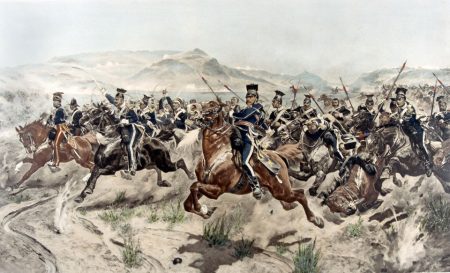
In the early 50’s, Roman Catholic and Greek Orthodox monks quarreled over the Holy Sepulchre in Jerusalem. Napoleon III, of France, sent a warship. Russia attacked the Turkish fleet in the Black Sea. Britain, France, and Piedmont intervened and the Crimean War was on, fought mainly over the harbor of Sevastopol. It was a miserable competition in incompetence, fought in the yellow light of newspaper correspondents instead of the decent privacy of previous wars. One blunder was immortalized in painting and poem as
The Charge of the Light Brigade
1.
Half a league, half a league,
Half a league onward,
All in the valley of Death
Rode the six hundred.
“Forward, the Light Brigade!
“Charge for the guns!” he said:
Into the valley of Death
Rode the six hundred.
2.
“Forward, the Light Brigade!”
Was there a man dismay’d?
Not tho’ the soldier knew
Someone had blunder’d:
Theirs not to make reply,
Theirs not to reason why,
Theirs but to do and die:
Into the valley of Death
Rode the six hundred.
3.
Cannon to right of them,
Cannon to left of them,
Cannon in front of them
Volley’d and thunder’d;
Storm’d at with shot and shell,
Boldly they rode and well,
Into the jaws of Death,
Into the mouth of Hell
Rode the six hundred.
Alfred, Lord Tennyson
That poem and Florence Nightingale’s nursing corps are all that is left of the Crimean War. The Peace of Paris, 1856, isolated Austria, shut Russia out of the straits, and – in clear violation of the Vienna settlement – made Romania independent.
There followed two Bulgarian crises, in 1875 and again in 1885, resulting in Bulgarian independence. The Serbs also gained independence, playing off Russia and Austria (now Austria-Hungary) against the Turks. Austria-Hungary resisted Serbian independence and sought to limit its gains because of their own restive Serbian population. Russia supported their fellow Slavs, but betrayed Serbia in the end, France betrayed Russia, and Britain was turned against Germany.
That brings us to the Balkan Wars of 1912 and 1913. The new Balkan states joined together to push Turkey almost out of Europe, then turned on Bulgaria. But this is getting into the story of World War I.
One more Eastern question needs to be addressed: the nation that wasn’t there: Israel. The Jewish experience in Christian Europe was that of a national minority in every nation. In general, they were consistent supporters of the central government, but never the beneficiaries. They were subject to special status and restrictions and a heritage of brutal expulsions and scapegoating. The Dreyfus case served as the example of the century. Captain Alfred Dreyfus was a French staff officer in the Franco-Prussian War (1871). France was humiliated. Dreyfus, who was Jewish, was accused of leaking secrets to the Germans. The case against him was dubious and he was eventually brought back from Devil’s Island and exonerated, but French anti-Semitism was brought out into the open and the case became a political football in the struggle of liberal vs conservative.
During the 19th century, assimilation was the trend among Jews in the west. They were able to blend in, with or without conversion to Christianity, and – at least until Dreyfus – pass as loyal nationals of the countries where they lived. Could this continue under the impact of nationalism and anti-Semitism? In the East, however, a pattern of persecution, isolation, and periodic attacks continued.
Where did Zionism come from? The idea is attributed to Theodore Herzl, who wrote an article on “The Jewish State,” in 1896. Mixing ideas of nationalism and socialism, he proposed a homeland for the Jews, where they could express their national culture without fear. Baron Rothschild, an international Jewish banker, and Arthur Balfour, a British statesman, launched the project of assisting Jews to emigrate to Palestine and buy land. There had always been Jewish people living there, but not since Roman times had Palestine been Jewish. These settlers brought a new element of Western culture and nationalism. The Balfour Declaration committed Great Britain to support a Jewish homeland. This story will be continued after the next war.
Think About It
1. What were the three great Muslim empires of Western Asia before 1914? What happened to them?
2. What was the Eastern Question and why was it so difficult?
3. Why was nationalism subversive of stability in Southeastern Europe?
Works Consulted
Arendt, Hannah. The Origins of Totalitarianism. Cleveland: World Publishing, 1958.
Craig, Gordon A. Europe since 1815. New York: Holt, Rinehart & Winston, 1961.
Duiker, William L. and Spielvogel, Jackson J. World History, 6th edn., Boston:
Wadsworth, 2010
Kieft, David. “Diplomatic History,” lectures at the University of Minnesota, 1970-71.
Thayer, William. “Cultural and Intellectual History,” lectures at the University of Minnesota, 1968-69.
Wolf, John B. The Emergence of European Civilization. New York: Harper &
Row, 1962.
David W. Heughins (“ProfDave”) is Adjunct Professor of History at Nazarene Bible College. He holds a BA from Eastern Nazarene College and a PhD in history from the University of Minnesota. He is the author of Holiness in 12 Steps (2020). He is a Vietnam veteran and is retired, living with his daughter and three grandchildren in Connecticut.