
by ProfDave, ©2022
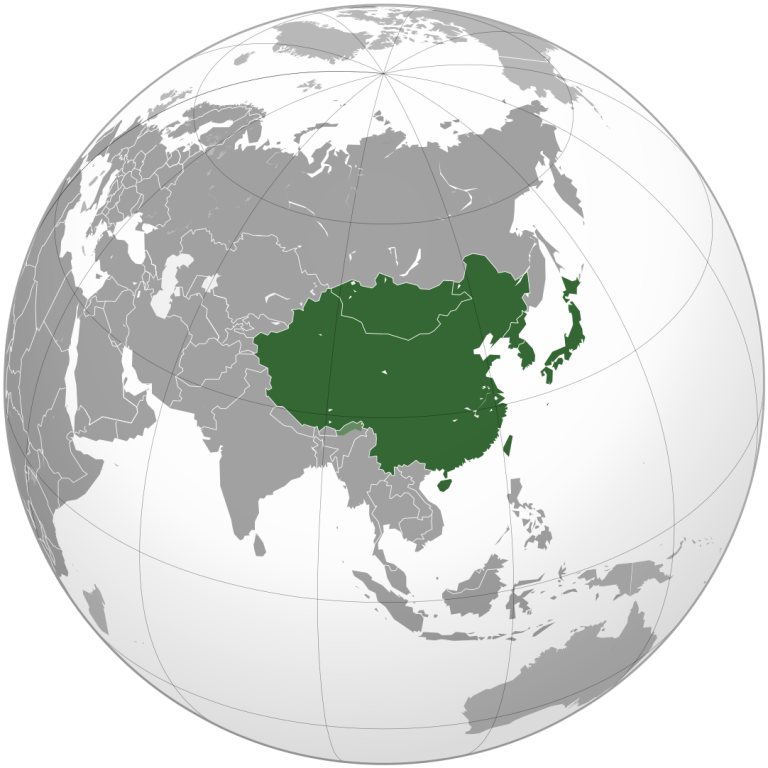
.svg)
(Apr. 5, 2022) — [Editor’s Note: Please see the previous installments in this series here.]
We are attempting to absorb the whole of Asian experience in the middle period of history, about 300 to 1500 AD – with flashbacks to centuries before the “Common Era.” If you are not on information overload, then you don’t understand what you are reading. For your instructor, too, this is a learning experience. We are just beginning to understand the other half of the world. Clearly, much of the detail of these centuries and lands will be lost from our memory in a few weeks – or days. Can we identify a small number of big ideas that we can take away from this unit as permanent learning? Can we organize the mass of detail? Let’s try.
You may have your own candidates, but if I had to choose three big ideas about the whole of Asia (beyond the Middle East) as “keepers” they would be: 1. Geo-cultural diversity, 2. the Confucian administrative model, and 3. Buddhism. Here goes.
Geo-cultural diversity. Asia is huge, but it is not monolithic. It breaks down into twelve distinct geographic regions: the Central Asian steppes, the Yellow River-Yangtze River valleys (China), the Korean peninsula, the Japanese archipelago, The Red River (North Vietnam), the Mekong River (Cambodia), the Chao Phraya (Thailand), the Malay and Indonesian coasts, the Irrawaddy and Salween Rivers (Myanmar), the Indus-Ganges valleys (Mauryan India), the Deccan plateau (Dravidian India), and the South Indian coastlands.
It seems as if the steppes of central Asia are the source of all barbarians (not strictly true, but it seems that way). Inhabited by nomadic herdsmen, and – like Arabia – dotted with oasis cities, this region lacks settled civilization and lies on the edge of history. From thence come wave after wave of warlike peoples who disrupt and destroy dynasties and civilizations from Korea to Germany – and supply the world with many of its leading peoples and languages.
The Yellow and Yangtze river systems combined from ancient times to support the largest cultural unity on earth. They were open to each other, connected by canal about 600, but also open to invasion from the north – despite the Great Wall. We will be looking at its evolution in detail in our next lecture. In many ways China is the cultural and geopolitical center of Asia, having a huge influence on its periphery, though less so in India.
Korean civilization, accordingly, is defined by its domination by and struggle for autonomy from China. The Han dynasty (China) dominated Korea until the third century, when three autonomous Kingdoms (nevertheless Chinese in culture) broke free. Buddhist and Confucian religion and institutions were well established in the fourth century. The kingdom of Shilla pushed out Chinese governors but paid tribute to the Tang dynasty. They imitated the Chinese centralized state, wrote their records and literature in Chinese, and the elite adopted Buddhism. The Koryo dynasty, in 958, adopted examinations for civil service on the Chinese model. Mongol conquest of China included northern Korea and led to the fall of the Koryo in 1392 and the rise of the Yi [Duiker & Spielvogel, 322-24].
Japanese civilization is defined by its freedom to selectively borrow from the Chinese. Shotoku Taishi (572-622) initiated contact with the Tang dynasty and used what he learned of the centralized Chinese state and the merit system of administration to launch the Great Change (Taika) reforms. Tribal Japan took on a Grand Council, administrative districts, a law code, and a tax system all modeled on Tang China. They began keeping records and writing literature in Chinese and the court, at least, adopted Chinese Buddhism in a big way. A new capital was built at Nara, modeled after Chang’an, and the ruler took the Imperial title of “Son of Heaven.” In Japan, however, the aristocracy pushed back, gaining exclusive access to the examination system, keeping the taxes under their own jurisdictions, and generally starving the central government. During the Heian period (794-1183), Japan was less dependent on China. While maintaining at least the shell of Imperial government, a semi-feudal society emerged. Great noblemen, with their Samurai retainers, dominated the countryside and reduced much of the population to un-free status. At the bottom was a hereditary caste of slaves similar to the untouchables of India. Shoguns, or generals, appeared in the 12th century, exerting centralizing power in the name of the emperor. Finally, attempts by the Mongols to invade and conquer Japan in 1266 and 1283 were defeated, but civil war 1467-77 virtually destroyed Kyoto and the unity of the nation.
Japanese religion and culture are a blending of the indigenous and the adopted. The original world view accommodated local spirits of nature and of ancestors. Shinto combined these traditional local beliefs with the state religion of the sun goddess – of whom the ruler claimed direct descent. Shinto, like the religion of the Greeks, lacked any clear cosmology, metaphysics or ethical system, but put a great deal of emphasis on ritual purity and the beauty of nature. Buddhism was taken up by the elites from China in the 6th century and became popular among the masses in the 8th century. The Pure Land sect (Jodo in Japanese) was good for ordinary people, concentrating on devotion and offering advancement through its extensive monastic system. Zen emphasized austerity and communion with nature, more accessible to upper classes. It was particularly influential in poetry and art. The sudden perception of the Haiku, the natural beauty and simplicity of the Japanese garden, the tea ceremony and the bonsai all bear the marks of Zen but are intensely Japanese. The Japanese writing system combined simplified Chinese characters with phonetic symbols.
The societies of Southeast Asia are laid out in north-to-south river valleys, isolated by mountain ranges, and concentrated in rich wet-rice growing deltas. The Red, the Mekong, and the Chao Phraya were peopled from China long ago and the Irrawaddy and Salween from Tibet. These were agricultural, not mercantile, societies. The civilization of the Red River, northern Vietnam, was distinct in sharing with Korea its exposure to Chinese domination and occupation. It was conquered by the Han Chinese in 111 BC. In 39AD, the Trung sisters, widows of three executed local officials led a rebellion that overthrew the Chinese regime – for a while. But for more than a thousand years, until the fall of the Tang Dynasty in the 10th century, Vietnam remained under Chinese domination – as the “smaller dragon.” At that point independence was achieved by the Dai Viet (Great Viet), who resisted two Mongol invasions and even managed to conquer the Champa Kingdom to the south. Even when independent, however, Vietnam showed great Chinese influence. Confucian administrative techniques and court rituals, the “mandate of heaven,” and such were symbols of national resistance and yet of Chinese origin. Buddhism, Daoism, and Confucianism mingled with nature spirits and Buddhist temples were dedicated to local deities.
Along the Mekong, modern Cambodia and South Vietnam, arose the Funan Kingdom on the lower river and the Angkor in the middle. Funan began in the 2nd century and trans-shipped goods from the South China Sea to India from its port on the Gulf of Siam for a time. Then it declined and was absorbed by the Angkor civilization. The Thai were late comers to the Chao Phraya in the 14th century and quickly converted to Buddhism. The Pagan Kingdom, Burma, grew up along the Irrawaddy and Salween and became Buddhist with an Indian culture. These kingdoms were heavily influenced, but not politically threatened, by India, especially the Dravidian Kingdoms of South India. Buddhist and Hindu missionaries came as early as the 4th century: god-like notions of kingship, Brahmin royal advisors in Angkor, caste-like social structures in Pagan, Sanskrit language and writing systems, and Theraveda Buddhism from Sri Lanka.
The Malays, it is thought, came from southeast China and spread as far a Hawaii and Tahiti. Among the Malay peoples of the coastlands and the islands of the “South Seas’ trading societies were growing up based on spices, precious stones, and exotic tropical products. In Indonesia, two states arose. The Srivijaya, on the eastern coast of Sumatra, ruled the seas from the 8th century until it was destroyed by the navy of the Indian state of Chola. The Majapahit on the Island of Java in the 13th and 14th century actually united most of the Islands and even portions of the mainland coast. The Malays converted to Islam in the 13th and 14th centuries.
India is dominated by the Indus and the Ganges valleys in the north. Like the Yellow and the Yangtze, they form a huge open area of agricultural wealth, unlimited by mountain barriers, except to the north. Great empires arose there. To the south lay the Deccan Plateau, another grain growing region, and a ring of coastal trading states in this period. These remained Dravidian in race and culture, while the north was ruled by an Aryan aristocracy. After the fall of the Mauryas, in the second century BC, India was disunited but home to up to one hundred million people. It was a time of cultural ferment.
First, the Kushan State arose in what is now Afghanistan, northern Pakistan, and northwest India. These Indo-European herdsmen promoted the Silk Road, a series of caravan trails linking central China to India, Persia, Constantinople and ultimately Rome. The volume of goods travelling this highway may have been small, and its markets only the super-rich, but the cash values were high and so were the cultural and religious exchanges – especially Buddhism, but later Christianity, too. Buddhists established monasteries and temples along the way to China. After 500 years, Kushan disappeared.
Then there was the Chola on the southeast coast. It fell in the fourth century AD but was revived at the end of the ninth century to conquer Sri Lanka, invade Bengal, and occupy parts of Myanmar, Malaya, and Sumatra. It passed into decline in the thirteenth century [“Chola,” Columbia].
In 320 Chandragupta established a state on the central Ganges that spread over all northern India, ushering in a new classical age 335-415 (Gupta Dynasty). This state directed profitable trade with China, southeast Asia, and the Mediterranean. Great cities were built with great temples and monasteries. We hear of gold and copper coinage, guild monopolies, and banking, but also barter. Then invaders came from the northwest in the 5th century and broke it up [Duiker & Spielvogel, 247-48].
Islam came to the subcontinent in the eighth century and Turkic peoples in the tenth and eleventh. First the Arabs invaded the lower Indus in 711, then Mahmud (997-1030) of the Ghazni Empire, Afghanistan, invaded the upper Indus valley, proving the superiority of the cavalry over the elephant. The Delhi Sultanate united the Indus and the Ganges again about 1200, but the Mongols were on the northwestern frontier by mid-century. The Tughluq Dynasty ruled northern and central India, 1320-1413, but Tamerlane (c. 1330-1405), based in Samarakand, conquered from Baghdad to the Caspian to Delhi. He was followed by the Mughals (and the Portuguese) by the end of the next century [258].
Each of these twelve geo-political regions has a unique history. There are interactions and occasional conquest, but the abiding reality is separateness. Each has its own language, culture, religion and art. Most are agricultural societies in tension between centralized command economy and aristocratic (feudal) control, where private commerce and industry were rather discouraged. But others, like the Chola and the Malay, specialized in long distance trade. It is in centralized administration and in religion that the regions of Asia have the most in common.
The second major theme, the Confucian administrative model was a unique contribution of Chinese society, imitated by surrounding cultures, even where Confucian philosophy and neo-Confucian religion were not upheld. The three-fold administrative structure (civil, military, censorate), the orderly system of equal provinces and districts, and above all the civil service system are unique to East Asian civilization until recent times. Behind them were the academies of systematic ethical and ceremonial training, based upon the Confucian classics. This system was taken over by Japan, Korea, and Vietnam. In Japan and Korea, and sometimes in China, it was adapted to Buddhism, but Confucian administration and Buddhist religion were not incompatible. More serious was the perennial efforts of the aristocratic classes to close the examinations to commoners. Even if eligibility were granted, however, it required a very specialized (and expensive) education to pass the test. This conservative indoctrination insulated Chinese society against any drastic change but did not prevent Vietnam from throwing off the Chinese yolk.
Third is the development of Buddhism. In the classical age of India (c. 400), Buddhism began to lose ground in the land of its origin. The Indian people may have desired a more satisfying heaven than the “blowing out” of Nirvana, they believed in any number of gods, and preferred to see the caste system as re-incarnational stages on the way to paradise. In other words, they wanted Buddhism to be more like Hinduism. This broader form of Buddhism for ordinary people, called Mahayana, or “great vehicle,” can be traced to the first century. It was a religion, rather than a philosophy, and Buddha was divine. It aimed at mass enlightenment, not self extinction. Nirvana, viewed as a state of bliss – not extinction – could be achieved by devotion. Ordinary people could achieve it by the intercession of a bodhisattva – the spirit of a holy one eligible for Nirvana who turned back instead to help others. Temples were built to particular holy men, recent or legendary, such as the Lord of Compassion (Avalokitesvara) – who was a woman in China. This kind of Buddhism became strong in northwest India, and spread to China, Korea, and Japan [Duiker & Spielvogel 249, Silk 357-58].
Purists taught Theravada, or Hinayana (small vehicle) Buddhism. Theirs was an older, more elitist vision, a way of life, not a means of salvation. Through right behavior and understanding one could eventually find release from the wheel of life [Duiker & Spielvogel 249]. This view remained strong in Sri Lanka and the kingdom of Pagan [269]
Meanwhile, Brahmanism was being transformed into Hinduism on a parallel path. It, too, had tended to be an elitist, ascetic discipline. After the Mauryas, it too placed more emphasis on devotion and good deeds (bhakti) rather than the sacrifice of self-abuse. This may have been in response to Buddhism [250].
Sources:
“Chola,” Columbia Electronic Encyclopedia, 6th edn, Columbia University Press, retrieved 5/25/11 from
http://web.ebscohost.com/ehost/detail?vid=6&hid=110&sid=0d7f907c-6f7f-417d-9997- 6dc2376708ad%40sessionmgr113&bdata=JnNpdGU9ZWhvc3QtbGl2ZQ%3d%3d#db=aph&AN=39052126
Duiker, William L. and Spielvogel, Jackson J. World History, 6th edn., Boston:
Wadsworth, 2010
Silk, Jonathan A., “What, if anything, is Mahayana Buddhism?” Numen, 2002, Vol. 49: 4, 355-405. Retrieved 5/26/11 from http://web.ebscohost.com/ehost/resultsadvanced?sid=75e8aa1d-d728-4cf4-b3b5-ac07fb44037a%40sessionmgr11&vid=3&hid=21&bquery=(mahayana)+and+(history+of)&bdata=JmRiPWU2aCZkYj1lMGgmZGI9YXBoJnR5cGU9MSZzaXRlPWVob3N0LWxpdmU%3d
David W. Heughins (“ProfDave”) is Adjunct Professor of History at Nazarene Bible College. He holds a BA from Eastern Nazarene College and a PhD in history from the University of Minnesota. He is the author of Holiness in 12 Steps (2020). He is a Vietnam veteran and is retired, living with his daughter and three grandchildren in Connecticut.