
by Jayne Friedman, ©2021


(Jul. 6, 2021) — This article is dedicated to all the ingrates and ignoramuses who were not taught the true history of the U.S.A, ––this magnificent country––in the hope that you will wake up and smell the coffee!
Sometimes the difference between loving something that is your birthright and loving something you have struggled to acquire is a quiet appreciation and daily gratitude for what you have in the moment.
Eduard Bogdan has earned that deep and abiding affection for his adopted country, America. In 1961, Eduard was born and grew up in Brașov, Romania, the youngest of three boys. His parents, Eva and Andrei, were part of the large Romanian working class.
Transylvanian Saxons developed many of Brașov’s towns. They built mines and cultivated the land of Transylvania between 1141 and 1300. Thus, the city is paved in cobblestones, with buildings reminiscent of Bavarian architecture. The descriptors “quaint” and “storybook” aptly describe the streets of Brașov.
Growing up in a town of antiquity gave Eduard the DNA of an older soul, a soul that valued history, tradition and craftsmanship and revered the creators and builders of beauty, culture and charm.
Religion is Not Red
Eduard’s father, Andrei, was a technician who supplied needed parts to factories. At night, he volunteered to officiate as Minister to underground churches in need of a clergyman. The practice of one’s religion was not a right granted to Romanians by the ruling Communists, and Andrei Bogdan volunteered under the watchful eye and heavy-handed government of Dictator Nicolai Ceaușescu.
Eduard’s mother, Eva, worked industriously from home, running a cottage industry repairing woman’s stockings during a time when going to a store simply to replace worn-out stockings was met with starkly empty store shelves.
Growing up Red
Growing up in Romania for Eduard was the story of most young people. His family had no political activists who raised the alarm bells of the government.
However, Eduard was born with a bone defect resulting in decalcification in the joint of his left leg, an anomaly that significantly shortened the leg. This deformity left his parents to search everywhere for medical help. Advanced and expert medical care in Communist Romania––as in all Socialist and Communist countries––was reserved for the ruling class. The rest of the population had to deal with the hand dealt to them.
In Eduard’s case, he would find that God often works in unconventional ways to provide opportunity through extraordinary avenues. More about that later.
Despite his physical limitations, Eduard played soccer with his neighborhood pals whenever they called. He taught himself how to play the guitar when he was just five. A prodigy was beginning to emerge. Over the years, his voice ripened into a deep and resonant baritone.
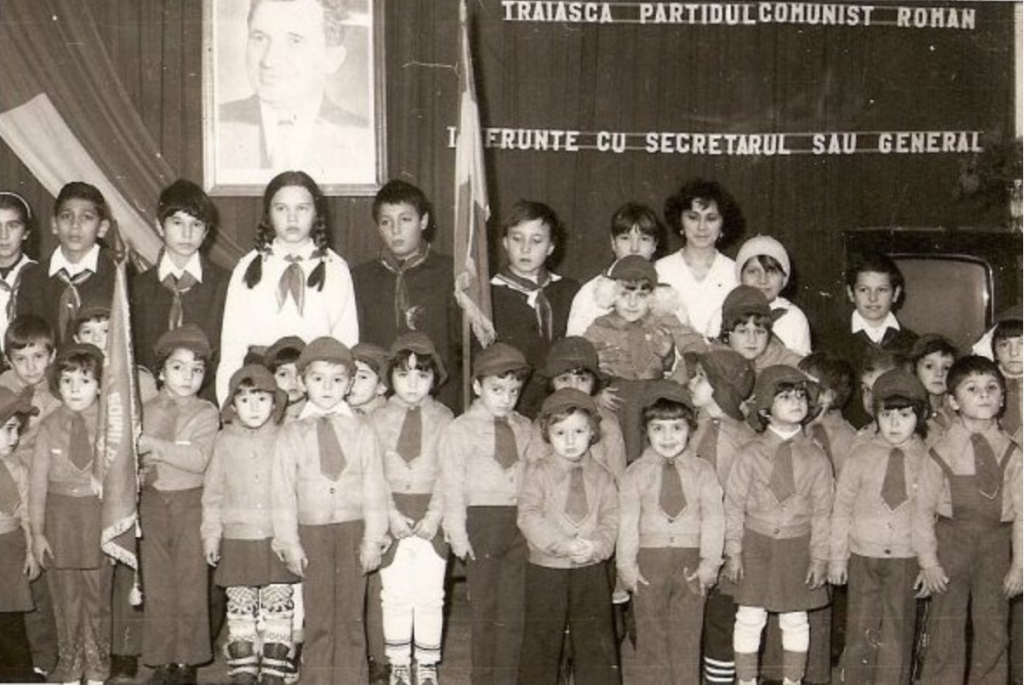
His youth was uneventful but the oppression, the rigidity of thought, the shortage of products and the suppression of opposing ideologies was the air he breathed every day. This was Romania in the mid-20th century.
A cloud of fear hung low in Romania back then. It was the ever-changing cloud cover of Totalitarianism. Strict allegiance to the pure ideology of Marxism was mandatory. After hearing his teacher denigrate Christianity in school one day, Eduard returned home agitated and upset. He confided his alarm to his mother. Eva listened and presented this grievance to the school. Predictably, she encountered the steel wall of Ceaușescu’s Totalitarianism and was told that there is no room for God in Romanian schools.
As a result, the very independent-minded Eduard Bogdan learned to turn off the indoctrination and brainwashing that confronted him, and, to this day, he credits his self-described “feisty” nature as the fuel that led to his resistance and which made him a “polite” rebel.”
Red Higher Ed
Eduard attended Transylvania University in Brasov where he studied engineering for six years. Unlike capitalist societies, in which a person graduates from his or her studies and pursues opportunities in his chosen field, in Ceaușescu’s Communist regime, there was a payback system in which Eduard was sent to the city of Beius for a “residency,” which meant low pay and busywork for three years to compensate the state for the expense of his education.
Meanwhile, the city of Eduard’s birth, Brasov, was flourishing with elites, intellectuals and religious diversity. However, many Jews living in Brasov changed their names to Romanian family names to better their chances of promotion and advancement. Romanian Communism demanded uniformity from its citizenry. In reaction and rebellion against this tyranny, Brasov became a hotbed of underground explosive rebellion that would soon erupt.
In 1989, the Romanian Revolution broke out. When it was over, the Romanian landscape was changed forever. Ceausescu was tried and convicted of economic sabotage and genocide. He and his wife, Elena, were executed by a firing squad in December of 1989.
Divine Intervention or Something Else?
Eduard’s prayers had been answered. A perfect storm was forming. For the first time, Romanians were able to secure passports outside of Communist countries. In 1990, Eduard found a team of American doctors who were visiting the country after the Revolution. They committed to correct his medical issues, and the U.S. Embassy issued Eduard a medical visa that became his introduction to a country he previously only dreamed about.
While in Wheaton, Illinois, Eduard attended a Christmas party given by one of the doctors on his medical team. He sang O Holy Night, and a staff member of Northwestern University heard his rich, velvety baritone. On the spot, a bigwig encouraged him to study music at the university. But he had a medical visa, not a student visa.
Nevertheless, he was advised by a sympathetic advocate to audition before the music department. Hesitant and still overwhelmed by the drama of all that had changed in his life, he delayed doing anything for a month. Finally, he auditioned and was rewarded with a music scholarship in 1992 to Northwestern University.
He had come to America for surgery in 1990. In 1991, he applied for political asylum. Northwestern University stepped up and offered Eduard an employment visa so he could stay here and study for his Master’s Degree in Vocal Performance.
Was it the luck of being in the right place at the right time or was it something else?
Clouds of Oppression and Choking Communism
In Romania, Eduard Bogdan did not witness his family being tortured or persecuted. He did not live in slavery nor involuntary servitude. But he did live in a Communist dictatorship and that was enough for him to yearn to inhale freedom. He had had enough of living under a system that:
- Denied Free Speech
- Prohibited opposition.
- Limited and hampered individual opposition to the state.
- Fiercely controlled public and private life.
- Subordinated Individual freedom to the authority of the state.
- Issued draconian punishments for any infractions.
Romania, at that time, was the most repressive country in the Eastern Bloc. Today, Eduard detects in America echoes of the life of hell he left. He is alarmed as he witnesses:
- The suppression of free speech.
- The ease with which media conglomerates are “bought” and controlled by our enemies.
- The degree to which colleges are weaponized to be anti-American and anti-Semitic by Arab and Chinese countries that endow them and then dictate their hate-America curricula.
Eduard compares the dictator Nicolai Ceaușescu, who saw protesters as political threats, to American leftists who echo the dictator’s philosophy.
Ceaușescu ordered his military to open fire on protestors and so does the American Left.
Ceaușescu kept people imprisoned with no legal representation just as the American Left has done to dozens of protestors on January 6, 2021.
- We are living under a coup. We are watching government grow and freedom incrementally vanish.
- We are told we are not a great nation.
- Our children are being divided by the color of their skins.
- Whites are shamed for their invented privilege.
- We are told that we are destroying the earth.
- We are told that we are racist for protecting our borders.
- We are spied upon, censored, canceled and, in some cases, beaten down by radical groups and end up mysteriously imprisoned or even dead by “suicide.”
Did Eduard Bogdan come to the country of his dreams? Or is he in a country that is slip-sliding into the abyss that he left?
——————-
Jayne Friedman, a native New Yorker who now lives in Cave Creek, Arizona is a Range Safety Officer and a National Rifle Association certified pistol instructor.
She teaches firearm skills to former victims of crimes as well as those interested in their personal defense.
Jayne began political activism in 2010. The formation of the Tea Party galvanized her passionate conviction to conservative ideals and policies. As a lifelong writer, she focused her goal on writing political commentary primarily on social media. She is now sharing her insights with a wider audience.
Jayne can be reached at jaynefriedman@protonmail.com