
by ProfDave, ©2021
(Apr. 1, 2021) — Wait a minute. It’s Thursday. It’s not Monday. Well, no. It is a middle English corruption of the Latin mandamus – “commandment.” As in “a new commandment I give to you, that you love one another.” John 13:34.
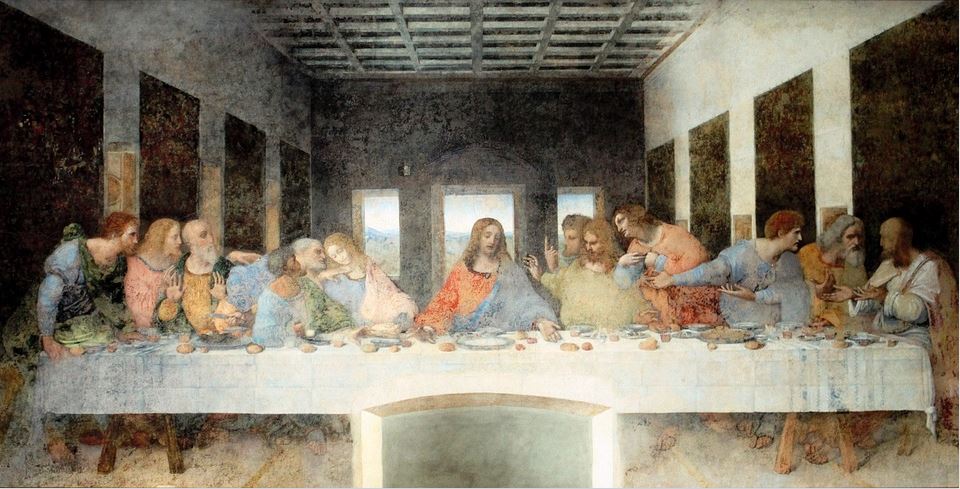
The evening before he was betrayed, Jesus celebrated the Seder with his disciples at a secret location in Jerusalem. He knew it was his last. His betrayer left during the meal and he led the eleven out of the city soon after. Three important things happened: he washed the disciples’ feet, he gave the new covenant, and, after the Seder, he gave the new command.
When you walk around all day in the dirt, with sandals, you need your feet washed before dinner. The lowest servant present should have done that, but none of the twelve could stoop to such a thing (pride). So Jesus took the part of the slave. A jaw-dropping moment! Wrapped in only a towel, he washed all 24 dirty feet. The lesson: the first in the kingdom must be the servant of all. Some churches occasionally observe this sacrament, but it is awkward in a shoe culture. Perhaps for other reasons, too. Do we remember the point? Not.
What caught on, and became the central sacrament for many, if not most, Christians was what Jesus did at the end of the Seder. As he broke the matzos, he said, “this is my body broken for you.” As he lifted the cup of blessing, he said “this is my blood of the new covenant, shed for you.” He then instructed his followers to do this “in remembrance of me” until he would come again in glory.
The “Last Supper” was a Seder. Why was that so important? Passover was and is the most important celebration in the Jewish calendar. It commemorates a series of divine actions by which the nation and the religion of the Hebrews was born in the 15th century BC. Modern Jewish atheists strive to find other explanations, but this is the only written history we have. How a slave people set free from Egypt, the superpower of the day, survived in a howling wilderness for two generations, and came up with a unique monotheistic religion has no natural explanation. It was a God thing.
Central to the Passover story – and the Torah – was the blood of a lamb standing between those who believed and obeyed and the judgment of God. The angel of death visited every home in Egypt that did not have the blood on its door frame – taking the firstborn. This broke the nerve of Pharaoh and the slave masters.
Israel was spared from judgment and set free by the blood of the Passover lamb – the covenant of Moses. When Jesus took up the cup, he deliberately instituted a new covenant. His own blood would stand between those who believe and obey and the judgment of God. By his blood we would be set free from the slavery of sin.
The new covenant would come with a new mandamus: love. Love for God and man were already required in Judaism. But in Jesus’ day it had been forgotten, buried under the law and the tradition. Today it has been forgotten, too. What Jesus meant by love was certainly illustrated in the Sermon on the Mount. He had modeled it in all his relationships and acted it out before them with a towel.
But the final demonstration would come the next day. The love that bled and died for his enemies bears no resemblance to the soft and sentimental or the horny desiring of what is called love today. Blasphemy!
So the Christian Seder – the Lord’s supper, communion, Eucharist, mass – brings us back to that moment of sacrifice, love and liberation. We are one at one table with the Lord. A Seder is a family observance. Jesus-followers (hello!) are a family. And “wherever two or three are gathered” in remembrance, He is there. The question is, will you be there?
David W. Heughins (“ProfDave”) is Adjunct Professor of History at Nazarene Bible College. He holds a BA from Eastern Nazarene College and a PhD in history from the University of Minnesota. He is the author of Holiness in 12 Steps (2020). He is a Vietnam veteran and is retired, living with his daughter and three grandchildren in Connecticut.