

by James Lyons-Weiler, PhD, Popular Rationalism, ©2026
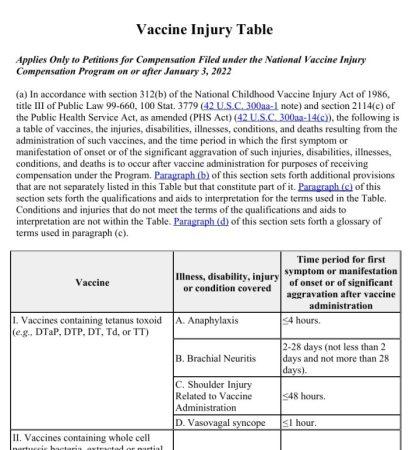
(Feb. 14, 2026) — The U.S. Department of Health and Human Services (HHS), through the Vaccine Injury Compensation Program (VICP), has formally and publicly recognized that encephalopathy—a serious neurological condition involving acute and chronic brain dysfunction—can be caused by specific vaccines. This recognition is not speculative or contingent. It is encoded in federal regulation, subject to rulemaking, supported by decades of epidemiologic data and scientific review, and reflected in how compensation claims are adjudicated in the U.S. Court of Federal Claims. This article walks through the legal foundation, clinical criteria, procedural mechanisms, and public health implications of HHS’s recognition of encephalopathy as a vaccine-induced injury under defined conditions. It is written to ensure clarity for attorneys handling vaccine injury cases, physicians who administer vaccines, parents navigating post-vaccine injury, and journalists covering vaccine law and safety.
Under federal vaccine law, the term “encephalopathy” carries a specific and rigorously defined meaning. It refers to a significant acquired abnormality or dysfunction of the brain’s function, marked by altered consciousness, lethargy, or personality change lasting at least 24 hours, and, in many cases, followed by chronic neurologic impairment. The Code of Federal Regulations (42 C.F.R. § 100.3(b)(2)) provides an operational clinical definition for use in legal adjudication. For an injury to qualify, it must not be better explained by an alternative diagnosis such as metabolic disorder, trauma, or congenital anomaly. The regulatory definition recognizes both acute presentations—such as persistent decreased consciousness—and long-term sequelae, including cognitive, sensory, or motor dysfunctions.
Glossary
VICP: Vaccine Injury Compensation Program
VIT: Vaccine Injury Table
CFR: Code of Federal Regulations
Encephalopathy: Significant acquired brain dysfunction (as defined in 42 C.F.R. § 100.3(b)(2))
Presumption of Causation: A legal standard that shifts the burden of proof to the Secretary of HHS once statutory conditions are met.
For purposes of the Vaccine Injury Table, “encephalopathy” is not a vague synonym for “altered behavior after vaccination.” A vaccine recipient “shall be considered to have suffered an encephalopathy” only when an acute encephalopathy occurs within the applicable Table time period and results in a chronic encephalopathy. For children under 18 months, acute encephalopathy is indicated by a significantly decreased level of consciousness lasting at least 24 hours (with additional constraints if the event follows a seizure, including that the decreased consciousness cannot be attributed to a postictal state or medication). For adults and children 18 months or older, acute encephalopathy must persist at least 24 hours and must include at least two of the specified features (including a non‑medication‑related significant change in mental status; a significantly decreased level of consciousness independent of seizure and not attributable to medication; and/or a seizure associated with loss of consciousness). The regulation also states what does not qualify by itself (sleepiness, irritability, high‑pitched screaming, poor feeding, persistent crying, bulging fontanelle, dementia symptoms), and it provides exclusionary criteria: the condition is not a Table encephalopathy if shown to be caused by specified unrelated underlying conditions (e.g., malignancy, structural lesion, psychiatric illness, dementia, genetic disorder, prenatal/perinatal CNS injury) or unrelated acute events (e.g., head trauma, stroke/TIA, complicated migraine, drug use, infectious disease). A “chronic encephalopathy” requires persistence of the change in mental/neurologic status for at least 6 months from first symptom/manifestation; return to baseline in less than 6 months defeats the presumption of residual neurologic damage from that event.
Thus, in the VICP context, encephalopathy is not a vague post-event report of “feeling off” but rather a severe, documentable neurological outcome with strict diagnostic features. The Table provides not only this definition but also the critical timing and vaccine pairings necessary to invoke a legal presumption of causation.
Read the rest here.