
by James Lyons-Weiler, PhD, Popular Rationalism, ©2026
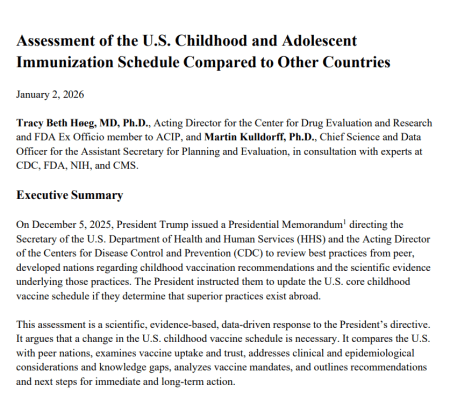
(Jan. 6, 2026) — The CDC’s January 2026 childhood vaccine schedule realignment is not a retreat from science—it is its restoration. By aligning the U.S. with international norms, reclassifying low-benefit vaccines, and preserving universal access, the policy reasserts informed consent, parsimony, and scientific integrity as central to public health. This editorial evaluates the evidence, clarifies common misinterpretations, and outlines the stakes of institutional credibility in the era of collapsing trust.
Ending the Era of Maximalism
In January 2026, the CDC issued a long-overdue correction to the American childhood vaccine schedule. Despite headlines framing this move as a rollback or retreat, not a single vaccine was removed from access or coverage. The change was not reductive—it was clarifying. It replaced one-size-fits-all mandates with a proportional, transparent structure based on international norms, current evidence, and a sobering admission of what science does not yet know. This was not a political maneuver. It was a governance correction, rooted in the principles of informed consent and institutional legitimacy.
The real story is not what was removed, but what was realigned—and why. The revised architecture reflects a basic truth: trust cannot be coerced. It must be earned. That is the starting point of science. And the endpoint of policy.
The CDC Recognizes Its Schedule as a Coercive Instrument
For decades, the CDC’s “routine recommendation” has operated less as guidance and more as soft mandate. Once a vaccine was recommended for all children, it cascaded through state school-entry requirements, insurance policies, quality metric scoring, and pediatrician compliance programs. Families who opted out often faced dismissal from care. Physicians faced insurer incentives tied to vaccination quotas. In this ecosystem, choice was technically permitted—but penalized.
The CDC’s own assessment acknowledges this explicitly: “Instead of implementing vaccination mandates, most peer nations maintain high childhood vaccination rates through public trust and education” (CDC, 2026, p.3). The updated policy aims to dismantle this coercive scaffolding—not by withdrawing vaccines, but by restoring clarity to what is essential, what is conditional, and what is contextual.
Comparative Overreach: America as an Outlier
The United States was not just a global leader in pediatric vaccination. It was a statistical outlier. According to the CDC’s comparative review (2026, Table 2), the U.S. schedule in 2024 recommended vaccines against 17 diseases, requiring 84 to 88 total doses delivered across 57 to 71 injections. By contrast:
- Denmark covers 10 diseases with 30 doses and only 11 injections.
- UK uses fewer doses but retains near-universal MMR uptake.
- Canada varies by province but aligns closely with European practice.
Importantly, many peer nations refrain from recommending routine use of hepatitis A, influenza, meningococcal B, and rotavirus for all children. These are not poor or negligent countries. They are scientifically robust, and they achieve high uptake by preserving credibility, not enforcing compliance.
The report introduces the ethical principle of clinical equipoise—the acknowledgment of uncertainty in the face of professional disagreement. When peer nations with equivalent disease burdens and health infrastructures diverge in recommendations, it signals unresolved evidence gaps, not ignorance.
Trust Collapse and Its Operational Consequences
Trust in U.S. health authorities fell precipitously between 2020 and 2024—from 71.5% to 40.1% (CDC, p.3). This collapse had measurable consequences. Uptake of the MMR vaccine, one of the most effective vaccines in the consensus schedule, dropped from 95.2% to 92.7% nationally. Sixteen states fell below the 90% threshold, increasing the risk of outbreaks.
Indeed, in 2025, the U.S. experienced 49 measles outbreaks—88% of the 2,065 reported cases were outbreak-associated (CDC, 2026). This wasn’t due to vaccine rejection. It was due to trust rejection. The report directly links trust erosion to coercive COVID-era policies, including mask mandates, school closures, disregard for natural immunity, and overstated claims about sterilizing immunity. The CDC writes, “The distrust of public health agencies during the pandemic has spilled over to other recommendations, including those with respect to vaccines” (p.3).
This trust decay wasn’t isolated. Countries like Denmark explicitly warned against adding low-benefit vaccines to their schedules, citing risks of degrading public confidence. Their prediction came true here. The U.S. attempted to do more—and got less.
Read the rest here.