
by Sharon Rondeau
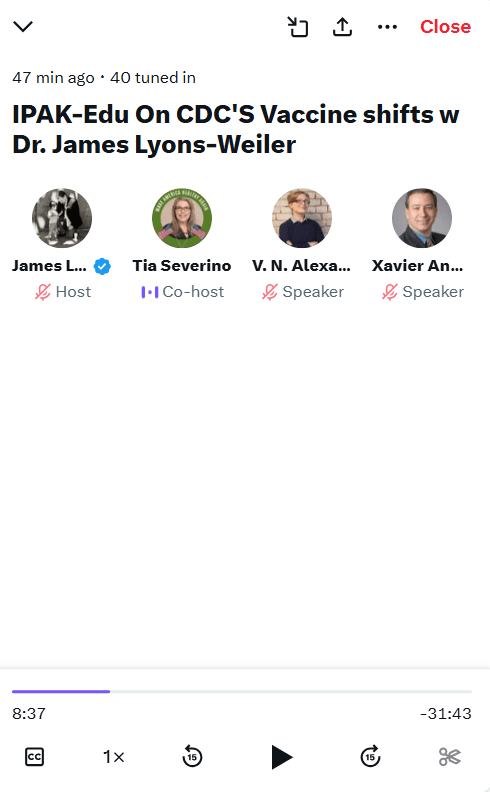
(Jan. 6, 2026) — On Tuesday afternoon, scientist, copious writer, founder of the Substack “Popular Rationalism” and the IPAK-EDU online school James Lyons-Weiler, PhD launched an inaugural X “Spaces” broadcast to discuss current issues of the day.
The live presentation concluded at 3:55 p.m. EST, but the recording is here: https://x.com/i/spaces/1yNxabBeEonKj?s=20
Tuesday’s topic was the CDC’s announcement Monday of a reduction in the number of diseases for which it recommends children receive vaccines from 16 to 11.
Lyons-Weiler wrote extensively about the change on Tuesday, stating, “In January 2026, the CDC issued a long-overdue correction to the American childhood vaccine schedule. Despite headlines framing this move as a rollback or retreat, not a single vaccine was removed from access or coverage. The change was not reductive—it was clarifying. It replaced one-size-fits-all mandates with a proportional, transparent structure based on international norms, current evidence, and a sobering admission of what science does not yet know. This was not a political maneuver. It was a governance correction, rooted in the principles of informed consent and institutional legitimacy.”
Vaccines for Hepatitis A and B, Meningococcal ACWY, rotavirus and flu are no longer recommended for all children, leaving in place those for diphtheria, tetanus, acellular pertussis (whooping cough), Haemophilus influenzae type b (Hib), pneumococcal conjugate, measles, mumps, rubella (chicken pox) and human papillomavirus (HPV).
The change follows the CDC’s withdrawing its recommendation for COVID-19 for children in September and automatic hepatitis B vaccination for newborns.
A CDC press release issued Monday outlines three categories of vaccine recommendations:
- Immunizations Recommended for All Children
- Immunizations Recommended for Certain High-Risk Groups or Populations
- Immunizations Based on Shared Clinical Decision-Making
In the memo, CMS Administrator Dr. Mehmet Oz assured the public that “All vaccines currently recommended by CDC will remain covered by insurance without cost sharing. No family will lose access. This framework empowers parents and physicians to make individualized decisions based on risk, while maintaining strong protection against serious disease.”
Lyons-Weiler has long criticized public health authorities for seemingly rubber-stamping the administration of childhood vaccines without properly assessing “risk.” He has been a longtime supporter of current HHS Secretary Robert F. Kennedy, Jr.
Between “84 and 88” total vaccine doses were administered to America’s children, Lyons-Weiler said, prior to the recent changes.
“It doesn’t take away universal access to any vaccine,” he said of the new recommendation schedule. “Vaccines are becoming more of another option in the toolbox of medicine to fight against infectious disease. And there’s more changes coming, I’m sure,” he said.
At 7:35 in the broadcast, Lyons-Weiler raised the issue of “vaccine injury” and who ultimately pays for it.
After the 8:00 mark, co-host Tia Severino said she is encouraged by the move and looks forward to “seeing what’s going to be next.” She predicted, however, that some members of the public might interpret the change as “not going far enough” or “this is going to be a threat to public health, that somehow allowing people to have informed choice is going to create a higher risk…”