
by Leonard Daneman, paraleaglenm, ©2025

(Jan. 23, 2025) — QUESTION: Is Birthright Citizenship granted to all children born on U.S. soil controlled by ‘common law,’ or ‘statutes and the constitution.’
Do you recall the advertising for CERTS, ‘Is it a Breath Mint, or a Candy Mint?’ This is the sort of question that vexes the United States after President Trump ordered no Birthright Citizenship for children of illegal aliens. The ACLU has already filed a complaint and the issue will be heard by the judiciary. The case will reopen the debate of whether the 14th Amendment’s ‘born in the United States’ clause is all inclusive to children born on U.S. soil, or whether it was only granting civil rights and citizenship to freed slaves.
What is at risk is whether the Supreme Court will socially engineer the law, following Justice Hugh’s hubris of, “the Constitution is what the judges say it means . . .” Or, will the court rely on the original intent of the 14th Amendment and its legislative history, and explanation of the amendment’s actual authors during ratification hearings.
“Today, the determination of national status in most parts of the world, as for the Virginia colonists in 1606, is a matter of positive law-either statutory or constitutional. But Calvin’s Case began a three-century period in which the rule determining citizenship in the English-speaking world, a rule based on place of birth, was self-consciously the product of judicial decisions.” ‘Natural Law and Birthright Citizenship in Calvin’s Case (1608)’ Polly J. Price,[1] Yale Journal of Law & the Humanities Vol.9: 73, 77
The cited law review juxtaposes the history of ‘common law’ or judicial determination of jus soli, ‘place of birth,’ against the statutory or constitutional jus sanguinis ‘right of blood,’ i.e., sanguinity from one parent, usually the father.[2]
In the United States and Britain (contrary to Price’s erroneous analysis), their models of citizenship in 1790 and 1772 statutes respectively were strictly jus sanguinis. United States nationality law only departed from this in 1866 and 1869, reverting to jus soli, but only as a resort to cure the fact that freed slaves had fathers without nationality to confer by sanguinity. Without any possible natural succession of allegiance from the father, the 1866 Civil Rights Act and the 14th Amendment resorted to ‘born in the United States,’ on the condition that the father had no subjection to any foreign power, i.e., ‘under the jurisdiction thereof.’ These conditions were both statutory and constitutional, not determined by any common law.[3]
So, the statute and constitution relied on both principles, the primary one being through the father. In the case of freed slaves, no ‘subjection to foreign power’ nor U.S. citizenship existed, so a secondary means of determining national allegiance was necessary, ‘place of birth.’ Conversely, if the father was subject to a foreign power, the child was not conferred U.S. citizenship by ‘soil,’ or ‘place of birth.’
The ‘common law’ principle from feudal times (jus feudale) determined Calvin’s Case (1608) to resolve the conundrum of an English monarch ascending to the throne of Scotland in 1603, Calvin being born under the Scottish king. The court under Judge Coke had to apply the English king’s dominion over Scotland to confer Calvin all rights, privileges, and protections of the English crown based on his place of birth now coexisting under an English monarch, Calvin’s acquisition of English national allegiance conferred post nati, or ‘after birth.’ Calvin’s was a unique case out of unusual historic circumstances, and therefore not universally or generally applicable.
This was the argument avoided in the U.S. Supreme Court case, Wong Kim Ark (1898), that declared in its decision that the ‘common law’ tradition from Great Britain of ‘place of birth,’ missing from U.S. legislation or its constitution, was a glaring omission of ‘a fundamental principle of citizenship’[4] and therefore within the power of the judiciary to add. Some may argue that this was outside the judiciary’s jurisdiction, in direct conflict with Article I Section 8 of the constitution, giving congress plenary power over rules of naturalization.[5] It was also in violation of stare decisis, precedent in case law the Wong Kim Ark court decided to ignore.[6]
[1] Assistant Professor, Emory University School of Law. B.A., M.A. Emory University; J.D. Harvard Law School. (https://openyls.law.yale.edu/bitstream/handle/20.500.13051/7701/06_9YaleJL_Human73_1997_.pdf?sequence=2
[2] 1940 INA §301(g) introduced post nati ‘citizenship at birth’ to children of U.S. citizen mothers who repatriated to the United States having children of foreign fathers.
[3] John Eastman, Henry Salvatori Professor of Law and Community Service, at Chapman University’s Fowler School of Law: “Subject to the jurisdiction” means more than simply being present in the United States. When the 14th Amendment was being debated in the Senate, Senator Lyman Trumbull, a key figure in its drafting and adoption, stated that “subject to the jurisdiction” of the United States meant not “owing allegiance to anybody else.” (See in the quote from Sen. Wade where he admits the Civil Rights Act’s ‘without allegiance to any foreign power’ settled the matter of which children born on U.S. soil were not granted citizenship.) New York Times UPDATED December 22, 2015 https://tinyurl.com/ydczevzt (shortened link to New York Times Guest Opinion Page) See also http://ashbrook.org/publications/oped-eastman-04-hamdi/
[4] [N]o act or omission of Congress, as to providing for the naturalization of parents or children of a particular race, can affect citizenship acquired as a birthright, by virtue of the Constitution itself, without any aid of legislation. The Fourteenth Amendment, while it leaves the power where it was before, in Congress, to regulate naturalization, has conferred no authority upon Congress to restrict the effect of birth, declared by the Constitution to constitute a sufficient and complete right to citizenship. Wong Kim Ark, (p704)
[5] The power, granted to Congress by the Constitution, “to establish an uniform rule of naturalization” was long ago adjudged by this court to be vested exclusively in Congress. Chirac v. Chirac (1817), 2 Wheat. 259.
[6] Ludlam v. Ludlam, 26 N.Y. 356 (1883) “Now, upon what ground can allegiances in such cases be claimed? If natural allegiance or allegiance by birth, does not depend upon boundaries or place, as Calvin’s case asserts, upon what does it depend? There can be but one answer to the question. It is impossible to suggest any other ground for the obligation than that of parentage. It must, I apprehend, be transmitted from the parents to the child, or it could not exist.”
The lead-off paragraph from this article presents a question:
Is Birthright Citizenship granted to all children born on U.S. soil controlled by ‘common law,’ or ‘statutes and the constitution.’ I will add the question mark.?
I have an uneducated answer:
Definitely not, because common law is a result of an adjudicated process.
Common law is the body of law primarily developed through judicial decisions rather than statutes. Although common law may incorporate certain statutes, it is largely based on precedent—judicial rulings made in previous similar cases. The presiding judge determines which precedents to apply in deciding each new case. Wikipedia
Although the US Supreme Court in the USA v. Ark (1898) decision designated a person as a citizen in direct violation of the 14th Amendment and the 1866 Civil Rights legislation, this wrongful decision probably ‘stands’ in some courts of law as common law.
2. Statutes and the constitution.
Yes. Three examples:
a. Baseline authority: US Constitution, Article 1, authorizes Congress to make laws of naturalization, aka a US citizen via positive law legislation.
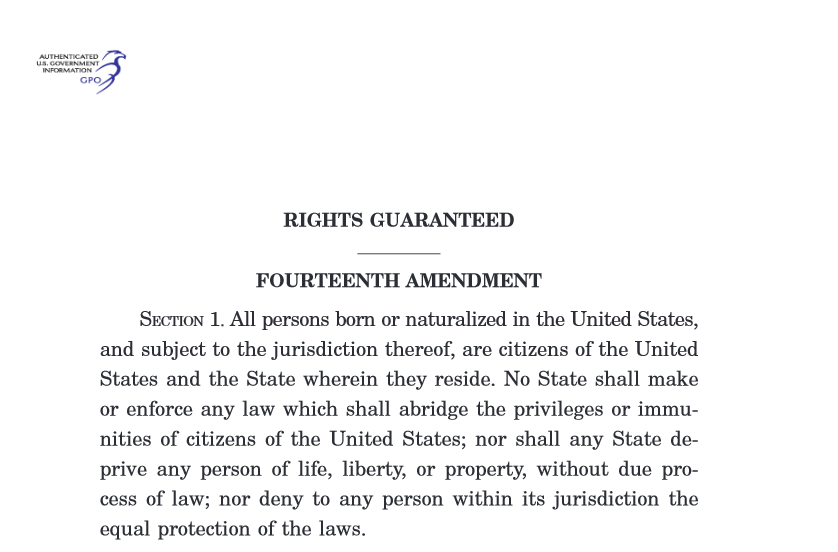
b. The first sentence of the 14th Amendment further authorizes persons to be naturalized as citizens. To wit: “All persons born or naturalized in the United States, and subject to the jurisdiction thereof, are citizens of the United States and of the State wherein they reside.”
c. The 1866 Civil Rights Act legislation delineated who is a US citizen and it excluded offspring of two (2) foreign parents in all cases, because they were subject to a foreign power.
3. I find it necessary to add a third category – natural law.
The rule, to determine whether one is a natural born citizen, is what is the allegiance of the parents of the child in question. The child always follows the allegiance of the father. Its been that way since the beginning of time. As a rule Monarchies rely on Jus Soli for taxation purposes and Modern Democracies rely on both Jus Soli and Jus Sanguinis, soil and blood. Here is John Jays letter to G. Washington explaining the need to prevent the influence of foreigners (allegiance) into the Government.
In Book I, Chapter 19, § 212, of the English translation of 1797 (p. 110) Vattel describes what is meant by the term Natural Born Citizen: The natives, or natural-born citizens, are those born in the country, of parents who are citizens.
http://www.usnaturalborncitizen.com/meaningofnaturalborn.html
Summary of item 3: Anyone born in the country to two (2) parents who already are citizens of the country is a natural born Citizen (nbC) and their status as a citizen is the most common kind of citizen, but US Congress cannot list their nbC status in legislation, because they cannot deem nor make anyone an nbC – and act that is done by the law of nature. I believe that is why Congress removed the words “natural born” from the Naturalization Act of 1795 where it did exist in the preceding and repealed Naturalization Act of 1790.
Caveat to Summary of item 3, above. There is a likelihood that the authors of the 14th Amendment hinted to natural born Citizens as well as a person born to one US citizen parent when they listed “born” in the first sentence of the 14th Amendment – partially re-listed here: “All persons born or naturalized…….”
In the 1970s US History classes in high school clearly delineated among naturalized, native born, and natural born citizenship and their connection to the prerequisites of presidential eligibility. Grandmother, born 1891 to parents from Austria-Hungary, happily told her grandchildren that she was elated that her children and grandchildren could be president, but that she never could. Born of legal immigrants in NYC, her parents were not yet naturalized when she was born, hence she was native born (of legal immigrants) but also had derivative qualities to foreign citizenship from her parents. Surely our founders did not want anyone with dual allegiances as commander in chief. Her descendants were natural born. The NYS elections website has merely “born a citizen,” but what happened to “Natural born citizen?$ This matter needs to be settled definitively asap!
I agree, but IMO it won’t happen with a Supreme Court whose Chief Justice John Roberts sworn-in the fraud Obama, several times. NBC was was effectively changed by the actions and inaction of Justice Roberts, and of both parties of Congress. This was known by both Roberts and Congress, and it added “ineligibility protection” to Obama’s race protection. The people who we elected as our Representatives to protect the Constitution instead locked themselves into something more important, protecting themselves. This was never difficult to see and understand, but apparently millions of Americans allowed the lies of the so-called main stream media to do their thinking for them…….
What happens with this while Trump is President will determine what will happens to America in the future….after Trump……
Hopefully, NBC will be returned to it’s original meaning intended to protect America from a President being elected who has allegiance to other than America…….Given the Supreme Court has already effectively said Obama is eligible, they have locked themselves into doing nothing that would intimidate them for allowing the fraud Obama to be sworn-in. This failure is treason by both Justice Roberts and Congress………….If nothing is done expect future presidents who also have diligence to other than America…The bad guys will have won….
America’s future is at a critical point, and for now I am very pleased to have President Donald J. Trump, as America’s strong and legitimate President……….
Very helpful article; insightful understanding herein vs inciteful response in the streets of USA, perhaps.
So, if we look back in U.S. history, how were previous U.S. citizens interpreting “natural born Citizen”(nbC) after 1787, and, how were they interpreting the 14th Amendment after 1866 BY THEIR OBSERVABLE ACTIONS?
For nbC, all previous U.S. citizens selected and elected their U.S. Presidents and U.S. VPs from 1825 (VP John C. Calhoun) to 08-27-08 (President Bush and VP Cheney) interpreted nbC to mean, “one who is born in USA to sole-US-citizen-parents”. https://www.scribd.com/doc/48856102/All-U-S-Presidents-Eligibility-Grandfather-Clause-Natural-Born-Citizen-Clause-or-Seated-by-Fraud
On 08-28-08, Speaker Pelosi began the unusual interpretation of nbC to mean, “one who is narratively born in the USA to foreign-citizenship-patents” (Obama, Kamala, “Canada” Cruz, et al, 2008- Today).
>>>
>>>
For the 14th Amendment, what does U.S. history reveal about how long U.S. citizens interpreted the application of the 14th Amendment to free resident slaves (1866- ?) before it was interpreted, via actions by more recent U.S. citizens, to mean, “one who is born in the USA to foreign-citizenship-parents automatically becomes a full U.S. citizen just like today’s U.S. resident-descendant-citizens of the Puritans of 1620”?
>>> https://www.whitehouse.gov/presidential-actions/2025/01/protecting-the-meaning-and-value-of-american-citizenship/ :
In summary,
nbC interpretation 1825- 08-27-08 vs nbC interpretation 08-28-08- Today
14th Amendment interpretation 1866- ? vs 14th Amendment interpretation ?- Today
Finally, I do not recommend running to the politically-saturated U.S. Supreme Court to, hopefully, have them incriminate themselves by mandating that nbC and the 14th Amendment will be interpreted as originally understood by previous U.S. citizens living in 1787 and in 1866 eras…President Trump and today’s U.S. citizens on Main Street USA, you and me, are already jury-enough to mandate that today’s We the People will follow the observable historic interpretive-actions of We the People of 1787 and We the People of 1866!
In all of this matter, will it be settled U.S.-citizenship HISTORY or today’s U.S.-citizenship HYSTERIA, that rules the day?