by Sharon Rondeau
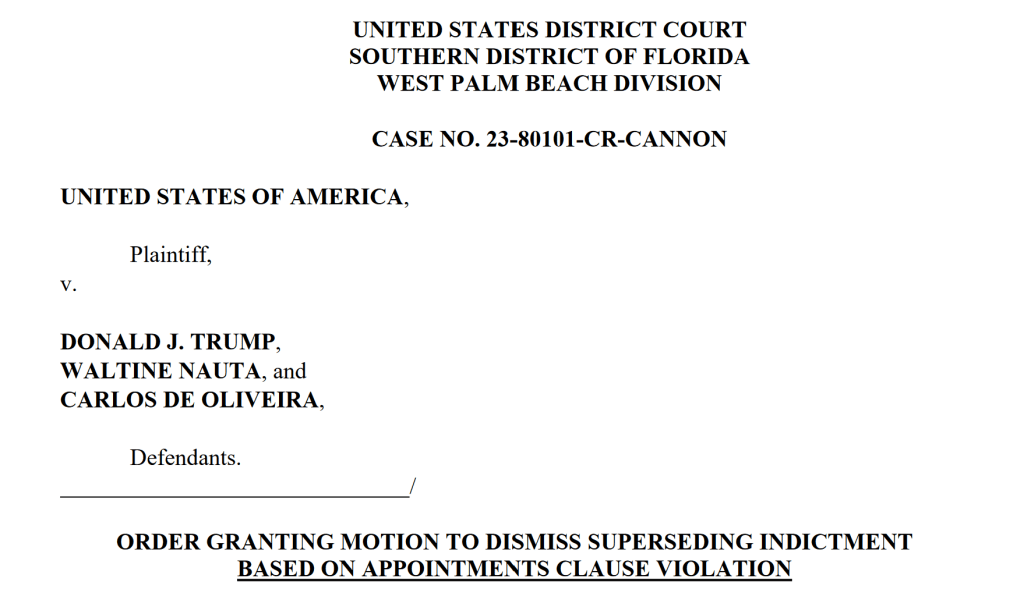
(Jul. 15, 2024) — On Monday morning the case against 45th president and 2024 presumptive Republican presidential nominee Donald J. Trump charging him and two others with mishandling classified documents was dismissed by U.S. District Court for the Southern District of Florida Judge Aileen Cannon.
A Trump nominee approved by the U.S. Senate on November 12, 2020, Cannon dismissed the case based on her finding that the “special counsel” appointed to investigate and ultimately prosecute the case, Jack Smith, was installed unconstitutionally.
On August 8, 2022, the FBI conducted an early-morning raid of Trump’s Florida estate and club, Mar-a-Lago, with a search warrant for classified documents.
Smith was appointed “special counsel” by Joe Biden’s attorney general, Merrick Garland, in November 2022, three days after Trump announced he would seek the Republican presidential nomination for the 2024 election.
A Harvard Law School graduate, Smith has spent most of his career in government positions including leading the Public Integrity Unit within the U.S. Department of Justice and as acting U.S. attorney for the Middle District of Tennessee. His most recent appointment prior to Garland’s was as head prosecutor at the Kosovo Specialist Chambers investigating war crimes from the 1990s. According to Smith’s Wikipedia entry, he resigned the same day Garland appointed him to investigate Trump, November 18, 2022.
Indictments Smith obtained from a grand jury filed June 8, 2023 claimed Trump committed “willful retention of national defense information,” obstruction of justice and numerous other crimes.
“The selection of someone from outside the department for the special counsel role was notable given how much emphasis Garland has placed in trying to ensure public confidence in his own workforce of prosecutors following the tumultuous years of the Trump administration, and to reassure Americans that his prosecutors’ decisions are based on facts, the evidence and the law and can therefore be trusted,” the AP reported on November 18, 2022.
On February 22 of this year, Trump’s attorneys, some of whom served on Trump’s defense team for the Manhattan trial emanating from allegations that Trump falsified business documents to conceal a payment to adult-film actress and producer Stormy Daniels, challenged Smith’s appointment on constitutional grounds.
In March former Attorney General Edwin Meese and others filed an Amici brief supporting Trump’s attorneys’ claims regarding Smith’s appointment.
“The legality of Jack Smith’s appointment is a potentially fatal flaw in this entire prosecution, and as such must be resolved before this case proceeds closer to trial,” Meese and his co-filers wrote. “He wields extraordinary power, yet effectively answers to no one. The Supreme Court has ‘expressly included Appointments Clause objections … in the category of nonjurisdictional structural constitutional objections that could be considered on appeal whether or not they were ruled upon below.’ Freytag v. Comm’r, 501 U.S. 868, 878–79 (1991) (collecting cases). It thus has something of a quasi-jurisdictional character that should be treated as a priority over standard defenses. This Court should rule upon the Motion to Dismiss raising this issue, [ECF No. 326], before ruling on other pre-trial motions.”
“Even as Smith’s team looks to press forward on a prosecution seen by many legal experts as the most straightforward and clear-cut of the four prosecutions against Trump, Friday’s arguments aren’t about allegations against the former president,” NPR wrote on June 21 of this year. “They’ll center instead on decades-old regulations governing the appointment of Justice Department special counsels like Smith, reflecting the judge’s continued willingness to entertain defense arguments that prosecutors say are frivolous and meritless, contributing to the indefinite cancelation of a trial date.”
The Manhattan case concluded with 34 “guilty” jury verdicts and sentencing scheduled for July 11. However, as a result of a July 1 ruling from the U.S. Supreme Court on the question of presidential immunity, sentencing was postponed to September 18 by presiding Judge Juan Merchan, a Democrat who donated to Biden’s campaign whose daughter is a Democrat fundraiser.
In her 93-page opinion, Cannon wrote that because Smith not confirmed by the Senate, his appointment was at odds with the “Appointments Clause” in Article II, Section 2, clause 2 of the U.S. Constitution.
Article II defines the role and responsibilities of the president, with Section 2 indicating “Advice and Consent of the Senate” as necessary in the case of many “Appointments.”
He shall have Power, by and with the Advice and Consent of the Senate, to make Treaties, provided two thirds of the Senators present concur; and he shall nominate, and by and with the Advice and Consent of the Senate, shall appoint Ambassadors, other public Ministers and Consuls, Judges of the supreme Court, and all other Officers of the United States, whose Appointments are not herein otherwise provided for, and which shall be established by Law: but the Congress may by Law vest the Appointment of such inferior Officers, as they think proper, in the President alone, in the Courts of Law, or in the Heads of Departments.
“The Appointments Clause sets as a default rule that all ‘Officers of the United States”—whether ‘inferior’ or ‘principal’—must be appointed by the President and confirmed by the Senate,” Cannon wrote on page 2. “…Both the Appointments and Appropriations challenges as framed in the Motion raise the following threshold question: is there a statute in the United States Code that authorizes the appointment of Special Counsel Smith to conduct this prosecution? After careful study of this seminal issue, the answer is no. None of the statutes cited as legal authority for the appointment—28 U.S.C. §§ 509, 510, 515, 533—gives the Attorney General broad inferior-officer appointing power or bestows upon him the right to appoint a federal officer with the kind of prosecutorial power wielded by Special Counsel Smith. Nor do the Special Counsel’s strained statutory arguments, appeals to inconsistent history, or reliance on out-of-circuit authority persuade otherwise.”
“Law professors have been divided on this,” Georgetown University Law Professor Jonathan Turley said on Fox News at 1:26 p.m. EDT. “It is not a frivolous question.”
Cannon also questioned Smith’s authority to expend money from the U.S. Treasury under the Appropriations Clause in Article I, Section 9, clause 7, which states:
No Money shall be drawn from the Treasury, but in Consequence of Appropriations made by Law; and a regular Statement and Account of the Receipts and Expenditures of all public Money shall be published from time to time.
The government can appeal the ruling to the 11th Circuit Court of Appeals if it chooses; a decision there could be taken to the U.S. Supreme Court by either side.
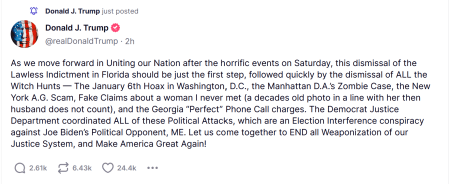
After learning of Cannon’s decision, Trump, who narrowly survived an assassination attempt on Saturday afternoon in Butler, PA and is scheduled to address the Republican National Convention this week, posted on TruthSocial, “…this dismissal of the Lawless Indictment in Florida should be just the first step, followed quickly by the dismissal of ALL the Witch Hunts…,” a reference to the Manhattan; Fulton County, GA; and January 6 “insurrection” cases, the latter of which Smith also filed.