
by Joseph DeMaio, ©2023

(May 13, 2023) — Introduction
Recently, your humble servant addressed the flawed reasoning of the “Heritage Guide to the Constitution” (“Guide”) set out in its explanatory analysis of Art. 2, § 1, Cl. 5. This, of course, is the Constitution’s “natural born Citizen” (“nbC”) presidential Eligibility Clause, the source of increasing scrutiny and debate as more and more presidential (and fallback vice presidential) candidates announce interest in seeking those offices as the 2024 general election approaches.
The same critique was made of the “kissing cousin” of the Heritage Guide, the Library of Congress (“LoC”) website page “Qualifications for the Presidency” here. Apart from the fact that the word “qualifications” is not the same as “eligibility,” the LoC digital document arrives at the same problematic conclusions as does the Heritage Guide.
As a prefatory refresher, the Constitution’s Eligibility Clause states: “No person except a natural born Citizen, or a Citizen of the United States, at the time of the Adoption of this Constitution, shall be eligible to the Office of President….” Simple words, more complex meaning.
Your servant’s first offering addressed the Eligibility Clause issues alone, based on the digital version of the Heritage Guide eligibility essay downloaded earlier this month, which is to say, in 2023. That section is worded virtually identically to the 2014 edition of the Guide available in hard copy book form. Other changes between and among the original 2005 edition, the 2014 edition and the 2023 digital edition largely reflect changes in the personnel who assisted in the preparation of the editions. However, there are also several substantive changes, discussed hereafter.
All three editions list as the author of the section explaining the nbC issue one “James C. Ho.” The 2005 edition lists him as “Majority Chief Counsel, United States Senate Judiciary Subcommittee on the Constitution” while the 2014 edition and digital version list him as “Partner, Gibson, Dunn & Crutcher LLP.” Now-Judge Ho was appointed to the U.S. Court of Appeals for the Fifth Circuit by President Trump in 2018. He is no dunce, having graduated from Stanford University, the University of Chicago Law School and served as a law clerk to Supreme Court Associate Justice Clarence Thomas (2000-2001). That said, even well-credentialed lawyers can arrive at erroneous conclusions.
Each edition or version of the Guide states in the preface that it is intended “to provide a succinct [in the 2005 edition, “brief”] and accurate explanation of each clause of the Constitution as understood by the framing generation [in the 2005 edition, “Framers’] and as applied in contemporary law.” While that may have been the stated intent, respectfully, the “eligibility” essay of each edition of the Guide falls short, at least with regard to the explanation produced by Judge Ho while he was Majority Chief Counsel (2005) and later, in private law practice (2014 and digital). Many of the shortcomings are relatively minor, such as the mis-citation to 1 Stat. 104 (a 1790 governmental appropriations bill unrelated to the nbC issue) instead of 1 Stat. 103, but others are – respectfully in your servant’s view – substantive and substantial.
The Present Offering
The present offering – admittedly, a long one, so interested readers should keep a supply of their favorite caffeinated beverage close by – will dig a bit deeper into the preface of each edition, as some useful information is found there. Specifically, all three editions state that each contributor of the numerous “explanations,” including, presumably, James C. Ho while Majority Chief Counsel (2005) and while in private practice (2014 and digital), was tasked with writing an essay on a particular clause, “with two objectives.”
The first one was to provide a “description of the original understanding of the clause,” as far as it could be determined. Then, “if within the standard of original understanding there are credible and differing interpretations, they were to be noted and explained.” Second, each essay was to “provide an explanation of the current state of the law regarding the clause and, where appropriate, to give brief explanations of the historical development of current doctrine.”
These are important instructions, as they support the need for transparency and objectivity over subjectivity and political bias. As posited in your servant’s prior post, due to errors in reasoning and misapplication of law, with due respect, the Guide – in both hard copy (2005 and 2014) and digital (2023) form – misfires on meeting these criteria.
The Differences Between/Among the Guide’s Editions/Versions
The conclusion of each edition’s eligibility essay is the same – that if one is a “citizen from birth” wherever in the world born, and regardless of U.S. citizen parentage in both the mother and father, one is “[t]hus” “plainly” (in the 2014 and digital editions, but not present in the 2005 edition) a “natural born citizen eligible to be president….” However, other differences exist.
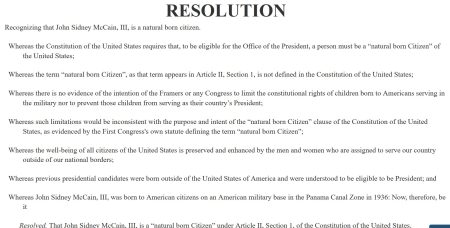
The main differences exist between the 2005 and 2014 editions, with the 2023 digital version being essentially identical to the 2014 hard copy edition. The primary difference between the 2005 and 2014 editions lies in the arrangement of the discussions of the principles of jus soli (law of the soil) and jus sanguinis (law of the bloodline), the relevance of a 2008 Senate Resolution – S.Res. 511 – addressing the presidential eligibility of Sen. John McCain, and the operation of 1 Stat. 103, misidentified in all three editions as “1 Stat. 104.”
None of the three editions addresses the repeal of 1 Stat. 103 (1790) a mere five years after its enactment by 1 Stat. 414 (1795), but the 2005 edition, cryptically, asserts that the “natural born” terminology of the 1790 statute was “dropped shortly thereafter,” citing, by way of an “e.g.” “for example” reader signal, “8 U.S.C. 1401(c).” That statute, born out of the 14th Amendment, declares who shall be U.S. “nationals” or “citizens,” but says absolutely nothing about status as a “natural born citizen.”
President-and-the-Natural-Born-Citizenship-Eligibility-Requirement-11-14-20#
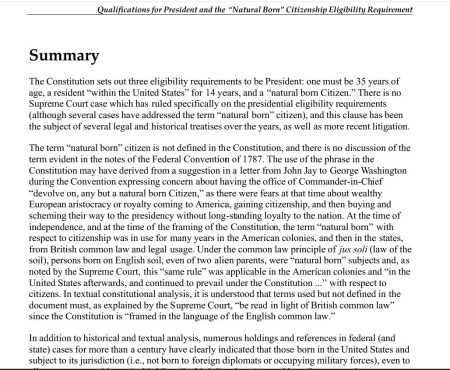
Furthermore, the term “dropped” in the 2005 edition is in this context misleading, as it suggests the potential that the words were inadvertently omitted – much as suggested by the CRS here – as being merely a “stylistic or grammatical” decision.
The conscious and intentional repeal of the “natural born” modifier by Congress in 1795 in apparent recognition that 1 Stat. 103 could not statutorily alter or amend the definition of a “natural born Citizen” as contemplated by the Founders in Art. 2, § 1, Cl. 5 of the Constitution cannot properly be analogized to actions which may be “accidental,” “immaterial” or “inadvertent.” Yet, the Guide and the CRS do both. Thus, use of the term “dropped” was inappropriate in 2005, explaining, perhaps, why that sentence from the 2005 edition was “dropped” in subsequent editions.
In this regard, the 2014 edition asserts that “1 Stat. 104” (sic: 1 Stat. 103) codified the jus sanguinis principle, declaring children born to U.S. citizen parents “beyond sea” as being “considered as natural born citizens,” but adds that commentators have “debated” whether a person – “so long as he is a U.S. citizen at birth” – was eligible “regardless of the place of his birth.” Apart from the fact that this statement indirectly acknowledges that 1 Stat. 103 was repealed, the “as long as he is a U.S. citizen at birth” is a false ratifying conditional assumption: the core question is whether the “citizen at/by birth” standard or the “born in the country to two citizen parents” standard should control.
The 2014 edition then claims that the “debate” ended, as a practical matter, when in 2008, the U.S. Senate passed S.Res. 511, purporting to “deem” Senator John McCain eligible to the presidency. As discussed here, that non-binding resolution, expressing only the “sense” or “opinion” of the Senate, rather than constituting a substantive “law,” was based in large part on the mistaken belief that 1 Stat. 103 was still controlling law…, 213 years after it had been repealed.
Moreover, the resolution’s claim that 1 Stat. 103 “defined” the term “natural born citizen” is manifestly wrong as well: the only thing 1 Stat. 103 did was declare – not “define” – that children born “beyond sea” to U.S. citizen parents were to be “considered as natural born citizens.” (Emphasis added) That is not a definition of the term. Instead, it only identifies those who may be “considered” a member of the class of persons elsewhere defined. Moreover, the use of the term “considered” suggests that the reality is different, much like use of the term “deemed.”
In 2008, there were two places where a true definition of the term “natural born Citizen” could be found: (1) § 212 of Book 1, Ch. 19 of the 1758 treatise The Law of Nations by Swiss jurist and legal scholar Emer de Vattel; and (2) the U.S. Supreme Court’s decision in Minor v. Happersett (“Minor”). And neither of the definitions found there supports the conclusions (or the “whereas” claims) of S.Res. 511.
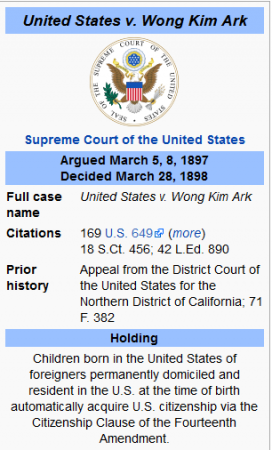
The 2005 edition (unlike the 2014 and 2023 editions) discusses in text the decision in United States v. Wong Kim Ark (“WKA”). The WKA decision is considered by most adherents of the “citizen at birth” or “citizen by birth” nbC theory to be the “be-all-end-all” authority on the point, despite the fact that its holding deals only with the question of the 14th Amendment status of a “citizen” and not the issue of a natural born citizen under Art. 2, § 1, Cl. 5 of the Constitution. Conspicuously – and inexplicably – the eligibility essays of the Guide make no mention of Minor at all. Odd.
The Omission of Minor v. Happersett
To begin with, as noted in the Supreme Court’s decision in Minor, the Constitution does not provide a definition of “natural born Citizen.” Neither the hard nor digital versions of the Guide mention or analyze the Minor case at all, either in the “eligibility” essay text or in the “Significant Cases” section at the end of each essay.
While the 2005 edition addresses and in text discusses WKA, both the 2014 and digital editions include only its citation at the end of the essay. The “Significant Cases” section lists two cases, i.e., the Supreme Court decision in WKA – again, a case involving only who may be a “citizen” under the 14th Amendment and having zero bearing or materiality on the issue of who may be a natural born Citizen under Art. 2, § 1, Cl. 5 – and the lower district (trial) court decision in United States ex rel. Guest v. Perkins – a case holding that the plaintiff was a “naturalized citizen,” but not, as the plaintiff claimed, a “natural born citizen.” Given the holding in the case, the relevance of Perkins to the nbC issue – other than its holding that the plaintiff therein was not a natural born citizen – is somewhat obscure.
The unanimous Court in Minor stated:
“[t]he Constitution does not, in words, say who shall be natural-born citizens. Resort must be had elsewhere to ascertain that. At common-law, with the nomenclature of which the framers of the Constitution were familiar, it was never doubted that all children born in a country of parents who were its citizens became themselves, upon their birth, citizens also. These were natives, or natural-born citizens, as distinguished from aliens or foreigners. Some authorities go further and include as citizens children born within the jurisdiction without reference to the citizenship of their parents. As to this class there have been doubts, but never as to the first.” (Emphasis added)
Against this backdrop, the Guide’s omission of Minor from the list of eligibility section “significant cases” is manifestly incomplete, as is its failure to “note and explain” in the text of the “explanation” the “differing interpretations” of the nbC clause extant among those examining it. That omission and failure suggests surrender to a species of bias the Guide professes it specifically seeks to avoid.
Stated otherwise, to fail to include a unanimous Supreme Court decision directly commenting on the meaning of the term “natural born Citizen” – as understood under the “nomenclature of which the framers of the Constitution were familiar…” and to fail to address “differing interpretations” of the same – is both baffling as well as troubling.
Indeed, under the first stated objective of the Guide – to ascertain a “description of the original understanding of the clause,” – the omission of the Supreme Court’s confirmation that, under the nomenclature of the common law, the Founders understood that a natural born citizen was a child born here to two parents who were already citizens, is plainly in error. As to that category, their natural born status “was never doubted.” But as to children born here without regard to both parents’ U.S. citizenship, “there have been doubts.” Stated otherwise, as to the “born here to citizen parents” group, any “doubts” as to their nbC status under the “nomenclature” as understood by the Founders were nonexistent. Yet the conclusions of the various Guide editions posit just the opposite by adopting the “citizen at/by birth” nbC theory.

Finally, as for the argument that the Minor discussion of the Founders’ understanding of the term “natural born citizen” constituted dicta, even if that were an accurate characterization, the empirical truth of the discussion – wholly apart from the women’s suffrage issue in the matter – cannot reasonably be challenged, at least in the collective opinion of the unanimous majority in the case.
The Citizen-Grandfather Exception
Undaunted by the (ignored) language in Minor, both the digital and hard copy editions of the Guide contend that under the jus soli principle purportedly extracted from British common law, anyone born within the “territory of the sovereign” became a “citizen from birth” (in Great Britain, a “subject” of the Crown). The Guide then boldly states: “Thus, [– a patent non sequitur when applied to the nation that had just vanquished Great Britain and forever terminated the “subject/liege” relationship theretofore existing] persons born within the United States are [“plainly” added to the 2005 edition language in the 2014 and digital editions] “natural born citizens” eligible to be president.”
Respectfully…, no they are not, and certainly not “thus” or “plainly.”
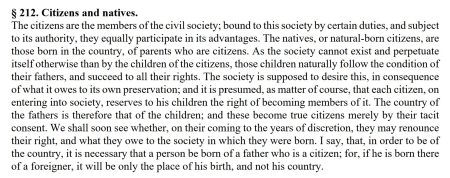
If that were true, there would have been no need at all for the “citizen-grandfather” clause as a time-limited exception to the rigorous “natural born Citizen” barrier to the presidency. Indeed, the mere presence of the citizen-grandfather clause ratifies and confirms the Founders’ original intent to adopt the natural born citizen restriction under the “nomenclature” of the language of the time with which they were “plainly” familiar: a “natural born citizen” was a person born here to U.S. citizen parents as articulated in § 212 of the de Vattel treatise. Without explanation, each edition of the Guide ignores this reality.
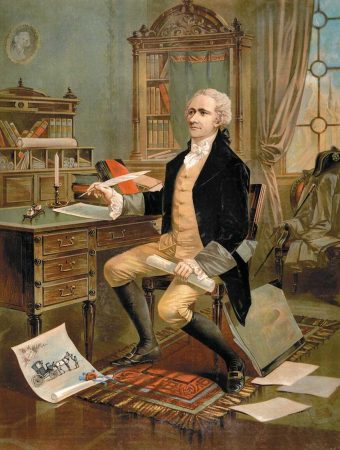
Furthermore, the claim by some in the “de Vattel Denier” camp that the citizen-grandfather exception clause was included merely as an accommodation to Alexander Hamilton – who was born out of wedlock in Charlestown, Nevis, British West Indies and thus, under a de Vattel analysis, discussed hereafter, not a natural born citizen – is highly unlikely. Certain other Constitutional Convention delegates or foreign “Revolutionary War Patriots” were also born abroad, and the “accommodation” theory would presumably extend to them as well. The theory is that the exception was added to allow Hamilton, as one of the Founders, or other delegates to be eligible to the presidency despite having been born outside the territorial limits of British America to parents who were not U.S. citizens.
For two primary reasons, this theory seems wildly implausible. First, if it was done, purportedly, as a “favor” or an accommodation to Hamilton, it could not have occurred without Hamilton’s knowledge and acquiescence and, in any event, the “accommodation” was ignored by Hamilton. This is confirmed by reference to Hamilton’s position in the 1796 election, the first one after the initial presidency of George Washington…, who, by the way, was the first beneficiary of the “citizen-grandfather” clause.
Instead of running for President himself, Hamilton supported John Adams (then Vice-President under President Washington) and Thomas Pinckney for Vice-President. Against this backdrop, if the “citizen-grandfather” clause was intended to benefit Alexander Hamilton, it was a colossal failure.
Second, the “accommodation” theory disregards the principles of § 212 of the de Vattel treatise, discussed hereafter, which views and concepts Hamilton himself praised and adopted. Indeed, Hamilton’s biographer, Forrest McDonald, notes that with regard to the objectives of government, Hamilton’s views “paralleled the ideas of [de]Vattel.” See John C. Miller, Alexander Hamilton: Portrait in Paradox, pp. 169-170, 316 (1959). It is thus highly unlikely that Hamilton would have subscribed to the theory that the “citizen-grandfather” clause was properly inserted into the Constitution merely as a “favor” to him or other similarly-situated Founders or Revolutionary War foreign-born patriots.
.jpg)
The more likely scenario is that Hamilton knew and accepted that he was not a natural born citizen as defined in § 212 of de Vattel’s tome and as to which treatise Hamilton’s views and ideas “paralleled.” Instead, it seems highly likely that as a matter of principle, and in order to underscore the commitment he had articulated in Federalist No. 68, he would not and did not seek by way of the “citizen-grandfather” clause to claim constitutional eligibility to the office. Other Founding Fathers might do so – as for example, George Washington, John Adams and Thomas Jefferson – but Hamilton would not. Although his face appears on $10.00 Federal Reserve notes, this is why he is not listed among the prior occupants of the office of the President. These facts are ignored in each edition of the Heritage Guide.
Returning, therefore, to the “no doubts” principle recognized by the Supreme Court in Minor, of course, the principle is identical to that found in Book 1, Ch. 19, § 212 of The Law of Nations. But as with the omission of reference to the Minor decision, the “eligibility clause” analysis of the Guide, both hard copy and digital, improperly ignores altogether any mention of the effect that de Vattel had or how his tome may have influenced the Founders regarding presidential eligibility.
The Omission of de Vattel
In fact, Emer de Vattel was well-known to the Founders as well as to other contributors to the Heritage Guide, as confirmed by reference to him and his treatise in the Heritage essays relating to declarations of war and the prohibition on state treaties. Similarly, other Guide contributors reference Minor with regard to the Constitution’s Guarantee Clause and the issue of women’s suffrage under the 19th Amendment. Thus, the omission in the eligibility essays of references to de Vattel and Minor, while simultaneously lionizing WKA, sticks out like the proverbial “sore thumb.”
Moreover, at minimum, the editors of the Guide knew, or should have known, of de Vattel’s impact on the Founders as they drafted the Constitution as a consequence of the Supreme Court’s recognition of his influence in United States Steel Corp. v. Multistate Tax Commission. There, he is described as being the “[t]he international jurist most widely cited in the first 50 years after the Revolution…,” citing 1 J. Kent, Commentaries on American Law 18 (1826). The “50 years after the Revolution” encompassed, plainly, the entirety of the period when the Constitution was being drafted, debated and ultimately ratified.
In addition, regarding de Vattel’s impact on the Founders, in the preface to the 1999 digital edition of his treatise, and commenting on the 1883 edition by Joseph Chitty, Esq., is found this:
“This 1758 work by Swiss legal philosopher Emmerich de Vattel is of special importance to scholars of constitutional history and law, for it was read by many of the Founders of the United States of America, and informed their understanding of the principles of law which became established in the Constitution of 1787. Chitty’s notes and the appended commentaries by Edward D. Ingraham, used in lectures at William and Mary College, provide a valuable perspective on Vattel’s exposition from the viewpoint of American jurists who had adapted those principles to the American legal experience.” (Emphasis added)
Stated otherwise, even if it was not an intentional act, the omission of any mention or analysis and discussion – even to distinguish or diminish – of de Vattel’s § 212 as contemplated under the Guide’s “differing interpretations” admonition and direction that such other interpretations “be noted and explained,” misses the mark. And this is true regarding both the 2005 and 2014 hard copies and the digital edition downloadable in 2023.
For a document purporting to “provide a succinct and accurate explanation of each clause of the Constitution,” (Emphasis added), Heritage might well consider preparing a third edition of the Guide addressing and correcting these anomalies.
The Reliance on Charles Gordon
Each edition of the Guide includes in its respective “Suggestions for Further Research” a law review article by one Charles Gordon: “Who Can Be President of the United States: The Unresolved Enigma, 28 Md. L. Rev. 1 (1968). At the time he wrote the article, Charles Gordon was General Counsel, U.S. Immigration and Naturalization Service and Adjunct Professor of Law, Georgetown University Law Center.
Among various other things, he addressed the statements of the Justices of the Supreme Court in the WKA case regarding the natural born Citizen issue thusly: “It is manifest that these statements of the majority and dissenters in Wong Kim Ark were dicta, pure and simple…,” (28 Md. L.Rev. at 19) and characterizing them as “questionable” and “not addressed to the presidential qualification clause and cannot control its construction.” (Emphasis added) (28 Md. L. Rev at 31-32). These statements by Professor Gordon cannot in any principled way be reconciled with the “plainly natural born citizens” language of the 2014 and digital eligibility essays touting the purported “be-all-end-all” decision in WKA. It is the old “you can’t fit a square peg into a round hole” problem. The Guide finesses the problem by simply – but improperly – just making the hole bigger.
In summary, the Heritage Guide’s failure to include in its eligibility essay discussions of Minor; of § 212 of de Vattel’s tome; and of the fact that the WKA decision has nothing to do with presidential eligibility because, as Professor Gordon notes, its “dicta are not addressed to the presidential [eligibility] clause and cannot control its construction” are manifest omissions. Moreover, its subliminal reliance on the “ghost of 1 Stat. 103” (despite being erroneously cited as 1 Stat. 104) in support of its conclusion that a “citizen from birth” is the equivalent of a natural born Citizen is both careless and, respectfully, unsupportable.
The “Natural Born Citizenship” Neologism
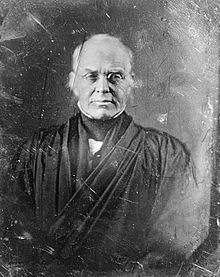
An additional substantive error is present in all three editions of the Guide: each edition utilizes the term “natural born citizenship” and attributes it to former Supreme Court Associate Justice Joseph Story in § 1473 of his treatise, Commentaries on the Constitution of the United States. As discussed here, the term “natural born citizenship” is a neologism, an unknown phrase frequently manufactured or concocted to drive a particular desired conclusion or result. The phrase appears nowhere in the Constitution, the 14th Amendment or in any Supreme Court case.
On the other hand, the Congressional Research Service (“CRS”) has used the term frequently, seemingly in an attempted linguistic somersault to equate the concept of a “natural born Citizen” with “citizenship” under the 14th Amendment. Contrary to the Guide’s claims, Justice Story never used the neologism but confined his discussion in § 1473 of his treatise to a “natural born citizen.” Suggestions to the contrary are misinformed as well as misleading.
In reality, this is what Justice Story had to say in § 1473 of his treatise, addressing not only the nbC issue for the presidency, but also the citizen-grandfather exception, and not once using the term “natural-born citizenship”:
.jpg)
“It is indispensable, too, that the President should be a natural born citizen of the United States; or a citizen at the adoption of the constitution, and for fourteen years before his election. This permission of a naturalized citizen to become President is an exception from the great fundamental policy of all governments, to exclude foreign influence from their executive councils and duties. It was doubtless introduced (for it has now become by lapse of time merely nominal, and will soon become wholly extinct) out of respect to those distinguished revolutionary patriots, who were born in a foreign land, and yet had entitled themselves to high honours in their adopted country. A positive exclusion of them from the office would have been unjust to their merits, and painful to their sensibilities. But the general propriety of the exclusion of foreigners, in common cases, will scarcely be doubted by any sound statesman.” (Emphasis and bolding added)
Conclusion
One would expect closer adherence to transparency, objectivity and balance – not to mention proofreading – in essays from a law clerk to Justice Thomas; Majority Chief Counsel to a Senate subcommittee; a partner (now a federal appellate court judge) at a major D.C.-based law firm; and a respected organization such as the Heritage Foundation. Some expectations are met, while others are not.
There is in the law a Latin phrase: “Falsus in uno, falsus in omnibus.” In English: “False in one thing, false in all things.” Your humble servant cannot posit that each of the three Heritage Guides in their eligibility essays are “false” in the sense that they were consciously written with the objective of misleading readers. Additional evidence would be needed to establish that fact. Mistaken, yes, but short of malevolent. But the same cannot be said of certain CRS “products,” especially if they include “collegial exchanges of information” with and from private law firms, as noted here and here.
That said, if the original objective of Heritage was to produce an “accurate explanation” of Art. 2, § 1, Cl. 5, then the reasoning, conclusions and decisions made in each edition of the Guide eligibility essays – which avoid addressing known Supreme Court precedent and known authorities who had substantive impact on the Founders as they drafted the Constitution, including the nbC Eligibility Clause – leave much to be desired.
And with the 2024 general election fast approaching, that is far from being a positive or acceptable outcome.
#2 response to DeMaio
“Perhaps the commenter will clarify.”
Gouverneur Morris’ statement,
“Mr. Govr. MORRIS moved to add to the end of the section a proviso that the limitation of seven years should not affect the rights of any person now a Citizen.”
would have grandfathered in current Citizens who did not meet the seven year requirement (such a clause would have negated Dr. Ramsay’s petition against Smith).
When the Breadley Committee drafted the presidential eligibility clause Wilson’s argument would have been still fresh in their minds. A Morris style grandfather clause would resolve it.
BTW, Morris is generally recognized as having drafted the final version of the Constitution. Wilson supposedly helped him even though Wilson was not officially on the Committee of Style)
“Messrs Morris and Wilson had the chief hand in the last Arraingt & Composition.” 3 Farrand 170
https://books.google.com/books?id=AZYsWQelKC8C&printsec=frontcover&dq=farrand+volume+3&hl=en&newbks=1&newbks_redir=0&source=gb_mobile_search&sa=X&ved=2ahUKEwjO_d_53_z-AhViIUQIHUHFB90QuwV6BAgHEAc#v=onepage&q=170&f=false
Response to DeMaio.
I apologize I incorrectly listed Wilson’s first speech as occurring on August 10th. In fact it was August 9th. This is when Colonel Mason suggested he would favor senators only be natives.
“Were it not that many not natives of this Country had acquired great merit during the revolution, he should be for restraining the eligibility into the Senate, to natives.”
Mr. Wilson:
“Mr. WILSON said he rose with feelings which were perhaps peculiar; mentioning the circumstance of his not being a native, and the possibility, if the ideas of some gentlemen should be pursued, of his being incapacitated from holding a place under the very Constitution, which he had shared in the trust of making. He remarked the illiberal complexion which the motion would give to the System, & the effect which a good system would have in inviting meritorious foreigners among us, and the discouragement & mortification they must feel from the degrading discrimination, now proposed. He had himself experienced this mortification. On his removal into Maryland, he found himself, from defect of residence, under certain legal incapacities which never ceased to produce chagrin, though he assuredly did not desire & would not have accepted the offices to which they related. To be appointed to a place may be matter of indifference. To be incapable of being appointed, is a circumstance grating and mortifying.”
I may have confused DeMaio when I used the synonym for natives in my original comment.
On the 13th when the suggestion again came up to limit House members to natives. Wilson again spoke against it for the same reasons;
“[Mr. WILSON] remarked that almost all the Genl. officers of the Pena. line of the late army were foreigners. And no complaint had ever been made against their fidelity or merit. Three of her deputies to the Convention [Mr. R. Morris, Mr. Fitzimmons & himself] were also not natives.”
From Joseph DeMaio:
———————
Fremick apology conditionally accepted…, but the questions remain.
First, as your humble servant has frequently noted, words are important. And in the context of discussions about and analyses of the Founders’ selection and use of the words “natural born Citizen” (“nbC”) in the Art. 2, § 1, Cl. 5 of the Constitution, the presidential eligibility restriction – as well as the different unmodified word “Citizen” of the United States in the citizen-grandfather exception clause – the words and the concepts they embody are not synonymous: they express different ideas.
Which brings your servant to the commenter’s explanation that he “may have confused DeMaio when … [he] used [“]the synonym[”] for natives in my original comment.” Respectfully, the commenter’s “original comment” employed the words “natural born citizen,” not a synonym for the word “natives.” Your servant was not confused: as an English-speaker from birth, he can identify grammatical anomalies (or gymnastics) when he sees them.
Specifically, the commenter’s intimation that “natural born citizen” is “the synonym for natives” (Emphasis added) is incorrect, bordering on misinformation. That verbiage might suffice for Congressional Research Service “products,” but not here at the P&E. By labeling it “the” synonym, the commenter suggests that it is, purportedly, the exclusive equivalent or “synonym.” It is not. And that is particularly relevant when addressing the Founders’ intent under Art. 2, § 1, Cl. 5.
Recalling that all natural born Citizens are also native-born citizens, but not all native-born citizens are natural born Citizens – cf., all Corvettes are Chevrolets, but not all Chevrolets are Corvettes – the Founders’ clear intent was to differentiate between the “natural born Citizen” for presidential eligibility purposes and the “Citizen” who, although naturalized, would still be eligible as a time-limited exception to the restriction.
Second, the relevance of the comments and remarks of Constitutional Convention Delegates James Wilson (Pennsylvania) and George Mason (Virginia) regarding restrictions on the “native-born” eligibility of Senators under Article 1 of the Constitution to the separate issue of the presidential eligibility of a “natural born Citizen” under Art. 2, § 1, Cl. 5 remains murky.
Indeed, the August 9, 1787 remarks of “Col. Mason” (George Mason) quoted by the commenter (Avalon Project – Madison Debates – August 9 (yale.edu)) were in support of a motion made by Delegate Charles Pinckney (South Carolina) to restrict eligibility to the Senate to “natives.” The reason articulated by Delegate Pinckney in his motion was to erect a barrier to guard the Senate against the “peculiar danger and impropriety in opening its door to those who have foreign attachments.” (Emphasis added). Delegate Wilson rose in opposition, to no avail.
Accordingly, this is why the eligibility of Senators in the Constitution is restricted to persons who “shall… [have] been nine Years a Citizen of the United States…,” (Emphasis added) the Founders intentionally selecting the word “Citizen” rather than “native” or “natural born Citizen.”
Moreover, Delegate Wilson’s remarks regarding senatorial eligibility viewed against the backdrop of the stated concern over “those who have foreign attachments” gaining access to the Senate could well explain why, on September 7, 1787, the Delegates – including James Wilson – adopted, nem. con. (without dissent) both the restrictive “natural born Citizen” Eligibility Clause as well as the “Citizen of the United States at the time of the Adoption of this Constitution” exception for Art. 2, § 1, Cl. 5.
At the end of the day, the still unanswered and overarching question for the commenter, as well as all other “de Vattel Deniers,” is simply this: against the backdrop of deep concern over precluding the insinuation into the office of the president of “foreign influence” from persons with “foreign attachments” – whether of jus soli or jus sanguinis origin, – when presented with the options of selecting (a) the higher “de Vattel” § 212 barrier with its nbC definition (a child born on U.S. soil to U.S, citizen parents), or (b) the lower “hurdle” of any person who is a “citizen at/by birth” regardless of (1) birthplace locale worldwide and (2) both parents’ citizenship status…, which one would the Founders, including James Wilson, have more likely chosen?
Hint: this is neither a trick question nor rocket science.
“nbC attorney-criminal”.
Not a professional “criminal attorney”, but an attorney educated, and licensed, to know better, but, instead, has chosen to be a liar for hire and a pimp of Lady Justice as an attorney-criminal, who is a subject matter expert on the fine art of “lies by omission” via relying on lying.
EXHIBIT A: https://www.c-span.org/video/?320640-1/licensed-lie
Joe Biden and Hunter Biden (aka, “Joke and Coke Biden”) are leading examples of unaccounted state-licensed attorney-criminals since they know better than most lay citizens what their profession’s foundational document, the U.S. Constitution, is all about, BUT they choose to mock and criminally ignore it for selfish gain.
EXHIBIT B: https://oversight.house.gov/release/icymi-comer-oversight-committee-members-present-evidence-of-influence-peddling-by-biden-family%ef%bf%bc/
Therefore, any state-licensed attorney on this premier website who argues that “Canada Cruz” and multi-allegiance-citizens-of-the-world, Barry Obama and Kamala, et al, are each a John Jay “natural born Citizen” 1787- TODAY is, I believe, an “nbC attorney-criminal”.
“nbC attorney-criminals” do not seem to care that John Jay’s “natural born Citizen” is still the supreme law of the land 1787- TODAY, nor do they seem to care to accept the overwhelming “exculpatory evidence” during their criminal arguments on this website, that from President Martin Van Buren to 08-28-08, all presidential candidates/incumbents/ex-presidents were “solely from the U.S. tribe” of sole-U.S.-citizen-parents, except little-known secretive Chester Arthur.
EXHIBIT C: https://www.youtube.com/watch?v=rXFwqUi3zR0&feature=youtu.be
EXHIBIT D: https://www.scribd.com/doc/48856102/All-U-S-Presidents-Eligibility-Grandfather-Clause-Natural-Born-Citizen-Clause-or-Seated-by-Fraud
What nbC attorney-criminal will argue that I am not qualified to be a U.S. President since I can fully document and disclose that I have lived in USA all my life, was born in Maine, of sole-U.S.-citizen-parents who were also born in Maine and resided in USA all their un-divorced 80 years of life? There is “no nbC doubt”, then, that I would qualify to run for U.S. President.
So, nbC attorney-criminals go where there is “nbC doubt” and ply their lie that foreign-allegiance residents of USA are John Jay “natural born Citizens”; and isn’t that what this entire 14 year (o8-28-09- 08-28-23) continuous P&E website is all about, being, exposing illegal nbC doubts about multi-citizen-foreign-allegiance presidential candidates/incumbents/ex-presidents?
“nbC attorney-criminal”; was this phrase coined on The Post & Email?
I realize this comment has little chance of making it into this mutual admiration society echo chamber but here goes.
Mr. DeMaio is mischaracterizing Professor Gordon’s paper on Presidential eligiblity. Gordon only describes the portions of Justice Gray’s opinion and Chief Justice Fuller’s dissent where they opined about the status of children born abroad to American citizens. In fact, Gordon’s article is 100% pro-English Common Law as the source of the presidential eligibility clause. And he argues throughout his thesis that foreign born children of American citizens are also eligible to the presidency.
DeMaio: “The Reliance on Charles Gordon”
Gordon states in the very first paragraph – “It is clear enough that
native-born citizens are eligible and that naturalized citizens are not.”
DeMaio – “[Gordon] addressed the statements of the Justices of the Supreme Court in the WKA case regarding the natural born Citizen issue thusly: “It is manifest that these statements of the majority and dissenters in Wong Kim Ark were dicta, pure and simple…,”
Justice Gray and Chief Justice Fuller statements cited by Gordon concerned children born outside the US to citizen parents. He points this out in the two paragraphs above his “dicta, pure and simple” statement. Additional in the sentence following the “pure and simple” sentence, Gordon explains why these comments are dicta – “The question before the Court concerned children born in the United States, and it was not asked to pass on the status of children born abroad.”
DeMaio – “Professor Gordon notes, its “dicta are not addressed to the
presidential [eligibility] clause…”
Gordon makes this statement in #4 of his conclusion, and he is referring back to his earlier statement on Justice Gray and Chief Justice Fuller opining about children born overseas to citizen parents. Conclusions summary:
1. Natural born in the eligibility clause “must be considered in the light of the English usage.”
2. It “seems likely” that presidential eligibility extended to everyone “born American citizens.”
3. The 14th did not “bar a construction” of the presidential eligibility clause “to include children born abroad to American citizens.”
#4 begins “Nor is such a construction foreclosed by questionable dicta in United States v Wong Kim Ark …” The “construction” referenced is that “children born abroad to American citizens” are eligible to be President.
https://digitalcommons.law.umaryland.edu/cgi/viewcontent.cgi?article=2068&context=mlr
From the author:
———————-
The commenter focuses all of his remarks on your humble servant’s treatment of Charles Gordon’s law review article. This suggests, parenthetically, that all of the other matters addressed in the post are accepted as accurate. If that is in error, no doubt the commenter will respond to the P&E “echo chamber” and clarify.
Turning to the substance of the comment and the claim that your servant is “mischaracterizing” the Gordon law review article, respectfully, we disagree.
First, the fact that Professor Gordon may have been focusing on the natural born citizen status of children born “beyond sea” to U.S. citizen parents does not foreclose application of his Wong Kim Ark (“WKA”) “dicta” observations to other elements of the natural born Citizen issue.
Indeed, because the sole and exclusive issue presented in WKA was whether under the 14th Amendment a child born here to foreign alien parents as a “citizen,” – and not a “natural born Citizen” under Art. 2, 1, Cl. 5 of the Constitution – completely without regard to Professor Gordon’s law review “dicta” statements, the WKA discussions about who is and who is not a natural born Citizen by Justice Gray and Chief Justice Fuller are, as an undisputed matter of law: dicta. And as noted by the Supreme Court: “Dictum settles nothing, even in the court that utters it.” (Emphasis added). See, Jama v. Immigration and Customs Enforcement, 543 U.S. 335, 351, n. 12. (2005).
As to the issue of “in light of the English usage,” if that is meant to be a reference to the English common law, one need look no further than the Supreme Court’s decision in Minor v. Happersett to learn that: “[a]t common-law, with the nomenclature of which the framers of the Constitution were familiar, it was never doubted that all children born in a country of parents who were its citizens became themselves, upon their birth, citizens also. These were natives, or natural-born citizens, as distinguished from aliens or foreigners.” And unlike the WKA decision, the Minor decision was unanimous.
Second, as to the “seems likely” partial quote the commenter extracts from the law review article, omitted is the first part of the sentence: “Although the evidence of intent is slender….” “Slender” is not synonymous with “compelling.” At least Professor Gordon is being candid, unlike others, who prefer categorical and dismissive terms like: “Thus, plainly, [a “citizen at birth” or a “citizen by birth”] is a natural born Citizen eligible to be president….” discussed here: https://www.thepostemail.com/2023/05/13/revisiting-the-heritage-guide-to-the-constitution/
Third, as to the “14th [Amendment] did not bar a construction….” issue, the fact that Professor Gordon’s article mentions only in passing and in footnotes the Minor decision – and fails to mention at all § 212 of Book 1, Ch. 19 of Emer de Vattel’s seminal The Law of Nations (“§ 212”) — casts considerable doubt on the viability of that conclusion.
Your humble servant never represented that he agreed with everything that Professor Gordon had to say, but as criticized here: https://www.thepostemail.com/2023/05/13/revisiting-the-heritage-guide-to-the-constitution/, the failure of the law review article to address – even tangentially or dismissively – a treatise relied upon by the Founders in the drafting of the Constitution is baffling and sticks out like the proverbial “sore thumb.”
Finally, as for the “[n]or is such a construction foreclosed by questionable dicta in United States v Wong Kim Ark …” comment, again, while the “construction” might not, in Professor Gordon’s “estimation,” be precluded under the dicta in WKA, the core question remains: did the Founders intend to adopt the “higher barrier” to foreign influence afforded by § 212 or did they intend to adopt the lower “hurdle” more easily cleared under a “citizen at/by birth” regardless of place of nativity or both parents’ citizenship? Your humble servant posits the former and welcomes an answer by the commenter to that question.
In conclusion, as to each of the points noted by the commenter in the “conclusions summary” of his comment (extracted from Professor Gordon’s “Summary and Conclusions) law review article, your servant notes the following caveat – omitted by the commenter – which immediately follows Professor Gordon’s 4th conclusion:
“Having endorsed these conclusions, I must concede that the picture is clouded by elements of doubt. These doubts will unquestionably persist until they are eliminated by a constitutional amendment, a definitive judicial decision, or the election and accession of a President who was “natural-born” outside the United States. The withdrawal of Governor Romney has ended the possibility that clarification would emerge as a result of his candidacy. Perhaps such clarification will develop from some future candidacy of another citizen in the same situation [e.g., Ted Cruz]. On the other hand, it may eventually be necessary to amend the Constitution in order to remove the ambiguity. It is unfortunate that doubts remain on an issue of such vital importance to many Americans.” (Emphasis added).
This caveat at the end of Professor Gordon’s law review article is, in essence, identical to that which your humble servant has been arguing for the past dozen years. And to reiterate that which he has noted during that same period of time: you can lead people to empirical facts and information, but you cannot make them think.
“If that is in error, no doubt the commenter will respond to the P&E “echo chamber” and clarify.”
Yes, you are mistaken. This site is strictly moderated (although its policies appear to be somewhat inconsistently applied) and there appears to be a restriction on comments lengths. This one can either write several (or in this case many) small comments and then hope some of them make it through moderation or simply leave and let the chamber echo away. Undoubtedly comments extolling the greatness of the author’s legal analysis always make it to print.
The doubts expressed by Gordon are about the status of children born abroad not the case of “native-born” or naturalized citizens whose status are “clear enough”.
On to other subjects.
DeMaio is wrong to contend that the grandfather clause would not be necessary if the Framers adopted the English Common Law as the source for the eligibility clause. The “favor” was more likely to James Wilson not Alexander Hamilton. It was Wilson who argued forcefully against requiring senators to be natural born citizens. The first time on August 10th (while Hamilton was not on attendance) and the second time on August 13th (the one day in August when Hamilton did attend). It was Wilson’s argument that because he was not a native such a requirement was unfair to him and other Framers who were not natives. It is logical to assume that when the question of presidential eligibility came up, Wilson’s speech would be remembered. In fact Governor Morris a member of the Brearley Committee had suggested a grandfather clause during the August 13th debates;
“Mr. Govr. MORRIS moved to add to the end of the section [art IV. S. 2] a proviso that the limitation of seven years should not affect the rights of any person now a Citizen.”
From the author:
——————–
The commenter makes a number of assertions regarding the history of the “citizen-grandfather” clause, sprinkling his comment with numerous references to arguments and statements made by, among others, James Wilson and “Governor” (sic: “Gouverneur”) Morris, both Constitutional Convention delegates from Pennsylvania. The commenter focuses on arguments claimed to have been made by James Wilson on August 10, 1787 and August 13, 1787, where he purportedly “argued forcefully against requiring senators to be natural born citizens.”
Assuming, for the sake of argument, that the commenter is referring to notes taken by James Madison over the course of the proceedings between May 14, 1787 and September 17, 1787 (Avalon Project – Notes on the Debates in the Federal Convention (yale.edu)), a large anomaly exists: nowhere in Madison’s Notes on the Debates (“Madison’s Notes”) for the dates cited by the commenter is there any reference or mention at all of the claimed topic of Mr. Wilson’s objections, i.e., requiring a senator to be a “natural born Citizen.”
In fact, throughout the entire period of debate, Madison’s Notes identify only two (2) instances when the words “natural born” appear as a modifier of the term “Citizen”: (1) on September 4, 1787, Delegate David Brearley, as chairman of the “Committee on Postponed Matters,” as discussed here (Revisiting the “What If?” Letter – The Post & Email (thepostemail.com)), reported to the Delegates on the committee’s recommendations, including adding the “natural born Citizen” (“nbC”) Eligibility Clause, along with the “citizen-grandfather” exception; and (2) on September 7, 1787, when the assembled Delegates approved and adopted both of the said clauses, nem con (“without dissent”).
Stated otherwise, if there is a source other than Madison’s Notes for the commenter’s claim that Delegate James Wilson “argued forcefully against requiring senators to be natural born citizens…,” your humble servant welcomes that clarification. Your servant has searched for a “Cliff’s Notes” version of Madison’s observations, to no avail, but he has not yet searched for a version which may exist as generated by the Congressional Research Service, whose acumen for concocting and altering words and language is legend.
Moreover, your servant would welcome clarification as to why the “natural born citizen” status of senators – again, assuming the Wilson statement can be accurately sourced – had anything at all to do with the Brearley committee’s recommendation to restrict the presidency to a “natural born Citizen” or a “citizen” when the Constitution was adopted.
As for the commenter’s claim that Gouverneur Morris, as a member of the “Committee on Postponed Matters,” had “suggested a grandfather clause during the August 13th [1787] debates,” a similar “relevancy” anomaly exists. Specifically, Madison’s Notes indicate that the matter under consideration at that session was the citizenship durational requirements for members of the House of Representatives, not the nbC eligibility requirements for the president or exceptions therefrom under the “citizen-grandfather” clause. Gouv. Morris was addressing the issue of ensuring that the seven-year U.S. citizen requirement for House members – as compared to the nine-year requirement for Senate members – should “not affect the rights of any person now a Citizen.”
Respectfully, the relevance of that statement regarding members of the House under Art. 1, § 2, Cl. 3 – as opposed to the operation of the “citizen-grandfather” clause in Art. 2, § 1, Cl. 5 – remains obscure. Perhaps the commenter will clarify.
“I realize this comment has little chance of making it into this mutual admiration society echo chamber but here goes.”
Why the doubt, Mr. Fremick? Because where you come from, the “diverse, inclusive and tolerant” left, they truly don’t allow dissenting opinions?
“Gordon states in the very first paragraph – ‘It is clear enough that
native-born citizens are eligible and that naturalized citizens are not.’ ”
The eligibility clause says “natural born Citizen” not “native-born Citizen”. As the ineligible, U.S. Constitution and legacy America hating, Marxist, Muslim from Kenya himself emphatically stated: “Words matter!”
Next obfuscation.
Okay so basically, you disagree with St. George Tucker, Revolution War hero and professor of law at William and Mary.
“That provision in the constitution which requires that the president shall be a native-born citizen (unless he were a citizen of the United States when the constitution was adopted,) is a happy means of security against foreign influence, which, where-ever it is capable of being exerted, is to be dreaded more than the plague.”
https://press-pubs.uchicago.edu/founders/documents/a2_1_1s18.html
Citing someone, no matter how illustrious past or present, making a mistake in some context and obviously in error in that instance in misquoting what the U.S. Constitution literally actually states in the presidential eligibility clause is a rather poor example to use for argument on your part. You are slipping up, or is it purposely more of your disinformation tactics to quote people in the past who misquoted what the Constitution actually says?
The Constitution’s presidential eligibility clause states “natural born Citizen,” not “native-born citizen.” George Tucker cannot and did not change what the U.S. Constitution literally states. So obviously Tucker misspoke in the example you are using from him to try to advance your “born in the USA” is good enough and sufficient argument here to be the President and Commander in Chief of our military forces per the U.S. Constitution. It is not.
Being born in the USA is necessary but not sufficient to being a “natural born Citizen” of the United States. See Vattel’s Law of Nations, Volume 1, Section 212 which was used by the founders and farmers to form our nation and write the founding documents for the precise definition of “natural born Citizen.” You argue a logical fallacy: http://www.kerchner.com/naturalborncitizen/cfk/Euler-Logic-Diagram-Shows-Logical-Relationship-of-natural-born-Citizen-Set-and-SuperSets.pdf
Again, see Vattel’s treatise in which the constitutional term “natural born Citizen” is clearly defined in Volume 1 Chapter 19 Section 212: https://lonang.com/library/reference/vattel-law-of-nations/vatt-119/
Here is the key sentence and definition from that legal treatise on the Laws of Nature and Natural Law by Vattel: https://cdrkerchner.wordpress.com/2023/04/15/my-translation-of-a-key-sentence-in-emer-de-vattels-1758-treatise-on-natural-law-in-section-212-des-citoyens-et-naturels/
Also, since you mentioned William and Mary College you should know that the prescribed textbook for Constitutional Law classes at William and Mary College was Vattel’s Law of Nations, so it is clear what the students were being taught as to what that term meant in our U.S. Constitution via Vattel’s legal treatise as the required textbook, even if a professor misspoke at some or other time. See: http://www.kerchner.com/protectourliberty/vattel/Vattel%20Law%20of%20Nations%20is%20textbook%20for%20National%20Law%20class%20at%20College-of-William-Mary-Laws-Regulations-1837.pdf
For more on the Who, What, When, Where, Why, and How re the “natural born Citizen” term in the presidential clause of the U.S. Constitution, see my “White Paper” on that:
http://www.kerchner.com/protectourliberty/The-Who-What-When-Where-Why-and-How-of-NBC-Term-in-Constitution.pdf
Or read my new book about the core constitutional term addressed in Joseph DeMaio’s latest and many excellent legal analysis articles, i.e., “natural born Citizen” of the United States: http://www.kerchner.com/books/naturalborncitizen.htm
CDR Charles Kerchner (Ret)
htttp://www.ProtectOurLiberty.org
Ray Fremick: A question to you regarding the true and original intent meaning of the “natural born Citizen” term in the presidential eligibility clause of our U.S. Constitution. Its purpose in being there in the presidential eligibility clause is that it was put there to ensure no foreign influence on a future commander in chief of our armies per the July 1787 John Jay’s letter to George Washington, i.e., being a strong check via or at birth against foreign influence on persons being eligible to be the future Commander in Chief (CINC) of our military forces. It was to ensure that a person once the founding generation was gone who would be future CINCs had no foreign influence at birth, no dual citizenship, etc., and had sole allegiance at birth to one country and only one country. So I ask you … do you care at all that if the meaning of “natural born Citizen” that “de Vattel Deniers” such as you assert would allow dual citizens and triple citizens at birth (and thus born with foreign allegiance and loyalty requirements to other countries) to serve as the Commander in Chief of our military forces? So answer that simple question. Do you care at all that your position as a “de Vattel Denier” for the definition of “natural born Citizen” would allow a person born a dual or triple citizen at birth to be the Commander in Chief of our military forces?
CDR Charles Kerchner (Ret)
http://www.ProtectOurLiberty.org
http://www.kerchner.com/protectourliberty/The-Who-What-When-Where-Why-and-How-of-NBC-Term-in-Constitution.pdf
Ray Fremick: A simple question for you. Do you care at all that your position as a “de Vattel Denier” for the meaning and definition of the “natural born Citizen” term used in the presidential eligibility clause of our U.S. Constitution would allow a person born a dual or triple citizen at birth to be the Commander in Chief of our military forces?
CDR Charles Kerchner (Ret)
http://www.ProtectOurLiberty.org
http://cdrkerchner.wordpress.com
http://www.kerchner.com/protectourliberty/The-Who-What-When-Where-Why-and-How-of-NBC-Term-in-Constitution.pdf
A superb piece of legal analysis and writing by Joseph DeMaio regarding the original intent meaning and understanding of the “natural born Citizen” term (a national security term) in the presidential eligibility clause in our U.S. Constitution. DeMaio also plainly addressed the faulty and imo agenda driven biased analysis of its incorrect meaning given in “The Heritage Guide to the Constitution” in the piece therein about the “natural born Citizen” term done by James C. Ho. All members of the U.S. Supreme Court should receive a copy of this essay by DeMaio. And also James C. Ho and the Chairman of the Editorial Advisory Board of the Heritage Foundation should receive a copy as well. One or more of us should make that happen. Bravo Zulu to Joseph DeMaio!
CDR Kerchner (Ret)
http://www.ProtectOurLiberty.org
http://www.kerchner.com/books/naturalborncitizen.htm
I want to thank you for the substantial effort in your research and understanding of a simple concept made incomprehensible by those with bias and personal agenda. Those of us without the skills to counter or refute all the arguments made to make the ineligible eligible have only our simple common sense to understand the written word. Your essays reinforce our understanding. I love Heritage and the work they are doing. I pray they are the recipient of your writing and use it to fix their inconsistencies where nbC is concerned.
I have a question concerning the Supreme Court. I am aware that Justice Thomas said they were avoiding this issue. How can a citizen bring this to them (like the Brunsons did) based on our confusion as to who to vote for that is eligible under Article 2, Section 1, Clause 5 of the Constitution? Do we follow the words in the Constitution or those of the political class?